



Contents: Examination 🠛 Replacement 🠛
Examination
With coded electronic unit
1. The components of this system do not require any attention other than checking the condition of the hoses.
1. This is obvious. Mark the location of the hoses before disconnecting them to avoid confusion during installation.
Exhaust emission control
1. The system can only be accurately tested using a suitable exhaust gas analyzer (for diesel engines).
Catalytic converter
1. The catalytic converter is replaced as part of the exhaust system.
Exhaust Gas Recirculation
Note: The following procedure applies to F8Q engines only. Due to the need to use special Renault diagnostic equipment to check the valve on F9Q engines, this work should be carried out by a Renault workshop.
1. Start the engine and allow it to warm up to normal operating temperature (the cooling fan should turn on).
2. With the engine idling, disconnect the vacuum hose from the EGR valve. You should hear the valve close and click. If you do not hear the valve close, proceed as follows.
3. Check that there is a vacuum at the end of the vacuum hose going to the recirculation valve. If a suitable pressure gauge is available, check that the pressure is less than 500 mbar. If there is a vacuum, the recirculation valve is probably faulty (diaphragm pinched or punctured). If there is no vacuum, perform the following checks.
4. Check that all hose connections are securely fastened.
5. Check the power supply to the valve coil.
6. Check the operation of the thermostatic valve. This can be done by checking for vacuum flow when the engine is warmed up to normal operating temperature. Turn off the engine and disconnect the thermostatic valve vacuum hoses from the EGR valve and the solenoid valve and check that air flows through the hoses. If it does not, the thermostatic valve is probably faulty or the hoses are clogged.
7. Check the operation of the EGR and pre-heating system microswitch as described in Chapter Engine electrical equipment.
Exhaust Gas Recirculation System Components - F9Q Engine
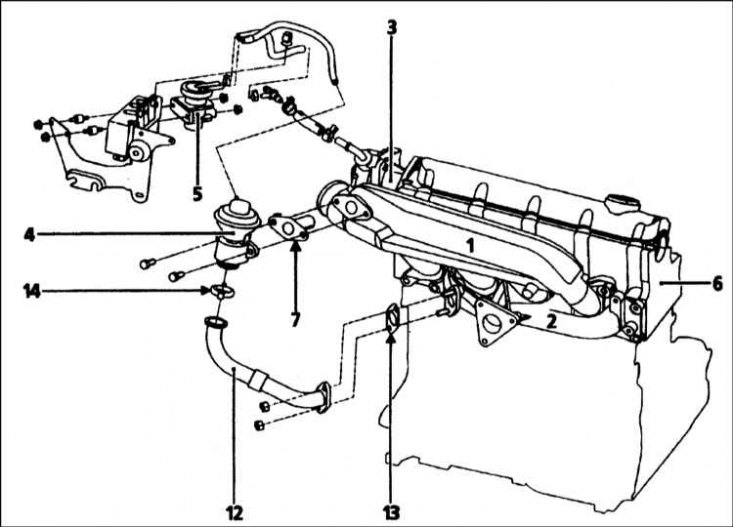
1 - Inlet manifold; 2 - Exhaust manifold; 3 - Vacuum pump; 4 - Exhaust gas recirculation valve; 5-Exhaust gas recirculation valve winding; 6 - Cylinder head; 7 - Fan; 12 - Steel pipe; 13 - Seal; 14 - Clamp
Replacement
Exhaust gas recirculation valve
1. The valve is located at the rear of the engine and is attached to the exhaust manifold (f8Q 620 engines) or to the intake manifold (f8Q engines with turbocharger and F9Q) (refer to the accompanying illustration above). The valve is connected to another manifold through a metal pipe.
2. Disconnect the vacuum hose from the valve.
3. Loosen the mounting bolts and disconnect the valve pipe from the intake manifold or exhaust manifold. Remove the gasket.
4. Unscrew the valve body from the manifold and remove the gasket. Remove the valve together with the pipe.
5. If a new valve is to be installed, loosen the mounting bolts or release the clamp and reinstall the pipe onto the new valve, using a new gasket where applicable.
6. Install in reverse order, using new gaskets.
Solenoid valve (f8Q engines)
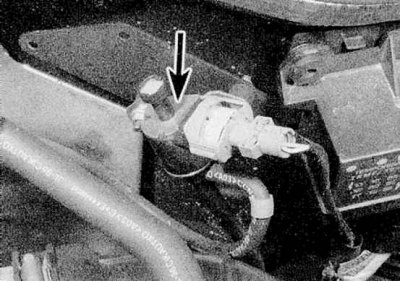
1. The valve is located on a bracket attached to the engine compartment bulkhead (refer to the accompanying illustration).
2. Disconnect the electrical connector and vacuum hoses from the valve.
3. Unscrew the fastening nuts and remove the valve together with the bracket.
4. Install in reverse order, making sure the vacuum hoses are securely connected.
Thermovalve (f8Q engines)
1. The thermostat valve is located in the cooling system hose, in the left front corner of the cylinder block.
2. To remove the valve, simply disconnect the electrical connector and unscrew the valve from the hose.
3. Install in the reverse order of removal. Check for coolant leaks and top up the coolant level if necessary.
Altimeter sensor (altitude meter) (f8Q engines)
Note: On F8Q turbocharged and F9Q engines, the sensor is integrated into the electronic control module and cannot be separated from it.
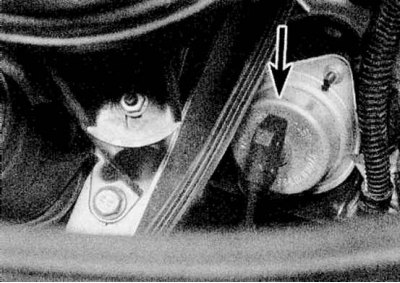
1. The sensor is located in the engine compartment on the front left wheel arch, behind the headlight (refer to the accompanying illustration).
2. Disconnect the electrical wiring connector from the sensor, then unscrew the mounting nuts and remove the sensor.
3. Perform installation in reverse order.
Replacing the fuel pump microswitch (exhaust gas recirculation circuit breaker) - F8Q engines
4. Removing and installing the switch is straightforward, but please note that the switch must be adjusted in the end. To do this, contact a Renault service station. For details, see Chapter Engine electrical equipment.