



Contents: Catalytic converter and exhaust gas…🠛 Crankcase ventilation system 🠛 Gasoline vapor recovery system 🠛 Removal and installation the adsorber 🠛 Removal and installation the…🠛
Catalytic converter and exhaust gas oxygen concentration sensors
The condition of the catalytic converter can be checked using a properly calibrated gas analyzer. Before determining the condition of the converter, it is necessary to check the condition of the ignition system, the replaceable air filter element must be sufficiently clean, the engine must be in good condition.
Warm up the engine to operating temperature, connect the gas analyzer in accordance with the operating instructions. Bring the engine speed to 2500 min⁻¹ and let it run for 30 sec, leave it to idle and check the CO content (see above). If the CO level is within the prescribed limits, the system is working properly.
If the CO level is higher than normal, try disconnecting the wiring from the oxygen concentration sensor. If the CO level increases after this, the sensor is most likely OK, but the catalytic converter is faulty. If disconnecting the sensor does not affect the CO level, the sensor is faulty.
If you have a digital millivoltmeter, you can measure the sensor's output voltage. When the engine is fully warmed up, it should be (840±70) mV (rich mixture) and 0–80 mV (lean mixture). The resistance of the upper sensor is 9.0 Ohm, the lower one is 3.4 Ohm. The faulty sensor must be replaced.
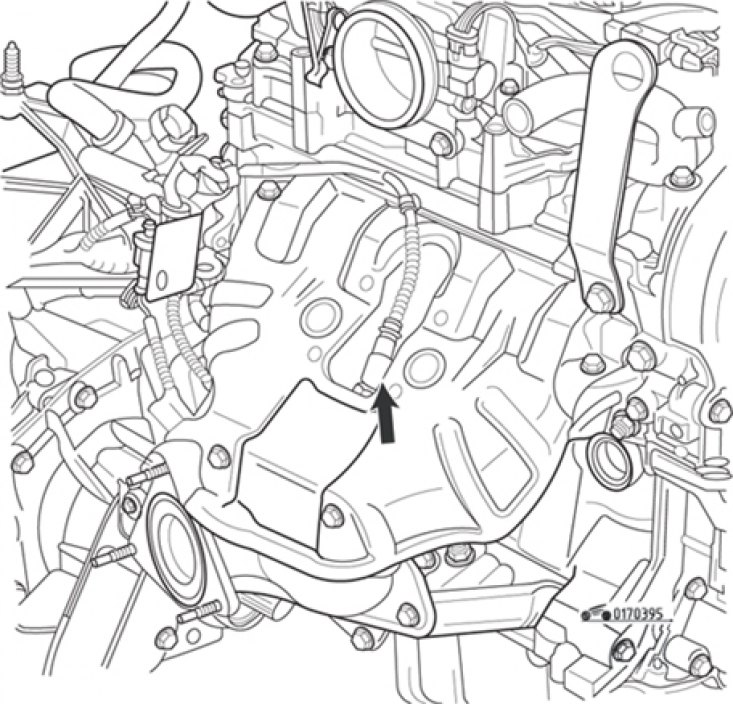
Fig. 3.95. Upper oxygen concentration sensor
To replace the upper sensor (see fig. 3.95) trace its wiring to the contact connector, disconnect the connector and use a high head with a ratchet to unscrew the sensor from the exhaust manifold. Clean the sensor threads, apply a non-stick compound to them, tighten by hand, then tighten to the specified torque. The process of replacing the catalytic converter is described in the subsection "Exhaust system".
[This article is taken from the website: www.renaultbook.ru]
Crankcase ventilation system
If the air filter is heavily oiled, it is necessary to check the connections, integrity and internal cleanliness of the hoses and calibrated bushings. When inspecting and cleaning, mark the hoses so as not to mix up the hoses during installation.
Gasoline vapor recovery system
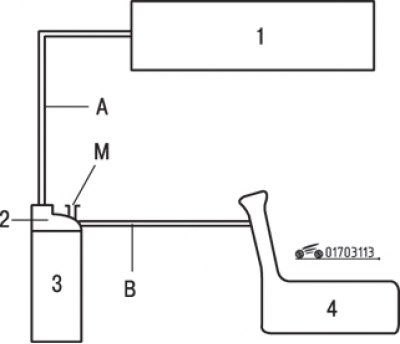
Fig. 3.113. Schematic diagram of the fuel vapor recovery system: 1 – intake manifold; 2 – fuel vapor recovery system electromagnetic valve; 3 – adsorber; 4 – fuel tank; M – opening for communication with the atmosphere; A, B – connecting hoses
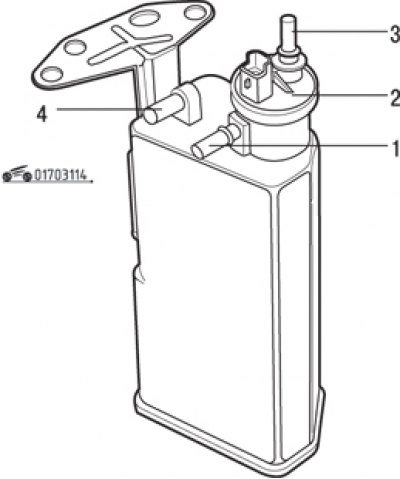
Fig. 3.114. Adsorber: 1 – pipeline from the fuel tank; 2 – electromagnetic valve for purging the adsorber; 3 – pipeline to the intake manifold; 4 – hole for communication with the atmosphere
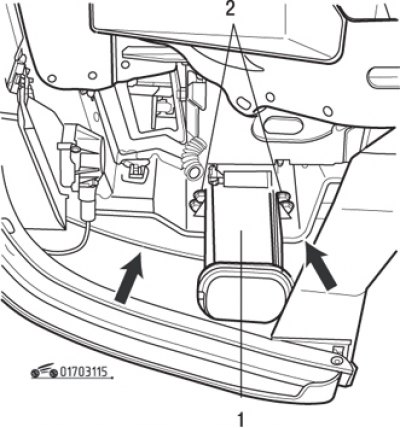
Fig. 3.115. Removing the adsorber: 1 – adsorber; 2 – mounting bolts
When working, refer to Fig. 3.113, 3.114, 3.115.
Warm up the engine to operating temperature and stop it. Connect a voltmeter to the solenoid valve connector. Connect a vacuum gauge with a scale of up to 1000 mbar to the hose between the adsorber and the solenoid valve.
Let the engine idle. The voltmeter should not show voltage, the vacuum gauge - vacuum.
If a vacuum is registered, temporarily disconnect and blow out the remaining gasoline vapors from the hoses coming from the valve. If the voltmeter shows voltage at the valve, the wiring or the ECU is faulty.
Increase the engine speed slightly - voltage and vacuum should appear on the instruments. If there is no vacuum, the cause is a leak in the hose connections or a faulty valve. The reason for the lack of voltage is a faulty ECU or wiring.
Removal and installation the adsorber
Under the hood, disconnect the hose connecting the canister to the intake manifold. Apply the parking brake, raise the front of the car and install safety supports. Remove the right front wheel and mudguard to gain access to the canister, installed under the front bumper support.
Disconnect the hose leading to the tank from the canister. Unscrew the mounting bolts and remove the canister from under the wing. Handle the canister carefully - it may contain fuel or its vapors.
Installation is carried out in the reverse order of removal. Install the hoses correctly.
Removal and installation the solenoid valve of the adsorber
The solenoid valve is mounted on top of the intake manifold.
Disconnect the connector and hoses from the valve. Remove the valve.
Installation is carried out in the reverse order of removal. Install the hoses correctly.