



Contents: Examination 🠛 Adjustment 🠛
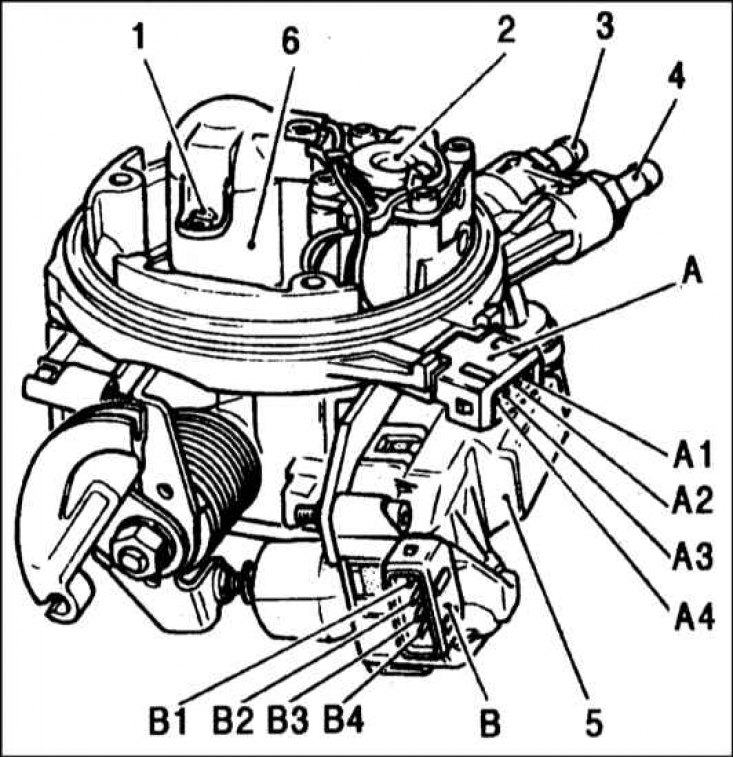
1 - Air temperature sensor; 2 - Fuel pressure regulator; 3 - Returning fuel to the tank; 4 - Fuel supply; 5 - Idle speed control stepper motor; 6 - Injector; A - Injector and air temperature sensor wiring connector; A1 - Air temperature sensor; A2 - Injector +; A3 - Injector -; A4 - Air temperature sensor; B - Idle speed and low load switch wiring connector; B1 - + or - motor power supply; B2 - - or + motor power supply; B3 - Low load switch; B4 - Low load switch
Throttle body components and terminals (left side) - E7J engine
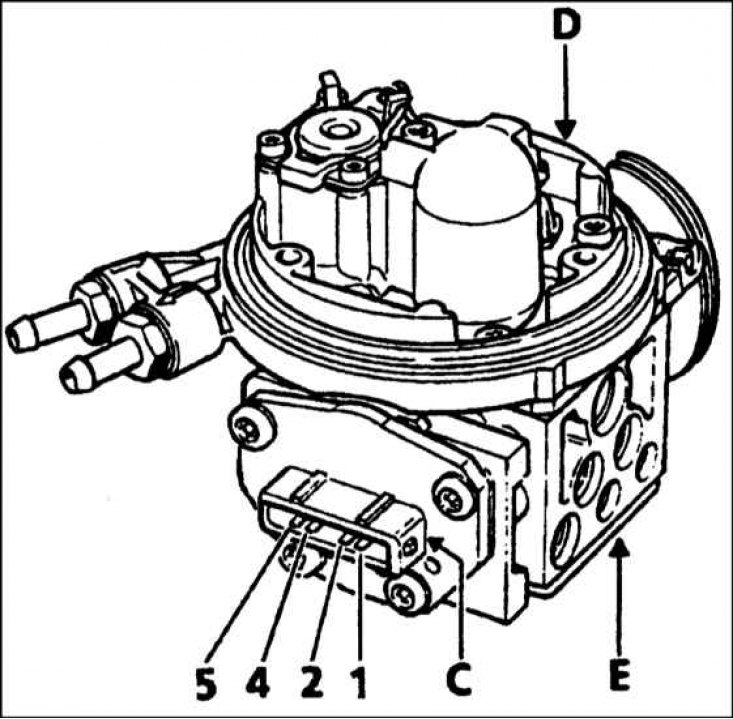
C - Throttle potentiometer wiring connector; C1 - Mass; C2 - Power supply +5 volts; C4 - Throttle position information (0 - 5 volts); C5 - Not used; D - Upper half of the throttle body; E - Lower half of the throttle body
Examination
1. If there is damage in the fuel injection system, first make sure that all the system wiring connectors are securely connected and not oxidized. Make sure that the air filter element is clean, the spark plugs are in good condition, the spark plug gaps are adjusted correctly, the compression in the engine cylinders is normal, the ignition timing is set correctly, the engine breather hoses are not clogged or damaged.
2. If these checks do not reveal the cause of the problem, you must contact a suitably equipped Renault centre for testing. The unit's wiring connector is included in the engine management system circuit, to which a special electronic diagnostic tester can be connected; the connector is stapled to the bulkhead in the engine compartment. The tester will identify the damage quickly and easily, without the need to test all the system components separately, which is time-consuming and can lead to damage to the ECU.
3. If the "electronic malfunction" indicator light on the instrument panel lights up while driving, or it stays on for more than 3 seconds after the ignition is turned on, the malfunction may be in one or more of the following components:
- a) Pipeline pressure sensor.
- b) Throttle potentiometer.
- c) Injectors.
- d) Idle speed control stepper motor (not on all engines).
- e) Vehicle speed sensor (while moving).
- f) Exhaust gas recirculation solenoid valve (only K7M and F3R engines).
- g) Automatic transmission computer.
4. You can check the resistance of some individual components using the information in Specifications, but other nodes (idle speed control stepper motor) cannot be checked and adjusted (refer to the illustrations).
Adjustment
1. Experienced car enthusiasts with significant experience and the availability of equipment (including a tachometer and a precisely calibrated exhaust gas analyzer) can check the CO level and idle speed. However, if adjustment is required, you should contact a Renault service station. Mixture (cO level) and the idle speed is not adjusted, and if any of these values are incorrect, there is damage in the fuel injection system.