



Contents: Fuel injector 🠛 Fuel pressure regulator 🠛 Inlet air temperature sensor 🠛 Idle speed control stepper motor 🠛 Throttle potentiometer 🠛 Coolant temperature sensor 🠛 Electronic control module (ecu) 🠛 Pipeline pressure sensor 🠛 Fuel injection system relay and fuel…🠛 Crankshaft speed/position sensor 🠛 Inertial fuel cut-off switch 🠛 Power steering pressure sensor 🠛 Knock sensor 🠛
Fuel injector
Note: If you suspect a faulty injector, it is worth trying one of the special cleaning products before throwing it away.
Removal
1. Remove the intake air temperature sensor as described later in this Section.
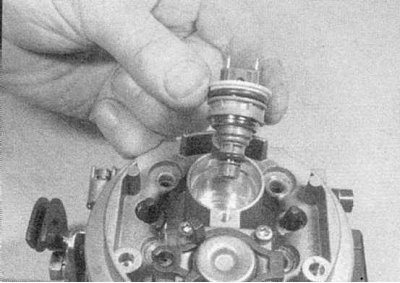
2. Note the location, then lift the injector and remove the O-rings (refer to the accompanying illustration).
Installation
1. Install in reverse order. Make sure the injector and cap seals are in good condition. When installing the injector cap, make sure the terminals on the injector are properly connected to the terminals in the cap, the terminals are marked "+" and "-".
Fuel pressure regulator
1. The fuel pressure regulator is part of the upper half of the throttle body. If it is faulty, the entire throttle body must be replaced.
Inlet air temperature sensor
Removal
1. Remove the air cleaner assembly as described in Section Removal and installation - air filter assembly and air intake ducts.
2. Disconnect the sensor multi-pin connector.
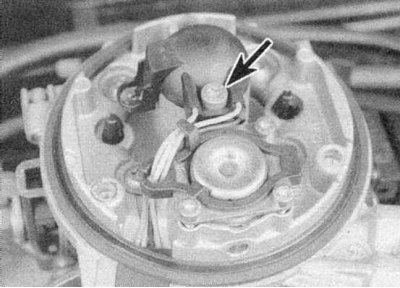
3. Loosen the fastening screw and release the sensor cover (refer to the accompanying illustration).
4. Release the connecting tabs and remove the sensor together with the cover, wiring and connector.
Installation
1. Perform installation in reverse order.
Idle speed control stepper motor
Removal
1. Remove the air cleaner assembly as described in Section Removal and installation - air filter assembly and air intake ducts.
2. Remove the throttle body mounting screws. Carefully lift the throttle body to improve access to the motor.
3. Disconnect the multi-pin connector.
4. Unscrew the three mounting screws and remove the motor.
Installation
1. Perform installation in reverse order. Then perform initial adjustment as follows.
2. Place a shim or feeler gauge approximately 5 mm thick between the throttle sector and the motor plunger. Turn on the ignition for a few seconds, then turn it off. Remove the shim or feeler gauges, then turn the ignition on and off again.
3. Start the engine and check that the idle speed and mixture quality are normal.
Throttle potentiometer
1. The throttle potentiometer is part of the lower half of the throttle body. If it is faulty, the entire throttle body must be replaced. The idle speed control drive motor can be relocated from the old throttle body.
2. After replacement, the initial setting of the potentiometer must be checked using the Renault XR 25 diagnostic tester
Coolant temperature sensor
1. The coolant temperature sensor is located on the front of the thermostat housing. For information on removal and installation, see Chapter Cooling and heating system.
Electronic control module (ecu)
Removal
1. The electronic control module is located in the front right corner of the engine compartment.
2. Before removing the module, disconnect the ground cable from the battery.
Warning: If the car radio in your car is coded, make sure you know the code before disconnecting the battery.
3. Unscrew the bracket from the top of the electronic control module and release the belt. Alternatively, the bracket can be left on the module until the assembly is removed.
4. Loosen the mounting screws and remove the electronic control module and bracket (refer to the accompanying illustration).
5. Disconnect the electrical connector from the control module.
Installation
1. Perform installation in reverse order.
Pipeline pressure sensor
Removal
1. The sensor is installed on the left side of the engine compartment bulkhead.
2. Disconnect the wiring from the sensor.
3. Unscrew the fastening nuts and remove the sensor.
Installation
1. Perform installation in reverse order.
Fuel injection system relay and fuel pump relay
Removal
1. These relays are located in the fuse/relay box in the engine compartment (relays "J" and "L").
2. Remove the cover from the unit.
3. Remove the desired relay.
Installation
1. Installation is carried out in reverse order.
Crankshaft speed/position sensor
Removal
1. The sensor is installed on the top of the transmission housing.
2. Before removing the sensor, disconnect the ground cable from the battery (refer to Chapter Engine electrical equipment for Scenic models), then remove the air cleaner housing as described in Section Removal and installation - air filter assembly and air intake ducts.
3. Follow the wiring from the sensor to the connector and disconnect it from the main harness.
4. Loosen the mounting bolts and remove the sensor.
Installation
1. Install in reverse order. Tighten the sensor mounting bolts securely - note that only special bolts should be used; these bolts accurately mount the sensor, ensuring the correct air gap between the tip and the flywheel/drive plate.
Inertial fuel cut-off switch
Removal
1. The inertia switch is located on the left side of the engine compartment.
2. Loosen and remove the screws securing the switch, then disconnect the wiring and remove the switch.
Installation
1. Installation is carried out in reverse order. Finally, reset the switch by pressing the button.
Power steering pressure sensor
Removal
1. The pressure sensor is screwed into the power steering supply pipe that runs from the pump to the steering gear.
2. To remove the switch, disconnect the electrical wiring connector.
3. Wipe the area around the switch, then unscrew the switch and remove it from the pipe. Plug the hole in the pipe to prevent fluid leakage and dirt from entering the hydraulic system.
Installation
1. Installation is carried out in the reverse order. Finally, check the fluid level in the power steering system as described in Section Schedule of current maintenance.
Knock sensor
1. Refer to Chapter Engine electrical equipment.