
English Русский
Български
Беларускі
Український
Српски
Hrvatski
Română
Polski
Slovenský
Magyar
Bookmark Contacts Articles Sitemap
Company vehicles Peugeot Company vehicles Opel Company vehicles Skoda Company vehicles Land Rover Company vehicles Mitsubishi Company vehicles Volkswagen Company vehicles Honda
RenaultBook.ru


Duster   Fluence   Kangoo   Laguna   Logan   Megane   Sandero   Scenic   Symbol   Clio   Other
Logan 1 (2004-2012, petrol) Logan 2 (2012-2020)

Air conditioning system (Renault Logan 2)

  • Main
  • Logan
  • Logan 2 (2012-2020)
  • Body and interior
  • Heating and air conditioning
  • Air conditioning system
0
Contents: Heater 🠛 Air conditioning system 🠛

Heater


The heater operates from the engine cooling system, transferring the heat generated by the engine into the car's interior.

Air conditioning system
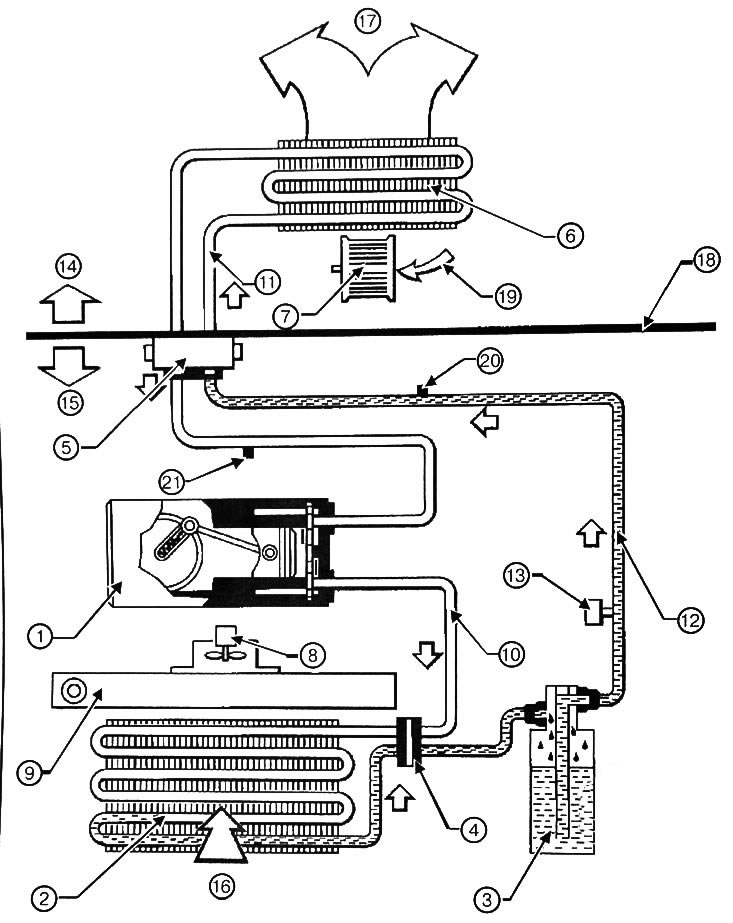


1. Compressor. 2. Condenser. 3. Receiver-dryer. 4. Pressure sensor. 5. Reducer. 6. Evaporator. 7.…

1. Compressor. 2. Condenser. 3. Receiver-dryer. 4. Pressure sensor. 5. Reducer. 6. Evaporator. 7. Cabin fan. 8. Engine cooling system fan. 9. Engine cooling system radiator. 10. High-pressure refrigerant. 11. Low-pressure steam. 12. High-pressure steam. 13. Pressure sensor. 14. Cabin. 15. Engine compartment. 16. Outside air. 17. To the air distribution unit. 18. Bulkhead shield. 19. Outside or recirculated air. 20. High-pressure valve. 21. Low-pressure valve.


The purpose of the air conditioning system is to absorb heat from the air in the car's interior. For this purpose, a certain liquid is used in the air conditioner (known as a refrigerant), capable of cooling (lower the temperature) and change the state of aggregation (change from liquid to gas) expanding under a large pressure difference. Therefore, the refrigerant is able to absorb heat from the environment. As the temperature rises, the pressure of the refrigerant increases, and it again changes from a gaseous state to a liquid and condenses.


The first task in this regard is to liquefy the gaseous refrigerant, which can only be achieved by bringing it to a temperature below evaporation (or boiling), which for the refrigerant Rl34a at atmospheric pressure is -26°C.

In order to achieve liquefaction of the refrigerant at room temperature, which in our case can also be quite high (in the engine compartment), it is necessary to raise the evaporation point of the refrigerant so that it remains in a liquid state until the moment when it is necessary to specifically cause its expansion to obtain the desired effect.

To raise the boiling point, the pressure must be increased while the temperature decreases, and this requires the expenditure of a certain amount of energy. This energy, produced by the air conditioner compressor, is subtracted from the energy produced by the car engine.

The operating principle of the air conditioning system can be represented in the form of the following phases:
  • Gaseous refrigerant R134a is supplied to the air conditioner compressor under pressure of 0.5 ~ 2.0 bar and is compressed to 10 ~ 17 bar. The boiling point under these conditions is 60°C.
  • The liquid refrigerant is heated at the compression stage to a temperature of 80~100°C, remaining in the compressor in a gaseous state. Then, subjected to a flow of cooling air (produced by a moving vehicle or a condenser fan), the refrigerant begins to condense, becoming a liquid under high pressure. The refrigerant then passes through a filter that performs three functions: trapping impurities, absorbing moisture contained in the air conditioning system circuit, and acting as a reserve tank for storing the available refrigerant.
  • The refrigerant reaches the expansion valve where it is introduced into the evaporator at a pressure of 1.52 bar. At this pressure, the liquid/saturated vapor of the refrigerant is in equilibrium at a temperature of -7°C. At the same time, the air passing through the evaporator (under the action of a fan), being at a significantly higher temperature than the refrigerant, heats it to the boiling point and completely evaporates, giving off heat. When the air cools, the moisture it contains collects on the evaporator in the form of condensate droplets, which are then collected in a chamber for further drainage from the car. The cooled and dried air is supplied to the car's interior, and the refrigerant returns from the evaporator to the compressor for a repeat cycle.
This article is available on: russian, bulgarian, belarusian, ukrainian, serbian, croatian, romanian, polish, slovak, hungarian
Article has been reviewed by editor: Petrovsky Roman
Share with friends:
Previous
Logan 2: Heating and air conditioning
Next

General information — air conditioning system
Air conditioning system specification
Necessary precautions: operations with the air conditioning system
Heater and air conditioner control
Cabin air temperature sensor
Recirculation flap drive
Other articles on other Renault models

➽ Air conditioning system Renault Duster 1 (2009-2017)
➽ Heating and air conditioning system Renault Fluence 1 (2009-2020, petrol)
➽ Starting system with E7J engines, manual transmission, without… Renault Kangoo 1 (1997-2007)
➽ Automatic air conditioning system Renault Laguna 2 (2001-2007)
➽ General description and precautions of the air conditioning… Renault Megane 1 (1995-2002)
Link to this article in different formats
Reviews and comments of visitors
No comments yet


Add two numbers 31 + 22


Logan 2 (2012-2020) 
  • General information
  • Faults en route
  • Daily checks
  • Governing bodies
  • Maintenance
  • Power unit
  • Petrol engines 1.2 l
  • Petrol engines 1.6 l
  • Diesel engines 1.5 l
  • Cooling system
  • Lubrication system
  • Power and control system
  • Intake and exhaust system
  • Engine electrical equipment
  • Transmission
  • Clutch
  • Car gearbox
  • Drive shafts
  • Chassis, running gear
  • Suspension and wheels
  • Brake system
  • Steering
  • Body and interior
  • Exterior (external elements)
  • Interior (internal elements)
  • Safety system
  • Heating and air conditioning
  • Electrical equipment
  • Equipment and devices
  • Wiring diagrams (sedan)
  • Wiring diagrams (wagon)
Logan 1 (2004-2012, petrol) 
  • General information
  • Vehicle device
  • User manual
  • Faults en route
  • Daily maintenance
  • First maintenance
  • Second maintenance
  • Driver tips
  • Power unit
  • Engine repair
  • Lubrication system
  • Cooling system
  • Power and exhaust system
  • Transmission
  • Clutch
  • Car gearbox
  • Drive shafts
  • Chassis, running gear
  • Front suspension
  • Rear suspension
  • Steering
  • Brake system
  • Wheels and tires
  • Body and interior
  • Exterior (external elements)
  • Interior (internal elements)
  • Doors, locks and windows
  • Body Care
  • Electrical equipment
  • Equipment and devices
  • Headlights and lighting
  • Power devices
  • Electrical circuits
RenaultBook.ru © 2018–2026 | Mobile version | News and articles | Sitemap: EN BG BY UA RS HR RO PL SK HU | Administration | Site search | Bookmark
Duster 1 (2009-2017) | Fluence 1 (2009-2020, petrol) | Kangoo 1 (1997-2007) | Laguna 2 (2001-2007) | Logan 1 (2004-2012, petrol) | Logan 2 (2012-2020) | Megane 1 (1995-2002) | Megan 2 (2002-2009, petrol) | Sandero 1 (2007-2012, petrol) | Scenic 1 (1996-2003) | Symbol 1 (1999-2008, petrol) | Symbol 2 (2008-2013, petrol) | Renault 19 (1988-1996) | Espace I and II (1984-1996) | Espace III (1996-2002) | Clio 1 (1990-1998) |
We want your visit to be comfortable 😌 and use cookies 🍪 to do so.