



Contents: Defrost/Defogging Key (1) 🠛 Key (2) "summer" 🠛 Key (3) "winter/mid-season with…🠛 Key (4) "winter/mid-season" 🠛 Temperature control knob (5) 🠛 Handle (7) for adjusting the amount…🠛 Air conditioning key (8) 🠛 Air recirculation key (9) 🠛 Heating system control unit on the…🠛 Cooling a car heated by the sun 🠛 Warming up the car interior 🠛 Defrost/ fog removal mode for windows 🠛 Pollen filter 🠛 Heated seats (depending on equipment) 🠛 Heated rear window and outside…🠛
The heating and ventilation system with air conditioning automatically maintains the microclimate in the car, except for extraordinary conditions, and helps ensure good visibility. The air supplied by the ventilation system to the car can be heated or cooled depending on the comfort conditions selected by the driver and passengers.
The control system consists of two parts:
- driver control system.
- front passenger control system.
The first includes the basic functions of the air conditioning system. The second allows the passenger to change the temperature setting on his side.
Defrost/Defogging Key (1)
The first time you press the button, the normal system for protecting the windows from fogging and defrosting is activated. In this case, the entire air flow is directed to the windshield, side windows and front door windows. When you press the button, the left indicator lamp lights up.
Only on modifications with air conditioning, when the button is pressed again for approximately 15 minutes:
- both mixing flaps are set to the maximum heated air supply position, while the operation of the air flow mixing mode of the heating unit and air distribution on the front passenger side is automatically controlled; - the system switches to outside air intake if the air recirculation mode was previously enabled;
- the fan switches to maximum speed;
- the rear window and outside rearview mirror heaters are switched on;
- the air conditioning system turns on;
- the right indicator light comes on (in addition to the left indicator lamp). After 15 minutes, the system returns to the defog/defrost mode. To turn off the function, press one of the air flow distribution keys 3-4-7 again. When this function is activated, the "recirculated air" and "conditioned air" keys are not functional.
Key (2) "summer"
The air flow is directed only to the central and side ventilation nozzles.
Key (3) "winter/mid-season with defogging"
The air flow is distributed between the glass heating nozzles (to prevent fogging and freezing) and openings for heating the feet of the driver, front and rear passengers.
Key (4) "winter/mid-season"
The main air flow is directed to the feet of the driver, front and rear passengers; a small amount of air is directed to the glass heating nozzles.
Temperature control knob (5)
In hot weather, turn the air conditioner knob to the extreme left position to turn on the air conditioner, at which the temperature of the air entering the passenger compartment is minimal. To prevent fogging of the windows in cold and humid weather, turn on the air conditioner and adjust the temperature at the outlet of the ventilation openings using the temperature regulator. Due to the presence of a receiver-dryer in the air conditioning system, dry air is supplied to the passenger compartment, which accelerates the evaporation of moisture from the inner surfaces of the windows.
The knob regulates the temperature on the driver and front passenger side if the indicator lamp (6) is on, or only on the driver side if the passenger side control is activated. To deactivate the passenger side control, press one of the air distribution buttons 2-3-4 for 2 seconds. In addition, the passenger side control is deactivated automatically when the defogging/defrosting mode (1) is selected
Handle (7) for adjusting the amount of air supplied to the passenger compartment
To increase the amount of air supplied to the cabin, move the handle to the right.
When the handle is set to the extreme left position, there is no air supply to the passenger compartment.
Air conditioning key (8)
When you press the switch, the air conditioner is activated. The air conditioner allows you to:
- lower the air temperature in the cabin;
- reduce the humidity of the air pumped into the cabin (this accelerates the removal of moisture from the inner surfaces of the glass).
The compressor clutch is engaged when two conditions are met:
- at user request (when pressing key 8);
- if there is permission to turn on from the injection computer.
Air recirculation key (9)
To achieve maximum air conditioning efficiency, press the button (9) once, the system switches to air recirculation mode. To refresh the air in the cabin and prevent the accumulation of unpleasant odors and carbon dioxide, it is recommended to periodically switch the system to the mode of operation with the supply of outside air to the cabin.
Heating system control unit on the front passenger side
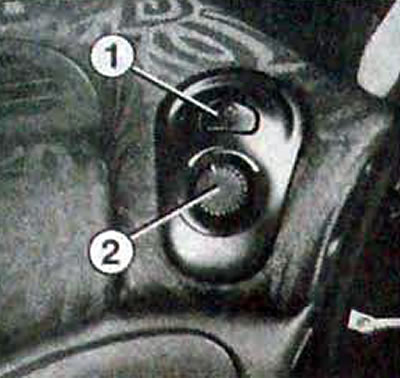
Heating system control unit on the front passenger side: 1 - temperature controller switch; 2 - temperature control knob
Temperature regulation is carried out as follows:
- press the button (1), the control lamp lights up and the temperature control function is activated.
- turn the knob clockwise to increase the temperature and vice versa.
If the function is switched off, the indicator lamp does not light and the temperature on the front passenger side is adjusted from the control unit on the driver's side.
In addition, the passenger side control panel is automatically deactivated when the defogging/defrosting mode is selected (1)
Cooling a car heated by the sun
Cars without air conditioning
Lower the windows and start the engine. Open the ventilation nozzles on the instrument panel, press the "summer" button (2), move the temperature control knob (5) to the cold air supply position and move the air supply quantity control knob to maximum.
Cars with air conditioning
Lower the windows and start the engine. Open the ventilation nozzles on the instrument panel, press the "summer" keys (2), the air conditioning system (8) and move the air volume control knob to maximum and, for a few minutes, move the temperature control knob (5) to the cold air position. Wait a few seconds and close the windows.
Warming up the car interior
Close the ventilation grilles on the instrument panel, press the button (4), move the air temperature control knob to maximum and the control knob for the amount of air supplied to the passenger compartment to maximum for a few minutes, during which time the car engine will warm up.
Defrost/ fog removal mode for windows
Cars without air conditioning
Close the ventilation grilles on the instrument panel, press the defogging/defrosting buttons (1), move the air temperature control knob (5) and the control knob (7) for adjusting the amount of air supplied to the passenger compartment to maximum.
Cars with air conditioning
Close the instrument panel vents and press the window defogger/defrost button (1) twice, the automatic defogger/defrost mode will be activated and the two indicator lamps will light. After defogging/defrosting the windows, use the air flow distribution buttons.
Pollen filter
On some versions of cars, the outside air is cleaned of dust particles and pollen before it enters the car. Both filters are accessible from the engine compartment and should be replaced every 30,000 km or more often when operating the car in dusty areas. If the supply of outside air to the car's interior has decreased, it is necessary to replace the filters without waiting for the normal replacement period.
Heated seats (depending on equipment)
Some versions of the car can be equipped with heated front seats. The buttons for turning on the heating are located on the outer side of the seats.
The heater operation indicator lamp is located in the instrument cluster. The indicator lamp only shows the function selection, as the system has a thermostat. The system only functions when the temperature in the vehicle interior is below 12°C.
Heated rear window and outside rearview mirrors (depending on equipment)
The rear window and outside rearview mirror heating is switched on by a button located on the instrument panel to the left of the driver. The indicator lamp is included in the button.
There are two ways to turn off the heating:
- automatically after approximately 12 minutes of operation;
- immediately by pressing a button
Note: Defrosting of the rear window is carried out automatically after pressing the window defrosting/defrosting button (1) or turning on the air conditioning system.