



Caution: The air conditioning system must be serviced only by trained technical personnel, who are trained in safe working practices, using the proper equipment, observing the depressurization rules, and who are familiar with the methods of collecting and storing the vehicle refrigerant.
The air supplied by the ventilation system to the car's interior can be heated or cooled depending on the comfort conditions selected by the driver and passengers. The heating and air conditioning systems are separate, but the units and components of these systems are located in the passenger compartment in one housing under the instrument panel.
The heat generated by the engine is transferred by the coolant to the heater radiator located in the passenger compartment. The air flow supplied by the ventilation system passes through the radiator and is heated by the heat of the engine coolant flowing inside the radiator.
The air conditioning system removes excess heat and moisture from the passenger compartment in accordance with basic physical principles. The refrigerant, circulating as a liquid in the high-pressure section of the system, evaporates and turns into a gas in the low-pressure section. As the gas expands, cooling occurs, accompanied by the removal of heat from the air supplied by the fan to the passenger compartment, and a decrease in its temperature. Then, as it passes through the condenser, the refrigerant gives off the absorbed heat to the surrounding air. The heat removal cycle continues indefinitely as the refrigerant circulates in a closed circuit. Moisture is removed from the air supplied to the passenger compartment due to condensation on the evaporator of the refrigeration chamber.
Most air conditioning system repair and maintenance operations require specialized equipment and certain skills.
To prevent fresh air from entering the car interior, there is an air recirculation mode.
Source link is located on [www.renaultbook.ru]
The source of increased danger in case of improper maintenance of the system by untrained technical personnel and when using improper equipment is the high pressure and chemical action of the refrigerant. In order to protect the environment, in accordance with current legislation, only R134a refrigerant is allowed to be used in air conditioning systems.
In order to improve the efficiency of the air conditioner, a special algorithm for exchanging information between the injection computer and the air conditioner computer has been developed.
When the air conditioner is turned on, the idle speed of the crankshaft is increased to improve its efficiency. The engine idle speed is adjusted to compensate for changes in engine load due to the compressor clutch engaging and disengaging.
If the coolant temperature is very high or if the engine is running under significant load at high crankshaft speed and high coolant temperature, the air conditioning compressor must not be switched on.
If the engine speed is below a certain threshold when the accelerator pedal is fully depressed, the air conditioning compressor is inhibited for 20 seconds in order to obtain the maximum possible engine torque.
Note: If during the air conditioner prohibition period, one of the two conditions that caused the prohibition to be entered is cancelled, the compressor will turn on automatically before the prohibition time expires.
Precautions when working with air conditioning system components
- Avoid contact of liquid refrigerant with skin or eyes. As standard protective measures when working with refrigerant, it is necessary to use goggles to protect the eyes. If refrigerant comes into contact with clothing or protective equipment, immediately rinse the affected area with plenty of water
- All work on the air conditioning system must be carried out in a well-ventilated area, since the gaseous refrigerant is heavier than air and can accumulate in the inspection pit. If the air conditioning system has accidentally discharged, ventilate the work area before servicing the system.
- A car equipped with an air conditioning system can be heated after painting in a drying chamber to a temperature of 80°C for no more than 20 minutes.
- When washing the engine, do not direct the steam jet at the air conditioning system components
- Use only the recommended oil to lubricate the air conditioning system components, otherwise the system may fail.
- Use an electronic sensor to check the air conditioning system for leaks. Keep in mind that R-134a refrigerant decomposes after contact with flame, releasing a highly toxic gas.
- Soldering and welding of air conditioning system components is strictly prohibited.
Notes when replacing air conditioning system components
- Never open the circuit or disconnect any air conditioning system components before discharging the system.
- After disconnecting the air conditioning system components, immediately close the connections with the appropriate caps to prevent moisture from the air from entering the system.
- When installing new air conditioning system components, remove them from their packaging immediately before installation.
- When connecting open fittings, always use new O-rings.
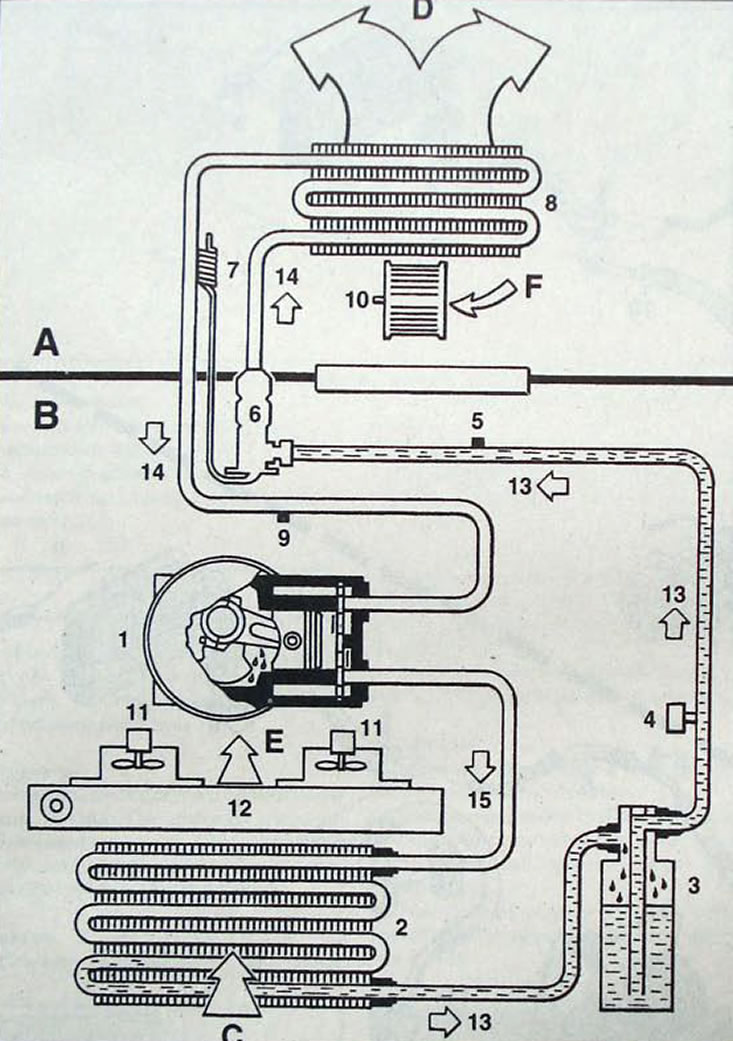
Fig. 14.9. Air conditioning system diagram:A - car interior; B - engine compartment; C - outside air; D - cooled air to the air flow mixing unit; E - heated outside air; F - outside or recirculated air; 1 - compressor; 2 - condenser; 3 - receiver-dryer; 4 - three-function pressure relay; 5 - valve for releasing gas under high pressure; 6 - valve; 7 - thermostatic valve regulation; 8 - evaporator; 9 - valve for releasing gas under low pressure; 10 - Electric heater fan; 11 - Electric fan of the engine cooling system; 12 - engine radiator; 13 - liquid under high pressure; 14 - low pressure gas; 15 - high pressure gas