


The identification number begins with the transmission code
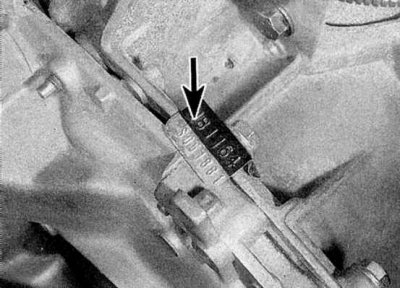
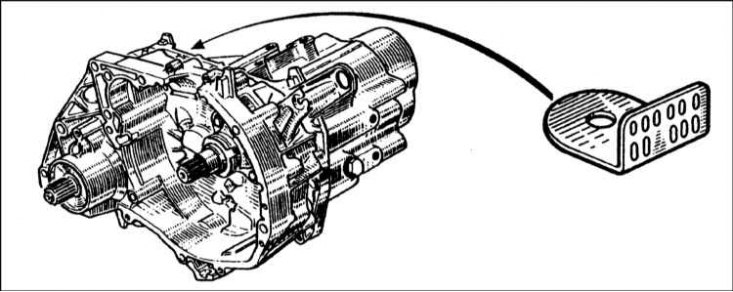
The gearbox is housed in a cast aluminum alloy housing bolted to the left end of the engine. The unit consists of the gearbox, final drive, and differential. The gearbox type is indicated on the identification plate attached to it (refer to the illustrations).
The torque from the crankshaft is transmitted through the clutch to the transmission input shaft, which rotates on ball bearings. From the input shaft, the drive is transmitted to the output shaft, which rotates on a roller bearing (right end) and ball bearing (left end), and further - to the driven gear of the main transmission, the side gears of the differential and the drive shafts. The rotation of the satellites on their shaft allows the inner wheel to rotate more slowly than the outer one when turning.
The output shaft is parallel to the input and drive shafts, the teeth of the transmission shaft gears are in constant engagement. In the neutral position, the output shaft gears rotate freely, and the drive is not transmitted to the driven gear of the main gear. The manual gearbox has five forward gears (all are synchronized) and reverse.
Gear selection is accomplished using a lever and rod attached to the floor.
A rod inside the manual transmission causes the corresponding gear shift fork to move the sliding synchronizer clutch along the shaft, causing the toothed ring of the desired gear to engage with the synchronizer clutch hub. Since the synchronizer hubs have a splined engagement with the output shaft, the drive is transmitted to the shaft. Synchronizers, which provide a quick and smooth gear change, consist of locking rings, a hub equipped with spring-loaded crackers and a clutch.