



Contents: Spare wheel 🠛 Tire repair kit 🠛 Tools 🠛 Decorative caps/wheel rims 🠛 Wheel replacement 🠛 Tires 🠛
In case of a flat tire, depending on the vehicle's equipment, you can use a spare tire or a tire inflation kit.
Spare wheel
The wheel is located in the luggage compartment.
To get it:
- open the trunk;
- depending on the vehicle, remove the luggage rack or fold it up and place it in the extreme position;
- place the luggage compartment mat vertically against the rear seatback or folded luggage compartment parcel shelf, if equipped;
- unscrew the central fastening (1);
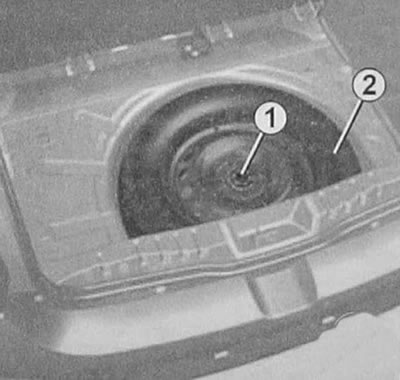
- remove the spare wheel (2).
Note:
Make sure the spare tire or punctured tire and wheel well are in place to prevent the luggage compartment mat from falling through.
After installation, make sure that the luggage compartment mat fits correctly into the stops to avoid damage (if the vehicle is equipped accordingly).
Attention:
If the spare tire has been stored for several years, take it to a service mechanic to check that the tire is safe for use
A vehicle equipped with a spare tire of a different diameter
- It is prohibited to install more than one such spare wheel on one vehicle.
- Since the normal tire is larger than the spare tire, the vehicle's ride height will be reduced.
- Replace the spare tire with a tire identical to the one originally installed as soon as possible.
- When using this spare tire (only temporary use is allowed) the vehicle speed must not exceed the value indicated on the wheel label.
- Installing a spare tire may affect the performance of your vehicle. Do not accelerate or slow down too quickly. Reduce speed when turning.
- If you need to use snow chains, install the spare tire on the rear axle and check the air pressure in the tire.
Tire repair kit
Attention:
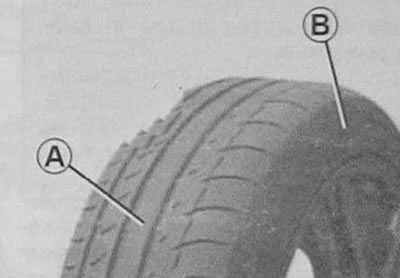
- The kit is designed to repair the tire tread (A), the damage size of which does not exceed 4 mm. The kit is not suitable for repairing damage larger than 4 mm and cuts on the sidewall (B) of the tire.
- Also, make sure the wheel rim is in good condition.
- Do not remove the object that caused the puncture if it remains in the tire.
- Do not use the kit if the wheel is damaged due to driving with a flat tire.
- Before carrying out repairs, carefully inspect the sidewalls of the tires.
- Also, driving when the tire pressure is insufficient or absent (the tires are punctured), may result in reduced safety and impossibility of tire repair.
- The above repair method is a temporary measure. A punctured tire must be examined by a specialist as soon as possible (and if possible, repair it).
- When replacing a tyre repaired with this kit, you must notify the tyre fitter.
- While driving, due to the presence of a special agent in the tire, slight vibration may be felt.
- The kit is certified for inflating tires of the vehicle it originally came with only. Do not use this kit to inflate tires of another vehicle or any other inflatable objects under any circumstances (inflatable ring, boat, etc.).
- When handling the tire repair solution, avoid contact with skin. If drops of the solution come into contact with skin, rinse with plenty of water.
- Keep the tire repair kit out of the reach of children.
- Don't throw away the empty cylinder. Take it to the dealer (service station or organization responsible for collecting such waste).
- The expiration date of the product is indicated on the label on the can. Check if the expiration date of the product has not expired.
- To replace the tire inflation tube and the bottle with the product, contact the manufacturer's service station.
Depending on the vehicle's equipment, the tire inflation kit may be located in the luggage compartment or under the luggage compartment carpet.
Attention:
Before using the kit, park the vehicle at a sufficient distance from the roadway, turn on the hazard warning lights and emergency brake, remove all passengers from the vehicle and ensure that they are not on the roadway.
With the engine running and the parking brake applied:
- unfold the cylinder hose;
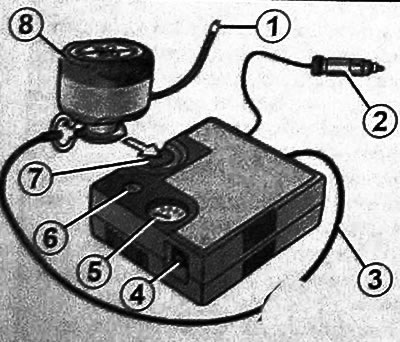
- connect the compressor hose (3) to the cylinder drain hole (8);
- depending on the vehicle configuration, connect or screw the cylinder (8) to the compressor at the level of the recess (7) of the cylinder;
- unscrew the valve cap of the corresponding wheel and screw on the cylinder tip (1) instead;
- be sure to insert the connector (2) into the vehicle's accessory socket;
- press the switch (4) to inflate the tires to the specified pressure level (see the section "Tyre air pressure");
- no later than 15 minutes later, stop inflating the tire and check the air pressure in it using the pressure gauge (5);
Note:
- While the cylinder is being emptied (about 30 seconds), pressure
- according to the pressure gauge (5) it can rise to 6 bar for a short time, then the pressure drops.
- adjust the pressure: to increase the pressure, continue to inflate the tire, and to decrease the pressure, press the button (6).
If after 15 minutes the minimum pressure of 1.8 bar cannot be reached, repair is not possible; do not continue driving and contact the manufacturer's representative.
Warning: When parked on the side of the road, you must warn other road users of the presence of your vehicle by installing a warning triangle or other devices prescribed by local regulations in the country in which you are located.
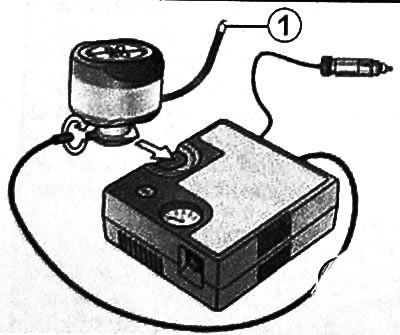
Once the tyre is inflated, remove the kit: slowly unscrew the inflation nozzle (1) to prevent the product from leaking out and place the can in a plastic container to prevent its contents from spilling later.
Caution: No objects should be placed on the floor in front of the driver, as they may get under the pedals in the event of sudden braking and interfere with their movement.
- Place a sticker with a reminder of driving rules after repair in a visible place on the dashboard.
- Remove the kit.
- After the first inflation, the air leak from the tire will continue, so to eliminate it, it is necessary to run the tire in to seal the puncture site.
- Immediately start driving for 3 km at a speed of 20-60 km/h to ensure that the product is evenly distributed in the tire, then stop and check the tire pressure.
- If the pressure is higher than 1.3 bar, but less than prescribed, bring it back to normal (see sticker on end of driver's door), and if this fails, contact the manufacturer's service station: repair is not possible.
Precautions when using the kit
The kit should not operate for more than 15 minutes continuously.
Attention:
- A poorly screwed valve cap or its absence can cause a loss of tire sealing and a drop in pressure in them.
- Valve caps should always be fully tightened and identical to those originally installed.
- After repairs made with the kit, the vehicle's mileage should not exceed 200 km, and the speed should not exceed 80 km/h. You will be reminded of this by a sticker that you should stick on a visible place on the dashboard after repairs.
- Depending on the country or according to local legislation, a tire repaired with a tire inflation kit must be replaced.
Tools
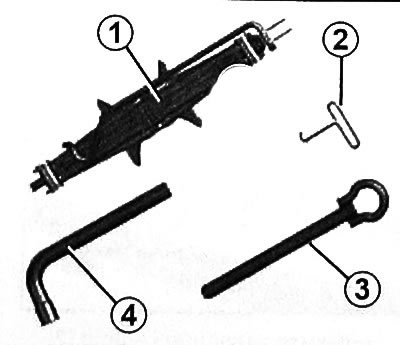
1. Jack. 2. Wheel trim removal tool. 3. Tow hook. 4. Wheel wrench
The presence and location of tools in the car depends on the vehicle configuration.
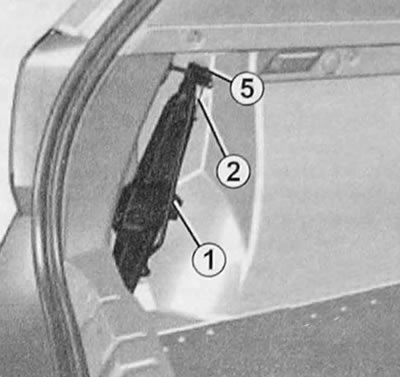
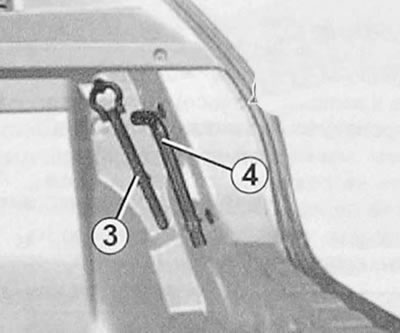
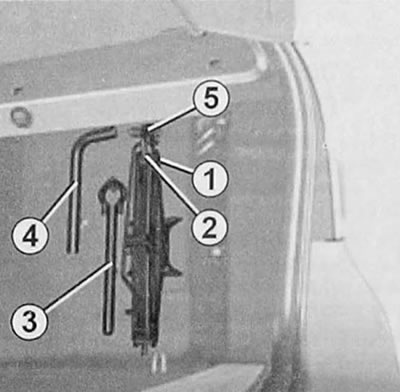
Jack
Attention:
- Never leave tools lying around in the car: they can cause you injury if you brake suddenly. After using the tools, put them back in their proper places, otherwise there is a risk of injury.
- If wheel bolts are included in the tool kit, use these bolts only for the spare tire (see label on spare tire).
- The jack is intended for changing a wheel only. Never use the jack to perform repairs or to access underneath the vehicle.
To use the jack (1), unscrew the nut (5). When storing the jack, fold it correctly, then put it back in place. Tighten the nut (5) to secure the jack.
Wrench for removing decorative wheel trim
Used to remove decorative wheel caps.
Towing hook
See section "Towing" below.
Wheel wrench
Used to tighten/loosen wheel mounting bolts.
Attention:
- Never leave tools lying around in the car: they can cause you injury if you brake suddenly. After using the tools, put them back in their proper places, otherwise there is a risk of injury.
- If wheel bolts are included in the tool kit, use these bolts only for the spare tire (see label on spare tire).
- The jack is intended for changing a wheel only. Never use the jack to perform repairs or to access underneath the vehicle.
Decorative caps/wheel rims
Central decorative cap that does not cover the wheel bolts
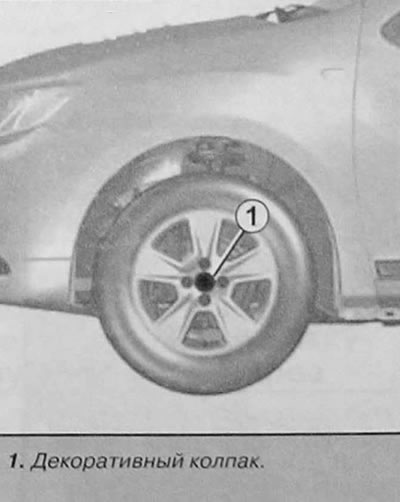
Access to bolts is direct.
Central decorative cap covering the wheel bolts
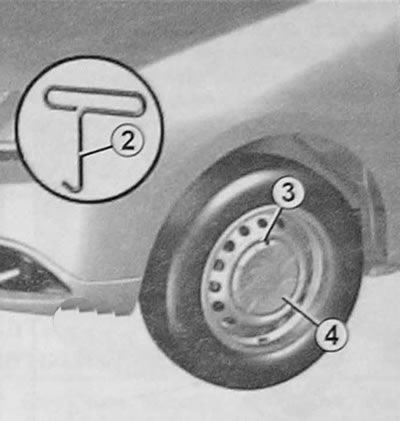
Remove the cap (4) using the cap removal key (2) by inserting it into the special groove (3).
When installing, position the cap correctly relative to the wheel rim and snap it into place.
Decorative cap covering wheel bolts
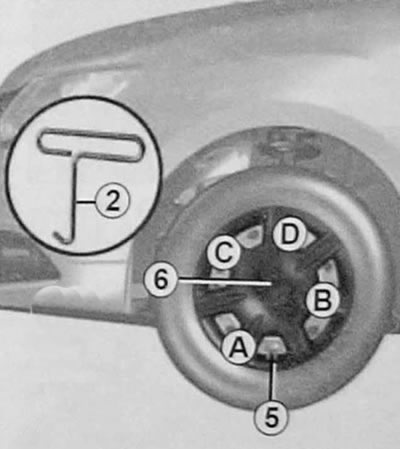
Remove the decorative cap (6) using the decorative cap removal key (2) by inserting the key into the recess in the valve (5).
When installing, position it correctly relative to the valve (5). Insert the clips, starting from the valve side A, then B and C, ending with the side opposite the valve D.
Wheel replacement
Turn on the hazard warning lights.
Stop the vehicle away from the roadway on a hard, horizontal, non-slip surface.
Apply the parking brake, then engage the gear (first or reverse).
Ask all passengers to exit the vehicle and stay away from the roadway.
Cars with jack and wheel wrench
If necessary, remove the decorative cap.
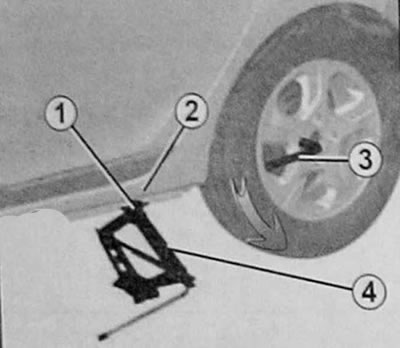
Loosen the wheel mounting bolts with the wheel wrench (3). Position it so that you can press from above.
Note:
If your vehicle does not have a jack and wheel lug wrench, they can be purchased from the manufacturer's representatives.
Warning: When parked on the side of the road, you must warn other road users of the presence of your vehicle by installing a warning triangle or other devices prescribed by local regulations in the country in which you are located.
Place the jack (4) horizontally, making sure to set its head at the height of the stiffening rib (1) near the corresponding wheel at the level of the mark (2).
Start rotating the jack (4) manually to correctly position its support foot (it should go slightly under the car).
Make a few turns until the wheel lifts off the ground.
Caution: To avoid injury or damage to the vehicle, raise the jack to a position where the wheel is no more than 3 cm from the ground.
Remove the bolts and remove the wheel.
Place the spare tire on the center hub and rotate it until the mounting holes in the hub and wheel align.
If the spare tire comes with bolts, use them only to secure the spare tire.
Tighten the bolts, making sure the wheel is properly positioned on the hub, and lower the jack.
After lowering the jack, tighten the bolts firmly and contact a service station to check the tightening of the bolts (tightening torque - 110 N·m) and the air pressure in the spare wheel.
Note: If you are using anti-theft wheel bolts, they should be installed according to the pattern on the inside of the hubcap (otherwise you won't be able to secure the cap).
Attention:
If a tire is damaged, replace the wheel immediately.
The damaged tire must be inspected (and repair if possible) specialist.
Tires
Tires and traffic safety
Tires are the only part of your car that is in constant contact with the road, so it is very important to keep your car's tires in good condition.
You must strictly follow the local requirements provided by the traffic regulations.
Replacement tires should only be used with the same brand, size, type and tread pattern as those originally installed on the vehicle.
New tires installed on a vehicle must be identical to the tires originally installed or match the tires recommended by the manufacturer's service station.
Tire care
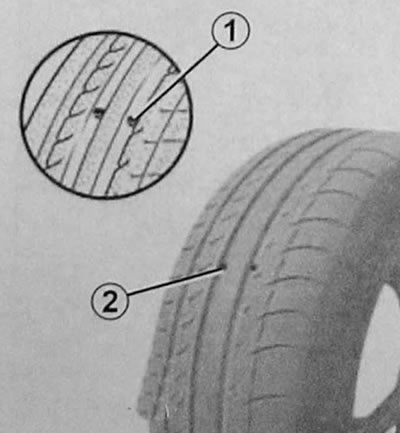
The tires must be in good condition and the tread must have sufficient tread depth. The tires recommended by the technical departments of the manufacturer have special wear indicator protrusions (1) which are molded onto the tread of the wheel.
When the tread pattern wears to the point where the indicator protrusions become visible (2), the tyres must be replaced, as the tread depth has decreased to 1.6 mm, resulting in poor grip on wet roads.
Overloading the vehicle, driving for long periods on highways, especially in hot weather, or constantly driving on poorly-surfaced roads will cause rapid wear of the tires and reduce their safety.
Warning: Driving errors such as crashing into obstacles (for example, on a curbstone), may cause damage to tires and wheel rims, as well as disruption of the correct geometry of the front or rear suspension. In this case, contact the manufacturer's service station for inspection.
Tire pressure
Tire pressure (including in the spare tire) should always strictly comply with the recommended values, it should be checked at least once a month, as well as before each long trip (see the sticker attached to the edge of the driver's door).
Attention:
- Insufficient tire pressure leads to intensive and uneven wear and overheating, which reduces driving safety and can cause:
- deterioration of vehicle stability on the road;
- rupture or destruction of the tread pattern.
- The internal pressure in the tire depends on the vehicle load and the speed of movement. Adjust the air pressure in the tires to the operating conditions (see the label attached to the edge of the driver's door).
Air pressure should be checked when the tires are cold. Do not pay attention if the tire pressure exceeds the recommended values after driving at high speed or in hot weather.
If it is not possible to measure the pressure when the tires are cold, the recommended values should be increased by 0.2-0.3 bar.
Attention:
- Never deflate hot tires to bring the pressure back to normal.
- A poorly screwed valve cap or its absence can cause a loss of tire sealing and a drop in pressure in them.
- Valve caps should always be fully tightened and identical to those originally installed.
Wheel rotation
It is not recommended to rotate the wheels.
Tire replacement
Attention:
For safety reasons, tire replacement should only be performed by a specialist.
Installing different types of tires on a vehicle at the same time will result in:
- your vehicle will no longer comply with current regulations;
- the car's behavior on turns will change;
- the effort on the steering wheel will increase;
- it will be difficult to install anti-skid chains.
Features of tire operation in winter
Anti-skid chains
For safety reasons, the installation of anti-skid chains on the rear wheels is strictly prohibited.
When installing tires larger than the original tires, the installation of snow chains becomes impossible.
Attention:
- Chains can only be installed on tires that are the same size as the tires originally fitted to your vehicle.
- Only special anti-skid chains may be installed on the wheels. Contact the manufacturer's service station.
Tires for driving on ice and snow ("winter" tires)
We recommend that you install these tires on all four wheels, which will provide your car with the best possible grip on the road.
Please note: Sometimes these tires have a forward rotation direction and a maximum speed rating that may be lower than your vehicle's maximum speed.
Studded tires
Studded tyres may only be used for limited periods and in accordance with local laws and traffic regulations.
It is necessary to adhere to the speed limits established by the current regulations.
Note: In all cases, we recommend that you contact a representative of the manufacturer, where you will receive recommendations on choosing the most suitable equipment for your vehicle.