



The check described below can only be carried out on cars without ABS. If your car is equipped with an anti-lock braking system, it is better to contact a service station.
It is desirable that the area be evenly covered with a thin layer of sand.
Car without load (only the driver in the cabin) accelerate in first gear to a speed of approximately 15 km/h. Press the brake pedal sharply and do not release it until the car comes to a complete stop.
Get out of the car and inspect the brake marks left by the car's wheels. If the brake marks of the front wheels are slightly longer than the rear ones, and the length of the marks on the left and right are the same, then the brake system is in good working order. Otherwise, repair the system.
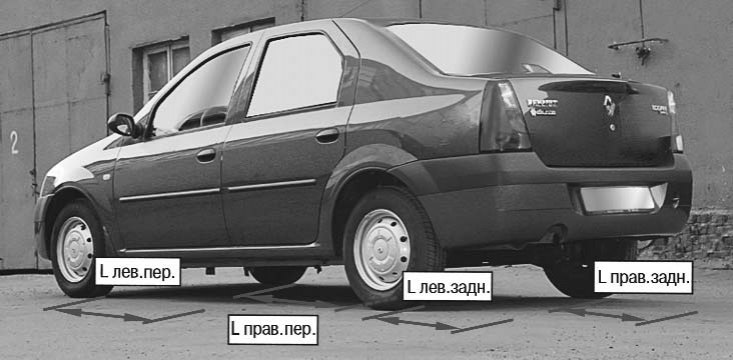
Note: The following relationships must be observed: L left front = L right front, L left rear = L right rear, L front. > L rear.
Attention! If, during a similar check of a car equipped with ABS, the brake marks are visible as clearly as during a check of a car without ABS, then the anti-lock braking system is faulty. In this case, urgently contact a car service for its repair.
Do not overuse this assessment, as it is associated with increased one-sided tire wear.
Note: If the vehicle pulls to one side or makes strange noise when braking, check the condition of the brake pads.