
English Русский
Български
Беларускі
Український
Српски
Hrvatski
Română
Polski
Slovenský
Magyar
Bookmark Contacts Articles Sitemap
Company vehicles Peugeot Company vehicles Opel Company vehicles Skoda Company vehicles Land Rover Company vehicles Mitsubishi Company vehicles Volkswagen Company vehicles Honda
RenaultBook.ru


Duster   Fluence   Kangoo   Laguna   Logan   Megane   Sandero   Scenic   Symbol   Clio   Other
Renault 19 (1988-1996) Espace I and II (1984-1996) Espace III (1996-2002)

Voltage Regulator — Design Description (Renault 19)

  • Main
  • Renault
  • Renault 19 (1988-1996)
  • Electrical equipment
  • Power devices
  • Voltage Regulator — Design Description
0
The faster the generator spins, the higher the voltage rises and with it the electric current produced, like a bicycle dynamo. The current consumers in a car cannot withstand such voltage surges up and down.

Therefore, the voltage regulator installed on the generator limits the voltage and prevents overloading of the battery.

A certain amount of electric current passes through the sliding graphite brushes of the generator; in addition, the graphite brushes move on smooth contact rings. This prevents severe wear of the brushes. On the Paris-Rhone generator, the sliding graphite brushes are located on the inside of the voltage regulator. On the Ducellier and Valeo generator, they are located on a separate brush holder.

If the voltage regulator is faulty or the carbon brushes are worn out, at least on most "F" type engines, you will have easy access to the alternator. However, before removing the suspected faulty voltage regulator, check the contact connection to make sure it is properly connected and not corroded.
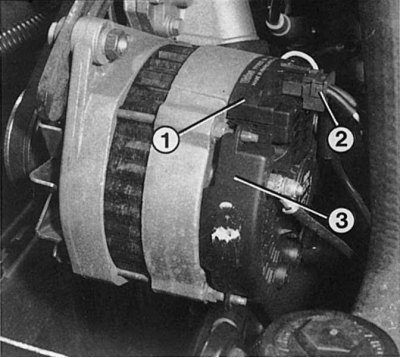
1 - voltage regulator with sliding graphite brushes;

1 - voltage regulator with sliding graphite brushes;
2 - contact connection;
3 — rectifier body.


(The text is available on this website: www.RenaultBook.ru)
This article is available on: russian, bulgarian, belarusian, ukrainian, serbian, croatian, romanian, polish, slovak, hungarian
Article has been reviewed by editor: Trofimova Anastasia
Share with friends:
Previous
19: Power devices
Next

Generator — design description
Starting an engine with a discharged battery
Charging the battery
Removal and installation the battery
Checking the battery discharge level
Checking the voltage regulator
Checking the V-belt tension
Checking the condition of the V-belt
Removal the generator
Broken V-belt
Other articles on other Renault models

➽ Voltage regulator Renault Fluence 1 (2009-2020, petrol)
➽ Generator and voltage regulator carbon brushes — checking and… Renault Scenic 1 (1996-2003)
➽ Brush holder/voltage regulator — replacement Renault Clio 1 (1990-1998)
➽ Fuel supply regulator Renault Duster 1 (2009-2017)
➽ Brake force regulator Renault Kangoo 1 (1997-2007)
Link to this article in different formats
Reviews and comments of visitors
No comments yet


Add two numbers 46 + 47


Renault 19 (1988-1996) 
  • General information
  • Maintenance
  • Power unit
  • Engine repair
  • Exhaust system
  • Cooling system
  • Supply system
  • Single-point injection
  • Multi-point injection
  • Diesel injection system
  • Transmission
  • Clutch
  • Car gearbox
  • Chassis, running gear
  • Car suspension
  • Steering
  • Brake system
  • Wheels and tires
  • Body and interior
  • Exterior (external elements)
  • Interior (internal elements)
  • Heating and ventilation
  • Electrical equipment
  • Equipment and devices
  • Headlights and lighting
  • Ignition system
  • Power devices
  • Electrical circuits
Espace I and II (1984-1996) 
  • General information
  • Introduction to the guide
  • Troubleshooting
  • Power unit
  • Engine repair
  • Cooling system
  • Carburetor fuel system
  • Injection fuel system
  • Diesel fuel system
  • Ignition system
  • Transmission
  • Clutch
  • Car gearbox
  • Drive shafts
  • Chassis, running gear
  • Brake system
  • Steering
  • Front suspension
  • Rear suspension
  • Body and interior
  • Exterior (external elements)
  • Interior (internal elements)
  • Doors, locks and windows
  • Electrical equipment
  • Equipment and devices
  • Electrical circuits
Espace III (1996-2002) 
  • General information
  • Introduction to the manual
  • User manual
  • Power unit
  • Petrol engines F3R
  • Petrol engines Z7X
  • Diesel engines G8T
  • Diesel engines G9T
  • Transmission
  • Clutch
  • Mechanical gearbox
  • Automatic gearbox
  • Drive shafts
  • Chassis, running gear
  • Steering
  • Front suspension
  • Rear suspension
  • Brake system
  • Body and interior
  • Exterior (external elements)
  • Interior (internal elements)
  • Doors, locks and windows
  • Heating and ventilation
  • Electrical equipment
  • Equipment and instruments
  • Power devices
  • Electrical circuits
RenaultBook.ru © 2018–2026 | Mobile version | News and articles | Sitemap: EN BG BY UA RS HR RO PL SK HU | Administration | Site search | Bookmark
Duster 1 (2009-2017) | Fluence 1 (2009-2020, petrol) | Kangoo 1 (1997-2007) | Laguna 2 (2001-2007) | Logan 1 (2004-2012, petrol) | Logan 2 (2012-2020) | Megane 1 (1995-2002) | Megan 2 (2002-2009, petrol) | Sandero 1 (2007-2012, petrol) | Scenic 1 (1996-2003) | Symbol 1 (1999-2008, petrol) | Symbol 2 (2008-2013, petrol) | Renault 19 (1988-1996) | Espace I and II (1984-1996) | Espace III (1996-2002) | Clio 1 (1990-1998) |
We want your visit to be comfortable 😌 and use cookies 🍪 to do so.