
English Русский
Български
Беларускі
Український
Српски
Hrvatski
Română
Polski
Slovenský
Magyar
Bookmark Contacts Articles Sitemap
Company vehicles Peugeot Company vehicles Opel Company vehicles Skoda Company vehicles Land Rover Company vehicles Mitsubishi Company vehicles Volkswagen Company vehicles Honda
RenaultBook.ru


Duster   Fluence   Kangoo   Laguna   Logan   Megane   Sandero   Scenic   Symbol   Clio   Other
Renault 19 (1988-1996) Espace I and II (1984-1996) Espace III (1996-2002)

Generator — design description (Renault 19)

  • Main
  • Renault
  • Renault 19 (1988-1996)
  • Electrical equipment
  • Power devices
  • Generator — design description
0
Contents: Alternator 🠛 Handling the generator 🠛 Power of different types of…🠛
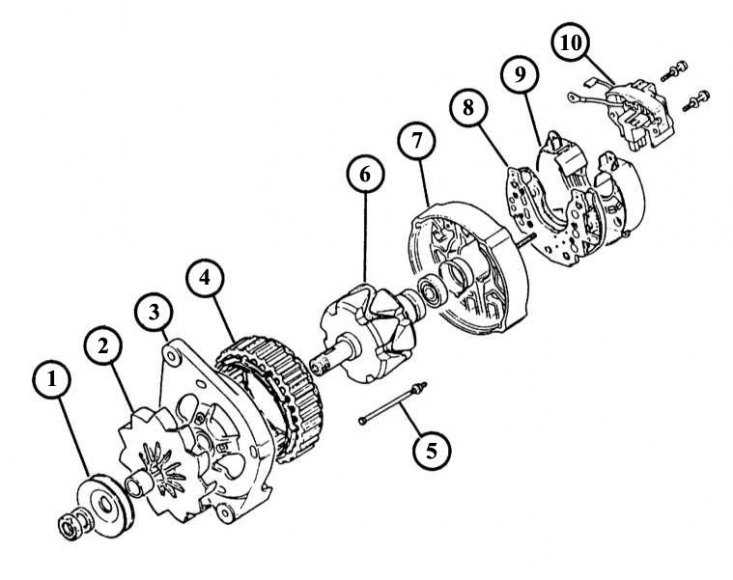
Valeo generator devices disassembled. The device of other generators is similar.

1 - V-belt drive pulley; 2 - fan; 3 - bearing cover on the drive side; 4 - stator winding; 5 -…

1 - V-belt drive pulley; 2 - fan; 3 - bearing cover on the drive side; 4 - stator winding; 5 - connecting bolt; 6 - rotor with slip rings; 7 - cover from the contact ring side; 8 - rectifier with diodes; 9 - plastic cover; 10 - voltage regulator with brush holder.


The three-phase alternator located on the side of the engine rotates continuously with the engine and supplies electricity not only to the ignition system and injection system, but also to the connected consumers of current. The remainder of the electricity produced is diverted to the battery.

Alternator


The Renault 19 uses an alternator, the commonly accepted term being "a machine for producing light" (literal translation from German) is incorrect because it supplies energy to various current consumers and is a small power plant.

The generator is driven by the engine via a V-belt and is virtually maintenance-free, as it does not require lubrication. The carbon brushes in it last 80,000 km or more.


The alternator produces the electric current taken from these brushes, due to the occurrence of magnetic fields, which are formed by the excitation windings. In this case, alternating current is generated. Since the battery must be charged with direct current, semiconductor diodes ensure the conversion of alternating current to direct current. Diodes are very sensitive to high voltages.

Handling the generator


1. When the engine is running, do not remove or connect the wires between the battery and the generator. This may cause a voltage surge and the diode will burn out.

2. The generator must not operate with an incorrectly connected or faulty battery. The battery serves as a generator voltage limiter and to some extent acts as a "buffer" against excess voltage.

3. All wires connected to the generator-battery-ground connection must be secured very tightly. One loose contact can cause significant voltage surges.

4. When quickly charging the battery and when performing electric welding work in the body, both wires should be removed from the battery.

Power of different types of three-phase generators


(This article is taken from the website: Renaultbook.ru)

Depending on the engine type, vehicle modification, special equipment and place of sale, generators from 3 manufacturers can be installed on the Renault 19. The generator power varies, depending on the type, from 60 to 110 A and, accordingly, from 840 to 1540 W. The generator produces two-thirds of this power already at 2000 rpm. The ratio of the generator speed to the oilcloth shaft speed is 1:2, therefore almost 2/3 of the generator power is realized at speeds that are slightly higher than idle speed.
This article is available on: russian, bulgarian, belarusian, ukrainian, serbian, croatian, romanian, polish, slovak, hungarian
Article has been reviewed by editor: Trofimova Anastasia
Share with friends:
Previous
19: Power devices
Next

Starting an engine with a discharged battery
Charging the battery
Removal and installation the battery
Checking the battery discharge level
Checking the electrolyte level in the battery
Voltage Regulator — Design Description
Checking the voltage regulator
Checking the V-belt tension
Checking the condition of the V-belt
Removal the generator
Other articles on other Renault models

➽ Generator — Design Description and Testing Renault Laguna 2 (2001-2007)
➽ Design Features of the Generator Renault Logan 1 (2004-2012, petrol)
➽ Generator — design features Renault Sandero 1 (2007-2012, petrol)
➽ Generator — removal and installation (engine K9K) Renault Duster 1 (2009-2017)
➽ Checking the generator mounts Renault Fluence 1 (2009-2020, petrol)
Link to this article in different formats
Reviews and comments of visitors
No comments yet


Add two numbers 15 + 40


Renault 19 (1988-1996) 
  • General information
  • Maintenance
  • Power unit
  • Engine repair
  • Exhaust system
  • Cooling system
  • Supply system
  • Single-point injection
  • Multi-point injection
  • Diesel injection system
  • Transmission
  • Clutch
  • Car gearbox
  • Chassis, running gear
  • Car suspension
  • Steering
  • Brake system
  • Wheels and tires
  • Body and interior
  • Exterior (external elements)
  • Interior (internal elements)
  • Heating and ventilation
  • Electrical equipment
  • Equipment and devices
  • Headlights and lighting
  • Ignition system
  • Power devices
  • Electrical circuits
Espace I and II (1984-1996) 
  • General information
  • Introduction to the guide
  • Troubleshooting
  • Power unit
  • Engine repair
  • Cooling system
  • Carburetor fuel system
  • Injection fuel system
  • Diesel fuel system
  • Ignition system
  • Transmission
  • Clutch
  • Car gearbox
  • Drive shafts
  • Chassis, running gear
  • Brake system
  • Steering
  • Front suspension
  • Rear suspension
  • Body and interior
  • Exterior (external elements)
  • Interior (internal elements)
  • Doors, locks and windows
  • Electrical equipment
  • Equipment and devices
  • Electrical circuits
Espace III (1996-2002) 
  • General information
  • Introduction to the manual
  • User manual
  • Power unit
  • Petrol engines F3R
  • Petrol engines Z7X
  • Diesel engines G8T
  • Diesel engines G9T
  • Transmission
  • Clutch
  • Mechanical gearbox
  • Automatic gearbox
  • Drive shafts
  • Chassis, running gear
  • Steering
  • Front suspension
  • Rear suspension
  • Brake system
  • Body and interior
  • Exterior (external elements)
  • Interior (internal elements)
  • Doors, locks and windows
  • Heating and ventilation
  • Electrical equipment
  • Equipment and instruments
  • Power devices
  • Electrical circuits
RenaultBook.ru © 2018–2026 | Mobile version | News and articles | Sitemap: EN BG BY UA RS HR RO PL SK HU | Administration | Site search | Bookmark
Duster 1 (2009-2017) | Fluence 1 (2009-2020, petrol) | Kangoo 1 (1997-2007) | Laguna 2 (2001-2007) | Logan 1 (2004-2012, petrol) | Logan 2 (2012-2020) | Megane 1 (1995-2002) | Megan 2 (2002-2009, petrol) | Sandero 1 (2007-2012, petrol) | Scenic 1 (1996-2003) | Symbol 1 (1999-2008, petrol) | Symbol 2 (2008-2013, petrol) | Renault 19 (1988-1996) | Espace I and II (1984-1996) | Espace III (1996-2002) | Clio 1 (1990-1998) |
We want your visit to be comfortable 😌 and use cookies 🍪 to do so.