



Contents: Checking the overrunning clutch 🠛 Checking the operation of the…🠛 Checking the operation of the…🠛
If the alternator is not installed correctly, it can cause noise from the alternator and the accessory drive belt. Also, faulty bearings and overrunning clutch can cause noise in the alternator (if installed). Make sure the alternator is installed correctly and is securely fastened. Make sure there is no play in the bearings and the overrunning clutch.
Note: It is easier to check the correct installation of the generator and the absence of play if you remove the accessory drive belt (see section "Engine").
Checking the overrunning clutch
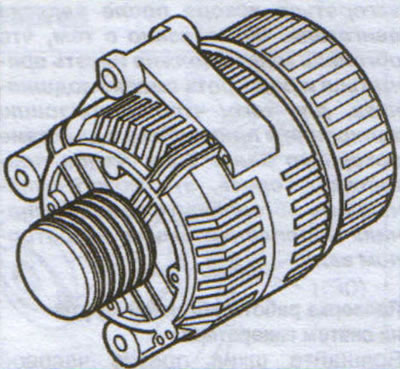
An overrunning clutch installed between the rotor shaft and the pulley allows the generator rotor shaft to rotate freely in one direction. This means that jerks in the belt drive are reduced to a minimum.
A faulty overrunning clutch can cause the following symptoms:
- low battery warning light comes on when engine is running;
- the battery is running low;
- noise from the belt drive can be heard;
- engine vibrates when accelerating;
- the engine runs unevenly at idle;
- noise from the generator can be heard.
Note: If your alternator has a cover over the pulley nut in the center, it has an overrunning clutch.
Checking the operation of the overrunning clutch on a car
Make sure no additional components that consume electrical power are connected. Turn on the ignition. Increase the engine speed to 3000 rpm.
When the overrunning clutch comes into contact with the rotor shaft and comes out of it, only a faint click is heard.
Quickly turn off the ignition. Make sure that the rotation in the generator continues longer than in the engine.
Note: In cold weather, the battery warning light may come on shortly after starting the engine. This is because the overrunning clutch must begin to rotate and warm up the bearing grease in order to lock and engage the rotor shaft. If the light remains on, it may mean that the overrunning clutch has failed to engage the pulley on the rotor shaft.
Checking the operation of the overrunning clutch on a removed generator
Rotate the pulley counterclockwise, then stop it abruptly. The overrunning clutch should engage the rotor shaft when rotating counterclockwise.
Stop the rotation by braking the pulley. When the pulley is braked, the overrunning clutch mechanism should release so that the rotor shaft continues to rotate.