



Contents: Performance characteristics 🠛 Recommended charging current 🠛 Checking the electrolyte level 🠛 Checking the density of the…🠛 Checking the quiescent voltage 🠛 Load testing 🠛 Self-discharge 🠛 Charging batteries 🠛 Before installing the battery 🠛 Fan calibration 🠛
The vehicle covered in this manual has a 12-volt electrical system. The body ground is connected to the negative terminal of the battery. The battery is located in the engine compartment or under the rear seat (models with air conditioning, as well as some diesel modifications).
Performance characteristics
The performance characteristics of a car battery are usually expressed as follows:
- values of current when turning the crankshaft on a cold engine;
- reserve capacity;
- charging capacity.
Recommended charging current
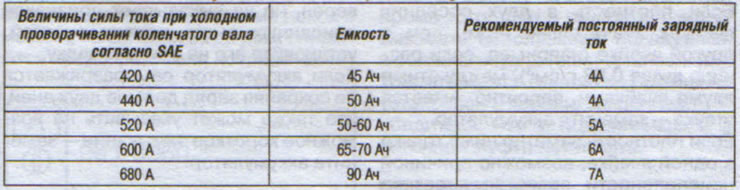
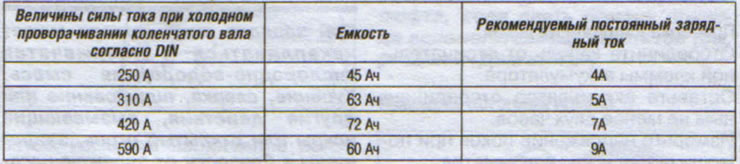
The table below shows the SAE and DIN cold cranking current values, as well as the corresponding capacity and recommended charging current.
Checking the electrolyte level
Note: Check the electrolyte level at each regular service. More frequent checks may be required for vehicles driven in severe conditions or in hot climates. Always check the electrolyte level before and after charging the battery.
Remove the battery plugs.
SAE Cold Cranking Current Values and Corresponding Capacity and Recommended Continuous Charging Current
Cold cranking current values according to DIN standard and corresponding capacity and recommended continuous charging current
Remove the battery plugs.
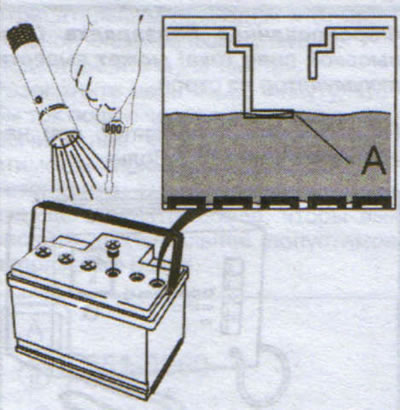
Check the level in all battery cells. Each cell has its own maximum mark (A) (use a flashlight). Fill the battery to the maximum mark A with distilled or non-ionized water.
Caution: Do not use ordinary water, it may damage the battery.
Caution: Do not fill the battery above the maximum mark. This may cause electrolyte leakage.
Install the plugs.
Caution: Do not replace the grey plugs (with exhaust filter) on black (tightly closed plugs).
Tighten the plugs completely.
Warning: The battery contains a hydrogen-oxygen mixture that is highly explosive. Open fire or smoking near the battery may cause an explosion.
The electrolyte is highly toxic. If it comes into contact with your skin, clothing or vehicle paintwork, rinse the area immediately with plenty of water.
If electrolyte gets into the engine compartment, it can cause corrosion of the engine and vehicle wiring.
Checking the density of the electrolyte
The density of the electrolyte is measured using an electrolyte meter or refractometer, at room temperature.
Measure the density in all cells. If the density is higher than 1.225 g/cm³ in each cell and the difference in density between cells is less than 0.03 g/cm³, the battery should be tested under load.
If the density is below 1.225 g/cm³ in each cell and the difference in density between cells is less than 0.03 g/cm³, the battery needs to be charged.
If the density in two adjacent cells is significantly lower than in another cell (for example, if the difference is higher than 0.03 g/cm³), there is probably a leak between these two cells - replace the battery.
If the density is noticeably lower in only one cell, the cause of the malfunction may be a short circuit. Check if the electrolyte is discolored. If so, replace the battery.
Checking the quiescent voltage
Disconnect the cable from the negative battery terminal.
Leave the battery disconnected for at least two hours.
Measure the resting voltage with a digital multimeter. The battery needs to be charged if the resting voltage is below 12.45 V (the charging procedure is described later in this section).
Make sure the battery is charging.
If the charge is normal, check the battery under load.
If the battery does not charge, it may be sulfited. Sulfited means the battery is damaged due to insufficient charging—replace the battery.
Load testing
During this test, the load current should increase to a value at least three times the battery capacity in amperes (A).
For example:a battery with a capacity of 60 Ah must be loaded with a current of 180 A (= 3 x 60).
Read the battery voltage after approximately 15 seconds - the voltage should be 9.6 V. If this voltage is not reached, there may be an open circuit or short circuit in the battery.
Open circuit: Can be identified, for example, by a rapid drop in voltage to 0V when the battery is under load, or if the voltmeter does not read when connected to the battery - replace the battery.
Short circuit: In case of this fault, the cell or cells that are shorted start to boil - replace the battery.
Self-discharge
Once the battery has been tested and does not show any signs of the above faults, set it to self-discharge.
If the battery self-discharges without holding a charge for more than two days, this may also indicate a possible short circuit - replace the battery.
Charging batteries
Caution: When charging a battery, an explosive oxygen-hydrogen mixture may accumulate. Smoking, welding, grinding or other activities that produce sparks or open flames are prohibited near a charging battery. Never charge batteries in a vehicle. Charge in a well-ventilated area.
Attention: Forced charging (at high current) may damage the battery.
Do not charge the battery at voltages above 14.5 volts.
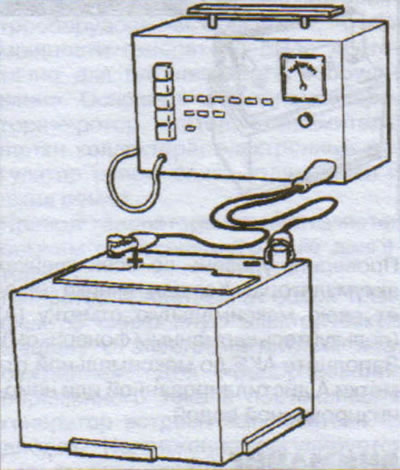
Before charging the battery, check the electrolyte level as described above. Do not charge the battery if the electrolyte level is low.
Remove the battery from the vehicle. Always disconnect the negative terminal first to avoid sparking.
Connect the battery charger to the terminals.
Charge the battery for approximately 10 hours at the recommended constant current.
After charging, put the battery back in place.
Connect the positive terminal first, then the negative one.
Disconnecting the battery
Caution: Since the Supplemental Restraint System (SRS) continues to operate for some time after the power is turned off, wait three minutes before working inside the vehicle.
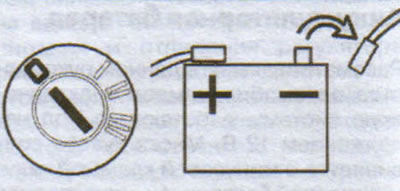
If the catalytic converter malfunction lamp is illuminated in the instrument cluster, the engine management system fault codes should first be read and, if necessary, corrected before the vehicle is disconnected from electrical power.
The ignition must be off for at least five minutes before disconnecting the battery to allow the control modules time to save information.
Before installing the battery
Caution: Turn on the power consumers. No one should be in the vehicle when connecting the battery. This is a safety precaution in case the airbag module is activated when the power supply is connected.
Fan calibration
If the car is equipped with an air conditioning system, the fan speed must be calibrated after disconnecting the battery. Turn on the ignition.
Turn the fan knob to the maximum blowing position. Turn the fan knob to the minimum blowing position.