



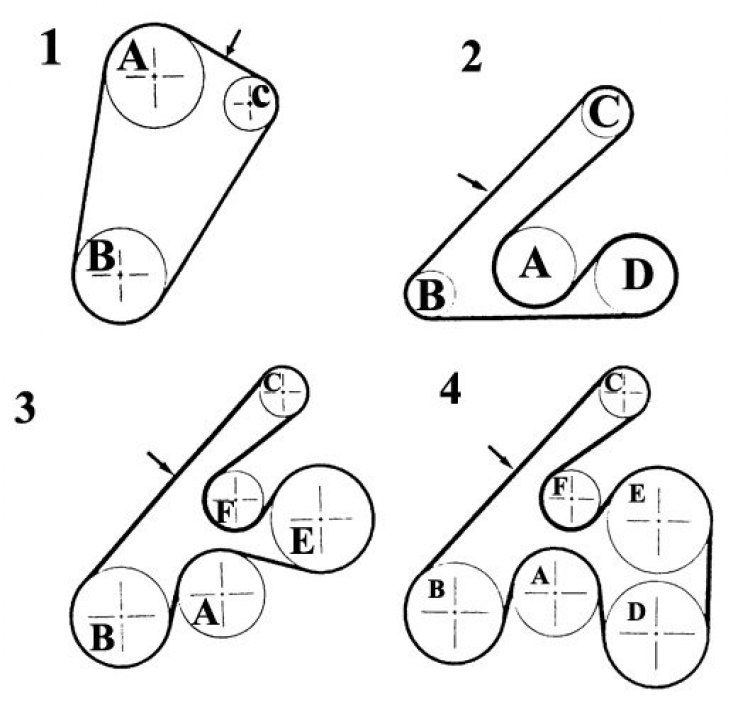
A - coolant pump; B - crankshaft; C - generator; D - servo pump; E - air conditioning compressor; F - tension roller.
V-belts must withstand high loads with modern powerful generators. This is the reason for the higher tension of the V-belt.
- Too little belt tension not only results in insufficient transmission of rotation to the generator, but also causes the belt to slip and premature wear on the sides.
- If the belt tension is so weak that it slips when the crankshaft pulley accelerates sharply, then uneven wear marks can be seen on the side surfaces of the belt.
- Too much belt tension damages the alternator bearings. In addition, the V-belt stretches over time.
- If, in addition to the generator and coolant pump, other units are also driven by the engine on an F-type engine, such as the hydraulic pump of the power steering gear and/or the air conditioning compressor, this is done by means of a so-called profile belt, which is held at the required tension by a tension roller.
- To check the condition of the belt, turn the engine a few revolutions.
- Only in this way you will be able to see the entire surface of the V-belt. Often the belt has only one, but deep crack, which during inspection may be located right on the pulley.
- A torn or worn belt must be replaced.
Replacing a V-belt or ribbed V-belt
The V-belt should never be moved along the pulley with a screwdriver, otherwise damage to the V-belt due to a damaged area on the pulley will already be predetermined.
[Article reprinted from the website: renaultbook.ru]
1. Type "C" engine: Loosen the mounting bracket tension bolt.
2. Lower the pivot support bolts.
3. Press the generator towards the engine.
4. Remove the V-belt.
5. Engine type "F" (conventional design): release the tensioner completely. To do this, loosen the bolt in the adjustment groove of the mounting bracket in advance.
6. Release the fastening in the swivel support.
7. Tilt the generator and remove the V-belt.
8. Engine type "F" (with power steering or air conditioning): Loosen the center nut and pull the tension roller away from the belt.
9. Remove the belt from the pulleys. When doing this, you should remember or mark the belt path for reassembly.
10. Once the new V-belt is installed, start the engine and let it run for 10 minutes, then check the belt tension again.
Replacing the tension roller
If there is a servo drive or air conditioning
A loud bearing noise does not always indicate a problem with the power steering or air conditioning - more often, the source of the noise is a worn out tensioner roller bearing.
1. Remove the V-belt as described above.
2. Unscrew the central bolt and remove the tension roller from the holder.