
English Русский
Български
Беларускі
Український
Српски
Hrvatski
Română
Polski
Slovenský
Magyar
Bookmark Contacts Articles Sitemap
Company vehicles Peugeot Company vehicles Opel Company vehicles Skoda Company vehicles Land Rover Company vehicles Mitsubishi Company vehicles Volkswagen Company vehicles Honda
RenaultBook.ru


Duster   Fluence   Kangoo   Laguna   Logan   Megane   Sandero   Scenic   Symbol   Clio   Other
Symbol 1 (1999-2008, petrol) Symbol 2 (2008-2013, petrol)

Rear window heating (Renault Symbol 2)

  • Main
  • Symbol
  • Symbol 2 (2008-2013, petrol)
  • Electrical equipment
  • Equipment and devices
  • Rear window heating
0
Contents: Determining the location of a break…🠛 Repair of heating filaments 🠛
The rear window heating is switched on by a switch located on the instrument panel. The current consumed by the heater is quite high, so after defrosting the rear window, turn off the heater.

The conductive thread mesh of the glass heater, applied by screen printing on the inside of the glass, can be damaged if handled carelessly, which can result in the corresponding part of the electrical circuit failing.

The exact location of the break can be determined using a voltmeter.

Repair of such faults is possible using varnish for repair of rear window heater, catalog number MPR 77 01 421 135 (packaging 2 g).

Determining the location of a break using a voltmeter


Search in zone A-B
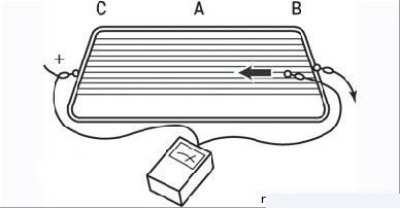


Figure 8.52. Determining a break in the rear window heating element in zone A–B

Figure 8.52. Determining a break in the rear window heating element in zone A–B


Turn on the ignition. Turn on the rear window heating.

Connect the voltmeter lead from the positive terminal to the positive terminal of the rear window defroster.

Connect the wire from the negative terminal of the voltmeter to the wire on the negative side of the rear window defroster (line B) – the voltage should be approximately equal to the battery voltage.


Move the negative wire to line A (by the arrow) – the voltage should gradually drop.

A sharp drop in voltage means that the thread is damaged in this place (do this operation for each thread). Mark the damaged area with a marker.

Search in zone C-A
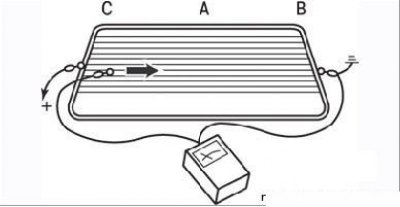


Figure 8.53. Determining a break in the rear window heating element in zone C–A

Figure 8.53. Determining a break in the rear window heating element in zone C–A


Original of this article on the website: renaultbook

Connect the wire from the negative terminal of the voltmeter to the negative terminal of the rear window defroster.

Connect the wire coming from the positive terminal of the voltmeter to one of the threads on the positive side of the rear window heater (line C) – the voltage should be equal to the battery voltage.

Move the positive wire to line A (by the arrow) – the voltage should gradually drop.

A sharp drop in voltage means that the thread is damaged in this place (do this operation for each thread). Mark the damaged area with a marker.

Repair of heating filaments


Using alcohol or glass cleaner, clean the repair area to remove dust and grease, then wipe it with a clean, dry cloth.

To obtain a straight line, cover the area to be repaired on both sides with adhesive tape, leaving only the damaged thread itself exposed.


Before applying the varnish, shake the bottle to remove any silvery sediment from the bottom.

Apply a sufficient layer of varnish with a thin brush. If applying several (no more than three) layers, observe the drying time of each layer.

If a drip does form, it can be removed with a knife or razor blade after a few hours, when the product has completely hardened.
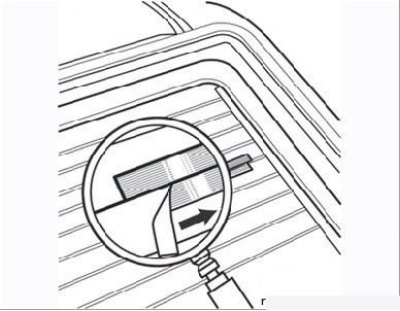
Figure 8.54. Removing the adhesive tape after repairing the rear window heating element

Figure 8.54. Removing the adhesive tape after repairing the rear window heating element


The adhesive tape used as a guide can be removed only approximately one hour after application of the product. The tape is torn off by applying force perpendicular to the thread in the direction of the arrow (Figure 8.54). At an air temperature of 20°C, the varnish dries completely after three hours. At a lower temperature, the drying time increases slightly.
This article is available on: russian, bulgarian, belarusian, ukrainian, serbian, croatian, romanian, polish, slovak, hungarian
Article has been reviewed by editor: Kupriyanov Sergey
Share with friends:
Previous
Symbol 2: Equipment and devices
Next

Windscreen washer — removal and installation
Rear windshield wiper — removal and installation
Front windshield wiper — removal and installation
Emergency stop switch — check
Central lock switch — check
Instrument cluster and its connectors
Operation of the central display
Outside air temperature sensor
Oil pressure and level sensor
Fuel level sensor
Other articles on other Renault models

➽ Rear window heating Renault Duster 1 (2009-2017)
➽ Rear window heating, audio system speakers Renault Fluence 1 (2009-2020, petrol)
➽ Rear window heating Renault Laguna 2 (2001-2007)
➽ Scheme 8. Electrical heating of the rear window Renault Logan 1 (2004-2012, petrol)
➽ Scheme 9. Rear window heating, anti-glare rearview mirror Renault Espace I and II (1984-1996)
Link to this article in different formats
Reviews and comments of visitors
No comments yet


Add two numbers 24 + 14


Symbol 2 (2008-2013, petrol) 
  • General information
  • User manual
  • Maintenance
  • Power unit
  • Engine repair
  • Cooling system
  • Fuel system
  • Exhaust system
  • Ignition system
  • Transmission
  • Clutch
  • Mechanical gearbox
  • Automatic gearbox
  • Drive shafts
  • Chassis, running gear
  • Front suspension
  • Rear suspension
  • Steering
  • Brake system
  • Body and interior
  • Exterior (external elements)
  • Interior (internal elements)
  • Doors, locks and windows
  • Heating and ventilation
  • Electrical equipment
  • Equipment and devices
  • Headlights and lighting
  • Power devices
  • Electrical circuits
Symbol 1 (1999-2008, petrol) 
  • General information
  • User manual
  • Car care
  • Maintenance
  • Power unit
  • Engine repair
  • Cooling and lubrication system
  • Supply system
  • Exhaust system
  • Ignition system
  • Transmission
  • Clutch
  • Mechanical gearbox
  • Automatic gearbox
  • Drive shafts
  • Chassis, running gear
  • Car suspension
  • Steering
  • Brake system
  • Body and interior
  • Exterior (external elements)
  • Interior (internal elements)
  • Doors, locks and windows
  • Restoration and repair
  • Electrical equipment
  • Equipment and devices
  • Headlights and lighting
  • Power devices
  • Heating and ventilation
  • Electrical circuits
RenaultBook.ru © 2018–2026 | Mobile version | News and articles | Sitemap: EN BG BY UA RS HR RO PL SK HU | Administration | Site search | Bookmark
Duster 1 (2009-2017) | Fluence 1 (2009-2020, petrol) | Kangoo 1 (1997-2007) | Laguna 2 (2001-2007) | Logan 1 (2004-2012, petrol) | Logan 2 (2012-2020) | Megane 1 (1995-2002) | Megan 2 (2002-2009, petrol) | Sandero 1 (2007-2012, petrol) | Scenic 1 (1996-2003) | Symbol 1 (1999-2008, petrol) | Symbol 2 (2008-2013, petrol) | Renault 19 (1988-1996) | Espace I and II (1984-1996) | Espace III (1996-2002) | Clio 1 (1990-1998) |
We want your visit to be comfortable 😌 and use cookies 🍪 to do so.