
English Русский
Български
Беларускі
Український
Српски
Hrvatski
Română
Polski
Slovenský
Magyar
Bookmark Contacts Articles Sitemap
Company vehicles Peugeot Company vehicles Opel Company vehicles Skoda Company vehicles Land Rover Company vehicles Mitsubishi Company vehicles Volkswagen Company vehicles Honda
RenaultBook.ru


Duster   Fluence   Kangoo   Laguna   Logan   Megane   Sandero   Scenic   Symbol   Clio   Other
Symbol 1 (1999-2008, petrol) Symbol 2 (2008-2013, petrol)

Operation of the engine cooling system (Renault Symbol 1)

  • Main
  • Symbol
  • Symbol 1 (1999-2008, petrol)
  • Power unit
  • Cooling and lubrication system
  • Operation of the engine cooling system
0
Cold coolant flows through the lower radiator hose to the water pump, which directs it to the water jacket of the cylinder block, the channels in the cylinder head and the heater radiator. After the block, combustion chambers and valve seats have cooled, the heated liquid goes to the lower thermostat valve, which is closed until the liquid is warmed up, then to the heater radiator and back to the water pump. When the engine is cold, the coolant does not get into the main radiator, which helps the engine warm up to operating temperature faster.

When the coolant reaches 89°C, a valve opens in the thermostat and the liquid enters the radiator, installed under the oncoming air flow in front of the car. The cooled liquid repeats the above cycle. If necessary, (in hot weather, when driving at low speed) additionally, an electric fan is switched on, which provides enhanced cooling of the liquid.

The cooling system uses a fluid based on ethylene glycol - it is most suitable for systems with components made of different metals. The fluid should always be replaced at the prescribed mileage interval. This is necessary not only to maintain its anti-freeze properties, but also because over time, anti-corrosion additives lose their properties and metal oxidation products form in the cooling system, polluting it and impairing engine cooling.
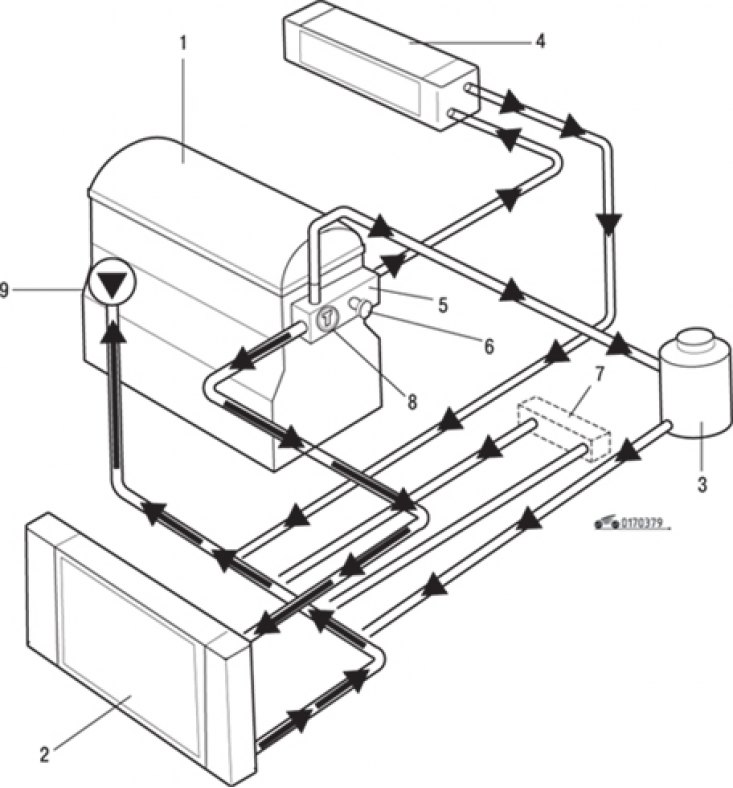
Fig. 3.79. Engine cooling system diagram: 1 – engine; 2 – radiator; 3 – expansion tank; 4 – heater…

Fig. 3.79. Engine cooling system diagram: 1 – engine; 2 – radiator; 3 – expansion tank; 4 – heater radiator; 5 – thermostat housing; 6 – air bleed nipple; 7 – water-oil cooler (for cars with automatic transmission); 8 – thermostat; 9 – water pump


The diagram of the engine cooling system is shown in Fig. 3.79.
This article is available on: russian, bulgarian, belarusian, ukrainian, serbian, croatian, romanian, polish, slovak, hungarian
Article has been reviewed by editor: Podkrepilov Maxim
Share with friends:
Previous
Symbol 1: Cooling and lubrication system
Next

General information about the cooling system
Replacing the coolant
Removal and installation the water pump
Removal and installation an electric fan
Removal and installation the radiator
Checking, removing and installing the coolant temperature sensor
Other articles on other Renault models

➽ Engine cooling system Renault Duster 1 (2009-2017)
➽ Removal the electric fan of the engine cooling system Renault Fluence 1 (2009-2020, petrol)
➽ Removal and installation the electric fan of the engine cooling… Renault Laguna 2 (2001-2007)
➽ Removal and installation of the electric motor of the radiator… Renault Logan 1 (2004-2012, petrol)
➽ Engine cooling system K4M Renault Sandero 1 (2007-2012, petrol)
Link to this article in different formats
Reviews and comments of visitors
No comments yet


Add two numbers 24 + 19


Symbol 2 (2008-2013, petrol) 
  • General information
  • User manual
  • Maintenance
  • Power unit
  • Engine repair
  • Cooling system
  • Fuel system
  • Exhaust system
  • Ignition system
  • Transmission
  • Clutch
  • Mechanical gearbox
  • Automatic gearbox
  • Drive shafts
  • Chassis, running gear
  • Front suspension
  • Rear suspension
  • Steering
  • Brake system
  • Body and interior
  • Exterior (external elements)
  • Interior (internal elements)
  • Doors, locks and windows
  • Heating and ventilation
  • Electrical equipment
  • Equipment and devices
  • Headlights and lighting
  • Power devices
  • Electrical circuits
Symbol 1 (1999-2008, petrol) 
  • General information
  • User manual
  • Car care
  • Maintenance
  • Power unit
  • Engine repair
  • Cooling and lubrication system
  • Supply system
  • Exhaust system
  • Ignition system
  • Transmission
  • Clutch
  • Mechanical gearbox
  • Automatic gearbox
  • Drive shafts
  • Chassis, running gear
  • Car suspension
  • Steering
  • Brake system
  • Body and interior
  • Exterior (external elements)
  • Interior (internal elements)
  • Doors, locks and windows
  • Restoration and repair
  • Electrical equipment
  • Equipment and devices
  • Headlights and lighting
  • Power devices
  • Heating and ventilation
  • Electrical circuits
RenaultBook.ru © 2018–2026 | Mobile version | News and articles | Sitemap: EN BG BY UA RS HR RO PL SK HU | Administration | Site search | Bookmark
Duster 1 (2009-2017) | Fluence 1 (2009-2020, petrol) | Kangoo 1 (1997-2007) | Laguna 2 (2001-2007) | Logan 1 (2004-2012, petrol) | Logan 2 (2012-2020) | Megane 1 (1995-2002) | Megan 2 (2002-2009, petrol) | Sandero 1 (2007-2012, petrol) | Scenic 1 (1996-2003) | Symbol 1 (1999-2008, petrol) | Symbol 2 (2008-2013, petrol) | Renault 19 (1988-1996) | Espace I and II (1984-1996) | Espace III (1996-2002) | Clio 1 (1990-1998) |
We want your visit to be comfortable 😌 and use cookies 🍪 to do so.