



- let the engine cool down;
- set the heater switch to the maximum heat position;
- open the expansion tank cap;
- place a 6-7L container under the lower radiator hose;
- remove the engine protective cover;
- loosen the clamp on the lower radiator hose, remove it from the radiator pipe and drain the coolant;
Caution! Avoid contact with skin, if liquid does come into contact with skin, wash off the liquid with plenty of water.
- to speed up the draining of liquid, unscrew the air bleed nipple in the area of the thermostat housing;
- after draining the liquid from the radiator hose, unscrew the drain plug on the cylinder block and drain the remaining liquid into a container;
- if the drained liquid has been in the system for less than two years, it can be reused after removing the sediment;
- attach a hose to the radiator and screw the drain plug into the cylinder block.
In case of contamination, cloudiness or loss of density (concentrations) coolant, as well as its untimely replacement, reduces the efficiency of the cooling system due to rust and other unwanted deposits in the channels. The system's performance can be restored by flushing the radiator and the engine's water jacket. These operations must be performed separately.
Radiator flushing
Work order:
- disconnect the upper and lower hoses from the radiator;
- insert a suitable hose connected to the water supply into the upper radiator hose and flush it until clean water flows out of the lower hose. If necessary, use a cleaning additive, which can be purchased at an auto store. You can also flush the radiator in the opposite direction, for which you will have to insert a hose with water into the lower hose;
- connect the hoses to the radiator.
Engine flush
Work order:
- screw the drain plug into the cylinder block;
- disconnect the lower hose from the radiator;
- remove the thermostat from the housing (see below) and temporarily install the housing pipe in its place;
- insert a hose connected to the water supply into the thermostat pipe and flush the engine water jacket until clean water flows from the lower hose;
- install the thermostat, connect the lower hose to the radiator.
Filling the system with coolant
To fill the system with liquid, do the following:
- make sure all pipes and hoses are securely fastened with clamps, the drain plug on the cylinder block is screwed in, the thermostat is installed in the housing;
- unscrew and remove the expansion tank cap;
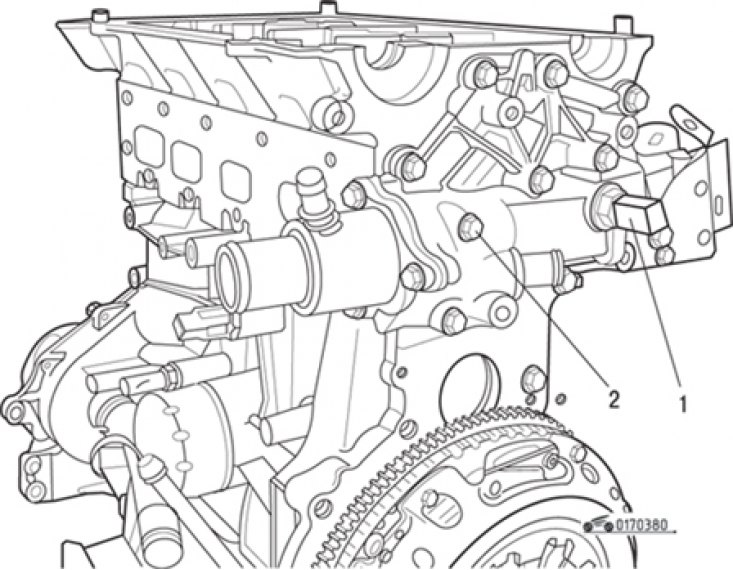
Fig. 3.80. Location of the coolant temperature sensor (1) and the air bleed nipple (2) on the thermostat housing
- unscrew the air bleed nipple located on the thermostat housing (Fig. 3.80);
- slowly pour liquid into the expansion tank up to the "MAX" mark on the tank wall;
- close the air bleed nipple after the liquid starts to flow out in a continuous stream;
- start the engine and warm it up for a few minutes at a speed of 1000–1500 min⁻¹, add liquid to the expansion tank, tighten the cap;
- set the engine crankshaft speed to 2500 min⁻¹ and leave it running until the electric fan turns on;
- stop the engine and after 30 minutes add fluid if necessary to the "MAX" level;
- install the engine protective cover.
View the original source on this resource www.RenaultBook.ru