
English Русский
Български
Беларускі
Український
Српски
Hrvatski
Română
Polski
Slovenský
Magyar
Bookmark Contacts Articles Sitemap
Company vehicles Peugeot Company vehicles Opel Company vehicles Skoda Company vehicles Land Rover Company vehicles Mitsubishi Company vehicles Volkswagen Company vehicles Honda
RenaultBook.ru


Duster   Fluence   Kangoo   Laguna   Logan   Megane   Sandero   Scenic   Symbol   Clio   Other
Symbol 1 (1999-2008, petrol) Symbol 2 (2008-2013, petrol)

Removal and installation the water pump (Renault Symbol 1)

  • Main
  • Symbol
  • Symbol 1 (1999-2008, petrol)
  • Power unit
  • Cooling and lubrication system
  • Removal and installation the water pump
0
The water pump cannot be repaired, so if there is increased noise or fluid leaks, it must be replaced.

Removal procedure:
  • disconnect the negative battery cable;
  • drain the cooling system by removing the lower hose from the radiator;
  • remove the timing belt and tension roller (see subsection "Cylinder head");
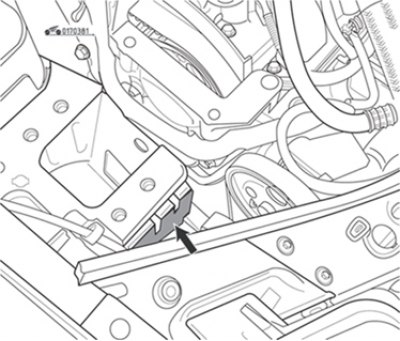
Fig. 3.81. Acoustic load

Fig. 3.81. Acoustic load

  • remove the acoustic weight (Fig. 3.81);
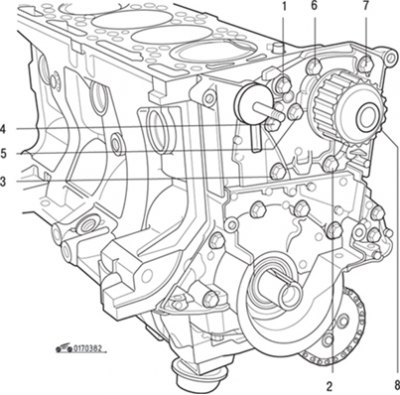
Fig. 3.82. Water pump mounting bolts: 1–8 – bolt tightening sequence

Fig. 3.82. Water pump mounting bolts: 1–8 – bolt tightening sequence

  • loosen and unscrew the water pump mounting bolts (Fig. 3.82), remembering their installation, since they are of different lengths;
  • remove the water pump assembly from the cylinder block;
  • clean the mating surfaces of the pump and cylinder block. It is strictly forbidden to use tools with a sharp edge for this. Use Decapjoint, which dissolves gasket residues.

Apply the specified product to the surface to be cleaned, wait for about 10 minutes, then remove the product with a wooden spatula. It is recommended to perform this operation wearing protective gloves. Do not allow the cleaning product to come into contact with paintwork.


(View the original on the specified resource: www.renaultbook.ru)

Installation procedure:
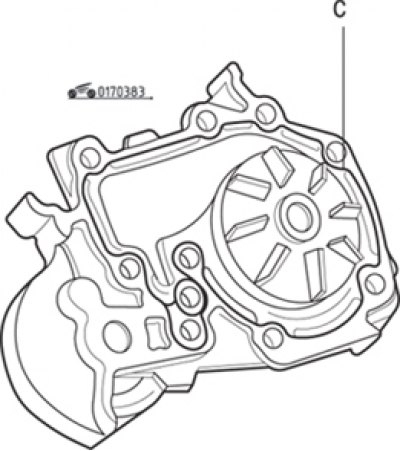
Fig. 3.83. Applying sealant to the mating surface of the water pump: c=0.6–1.0 mm

Fig. 3.83. Applying sealant to the mating surface of the water pump: c=0.6–1.0 mm

  • apply a 0.6–1.0 mm wide bead of Loctite 518 sealant (Fig. 3.83) to the mating surface of the pump being installed;
  • install the pump on the cylinder block, put the bolts in their places and tighten them preliminarily to a torque of 8 N·m in the sequence shown in Fig. 3.83, then finally tighten the M6 bolts to a torque of 11 N·m, and the M8 bolts to a torque of 22 N·m;

Note: Apply 1-2 drops of Loctite Frenetanch to bolts 1 and 4 (see fig. 3.83) water pump mounts.

  • perform the remaining operations in the reverse order of removal;
  • check for coolant leaks.
This article is available on: russian, bulgarian, belarusian, ukrainian, serbian, croatian, romanian, polish, slovak, hungarian
Article has been reviewed by editor: Podkrepilov Maxim
Share with friends:
Previous
Symbol 1: Cooling and lubrication system
Next

Replacing the coolant
Operation of the engine cooling system
General information about the cooling system
Removal and installation an electric fan
Removal and installation the radiator
Checking, removing and installing the coolant temperature sensor
Removal, checking and installation the thermostat
General information about the engine lubrication system
Other articles on other Renault models

➽ Water pump (K9K engine) Renault Duster 1 (2009-2017)
➽ Removal the water pump inlet pipe Renault Fluence 1 (2009-2020, petrol)
➽ Removal, cleaning and installation of the water pump (engines… Renault Laguna 2 (2001-2007)
➽ Replacing the water pump Renault Logan 1 (2004-2012, petrol)
➽ Removal and installation the water pump Renault Megane 1 (1995-2002)
Link to this article in different formats
Reviews and comments of visitors
No comments yet


Add two numbers 43 + 45


Symbol 2 (2008-2013, petrol) 
  • General information
  • User manual
  • Maintenance
  • Power unit
  • Engine repair
  • Cooling system
  • Fuel system
  • Exhaust system
  • Ignition system
  • Transmission
  • Clutch
  • Mechanical gearbox
  • Automatic gearbox
  • Drive shafts
  • Chassis, running gear
  • Front suspension
  • Rear suspension
  • Steering
  • Brake system
  • Body and interior
  • Exterior (external elements)
  • Interior (internal elements)
  • Doors, locks and windows
  • Heating and ventilation
  • Electrical equipment
  • Equipment and devices
  • Headlights and lighting
  • Power devices
  • Electrical circuits
Symbol 1 (1999-2008, petrol) 
  • General information
  • User manual
  • Car care
  • Maintenance
  • Power unit
  • Engine repair
  • Cooling and lubrication system
  • Supply system
  • Exhaust system
  • Ignition system
  • Transmission
  • Clutch
  • Mechanical gearbox
  • Automatic gearbox
  • Drive shafts
  • Chassis, running gear
  • Car suspension
  • Steering
  • Brake system
  • Body and interior
  • Exterior (external elements)
  • Interior (internal elements)
  • Doors, locks and windows
  • Restoration and repair
  • Electrical equipment
  • Equipment and devices
  • Headlights and lighting
  • Power devices
  • Heating and ventilation
  • Electrical circuits
RenaultBook.ru © 2018–2026 | Mobile version | News and articles | Sitemap: EN BG BY UA RS HR RO PL SK HU | Administration | Site search | Bookmark
Duster 1 (2009-2017) | Fluence 1 (2009-2020, petrol) | Kangoo 1 (1997-2007) | Laguna 2 (2001-2007) | Logan 1 (2004-2012, petrol) | Logan 2 (2012-2020) | Megane 1 (1995-2002) | Megan 2 (2002-2009, petrol) | Sandero 1 (2007-2012, petrol) | Scenic 1 (1996-2003) | Symbol 1 (1999-2008, petrol) | Symbol 2 (2008-2013, petrol) | Renault 19 (1988-1996) | Espace I and II (1984-1996) | Espace III (1996-2002) | Clio 1 (1990-1998) |
We want your visit to be comfortable 😌 and use cookies 🍪 to do so.