


Contents: Drain 🠛 Flushing the cooling system 🠛 Radiator flushing 🠛 Engine flush 🠛 Filling the cooling system 🠛 Antifreeze 🠛
Warning! If antifreeze comes into contact with your skin or the painted surfaces of your vehicle, immediately wash away spilled drops with plenty of water. Never leave antifreeze in an open container or spilled on the garage floor - the deadly poisonous liquid can attract children and pets with a pleasant smell.
Drain
1. With the engine completely cooled, place a rag over the expansion tank cap and slowly turn the cap counterclockwise to relieve pressure in the cooling system (a hissing sound is usually heard). Then unscrew the cap completely and remove it.
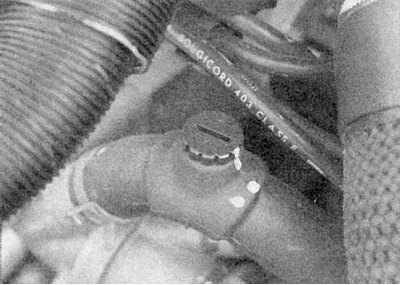
2a. Open the bleed nipples in the cooling system. On all engines except the F7R, these are mounted on the heater hose at the left end of the cylinder head (e7J engine) on the heater return hose on the upper right side of the radiator (refer to the illustrations).
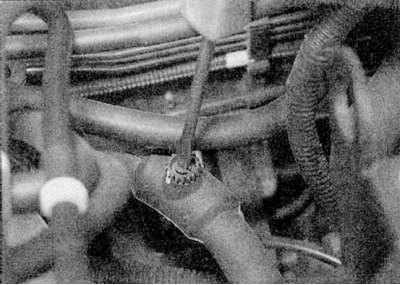
2b. The F3R engine has an additional bleed nipple on the thermostat housing. The F7R engine only has a radiator bleed nipple.
3. Remove the engine sound shield. Place a suitable container below the lower radiator hose connection. Loosen the hose clamp, remove the hose and allow the coolant to drain into the container.
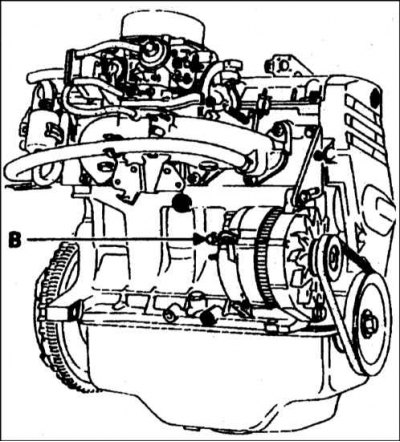
4. To completely drain the cooling system on 1.4 and 2.0L engines, remove the drain plug (B) on the engine. It is located on the rear of the cylinder block, behind the alternator on E 7J engines and above the intermediate shaft housing on F3R 750, F3R 751 and F7R engines (refer to the illustrations).
5. If the coolant is not being drained for replacement and is clean and has been used for less than two years, it can be reused, although this is not recommended.
6. Finally, install the lower radiator hose and drain plug on the cylinder block.
Flushing the cooling system
1. If coolant changes have been neglected or the antifreeze mixture has become diluted, the cooling system may gradually lose efficiency as the radiator passages become restricted by rust and other deposits. Cooling system efficiency can be restored by flushing the system.
2. The radiator should be flushed independently of the engine to avoid unnecessary contamination.
Radiator flushing
1. Disconnect the upper and lower hoses from the radiator as described in Chapter Cooling and heating systems.
2. Insert a garden hose into the inlet of the upper radiator hose. Direct a stream of clean water through the radiator and continue flushing until clean water emerges from the outlet of the lower radiator hose.
3. If after a sufficiently long time the water flowing out is still not clear, the radiator can be flushed with a special cleaning agent for the cooling system. It is important to carefully follow the instructions of the manufacturer of the agent. If the contamination is particularly severe, insert a hose into the outlet of the lower radiator tank and run the flushing stream in the opposite direction.
Engine flush
1. Remove the thermostat as described in Chapter Cooling and heating systems, then temporarily install the upper hose to the engine connection.
2. Disconnect the upper and lower radiator hoses, insert a garden hose into the upper radiator hose and run clean water through the engine. Continue flushing until clean water comes out of the lower radiator hose.
3. After flushing, install the thermostat and connect the hoses to the radiator as described in Chapter Cooling and heating systems.
Filling the cooling system
1. Before starting work, check the condition of all hoses and clamps. Note that the antifreeze mixture should be used all year round to prevent corrosion of engine components.
2. Remove the drain cap of the expansion tank
3. Open the cooling system bleed nipples.
(Text provided by an online resource: www.renaultbook.ru)
4. Place a rag around the expansion tank.
5. Slowly fill the system until the coolant level reaches the top of the expansion tank filler neck.
6. Close the bleeder screws when the coolant appears without air bubbles.
7. Start the engine and let it run at fast idle speed (do not exceed 2500 rpm) approximately 4 minutes.
8. Install and tighten the expansion tank filler cap.
9. Let the engine run for approximately 20 minutes.
10. Turn off the engine and check the coolant level, which should be up to the "MAX" mark on the side of the tank. Make sure that the filler cap of the expansion tank is tightly tightened.
11. Wait until the engine cools down, then recheck the coolant level. If necessary, top up the coolant level. Install the engine crankcase protective shield.
Antifreeze
1. It is essential to replace the antifreeze at the intervals specified in Chapter Maintenance. This is necessary not only to preserve the properties of the antifreeze, but also to prevent corrosion.
2. Use ethylene glycol based antifreeze. The amount of antifreeze and the temperature limits are specified in the Specifications.
3. Before adding antifreeze, the liquid from the cooling system must be completely drained, the system must preferably be flushed, and the condition and reliability of all hoses must be checked.
4. After filling with antifreeze, stick a label on the expansion tank indicating the type and concentration of antifreeze used, as well as its filling. For all subsequent refills, you must use antifreeze of the same type with the concentration indicated on the label.
5. Do not use antifreeze in the system as it will damage the paintwork of the vehicle.