



1.7. Instrument panel and controls
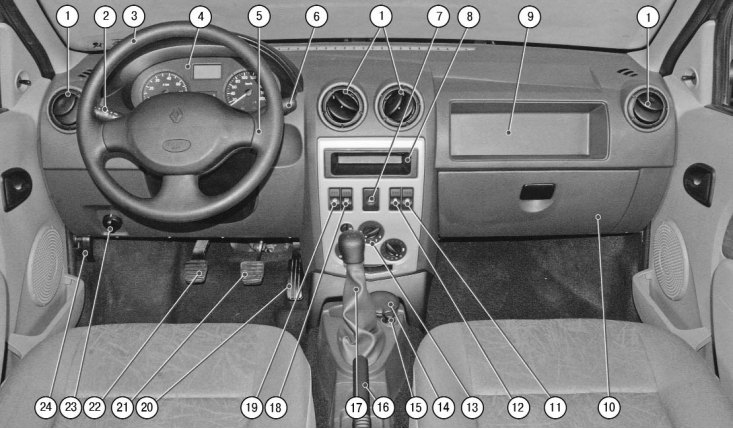
The following controls and instrumentation are located on the instrument panel: (see figure 1.7).
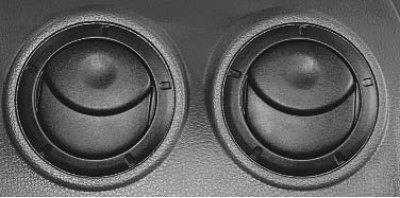
1 – nozzles of the ventilation and heating system of the passenger compartment. Designed to direct the air flow from the heater, air conditioner or ventilation system.
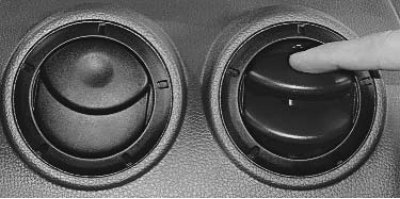
The air flow is regulated by changing the position of the deflectors of the ventilation and heating system nozzles...
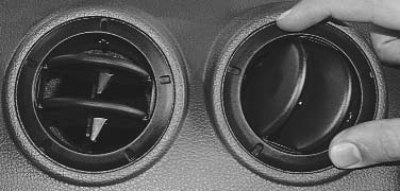
...and the direction of the air flow is determined by turning the deflectors in the appropriate direction.
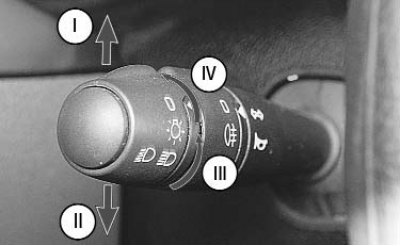
2 – lever of the switch of external lighting and direction indicators with the button of turning on the sound signal. The lever of the switch can occupy the following positions:
- I - right turn signals are on (fixed position);
- II - left turn signals are on (fixed position);
- III - side lights on;
- IV - low/high beam on;
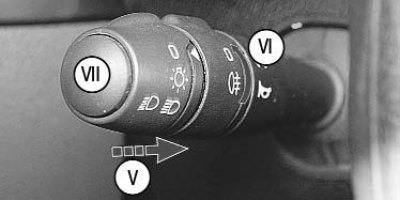
- V - switching low/high beam (non-fixed position). When you hold the lever, the high beam comes on;
- VI - rear fog lights on (side lights must be on);
- VII - sound signal on/off button. To turn on the sound signal, press the button.
Note: On vehicles equipped with fog lights, turning the ring to position VI turns on the fog lights. To turn on the rear fog light, turn the ring to the corresponding position (side lights must be on).
1.8. Instrument cluster
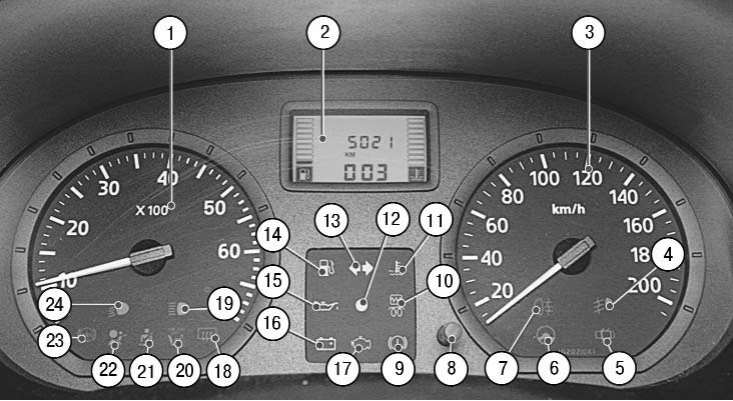
When the lever is moved to position I or II, the indicator lamp 13 in the instrument cluster flashes (figure 1.8). When the steering wheel is returned to the straight-ahead position, the lever is automatically reset to its original position. When changing lanes, to turn on the turn signal, simply press the lever in the direction of position I or II until you feel a noticeable resistance, without fixing the lever. When released, the lever will return to its original position.
When the low or high beam is switched on, the control lamp 24 or 19 lights up in the instrument cluster (see figure 1.8) respectively.
When the rear fog lights are switched on, indicator lamp 7 lights up in the instrument cluster; when the fog lights are switched on, indicator lamp 4 lights up.
Note: If the ignition switch (lock) is in the "S" or "A" position, and the exterior lights are on, a buzzer will sound when the driver's door is opened, reminding you to turn off the lights.
3 – steering wheel.
4 – instrument cluster (see "Instrument cluster").
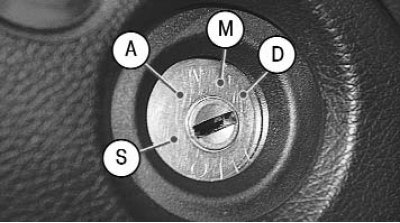
5 – ignition switch (lock), combined with the anti-theft device, is located on the right side of the steering column. The key in the lock can occupy one of four positions:
- S (blocking) - ignition off, with the key removed, the anti-theft device is on. To ensure that the steering shaft is locked, turn the steering wheel to the right or left until it clicks. To turn off the anti-theft device, insert the key into the ignition switch and, slightly turning the steering wheel to the right and left, turn the key to position "A";
- A (additional equipment) - ignition off, key cannot be removed, steering is unlocked. Power circuits for horn, exterior lighting, high beam headlights, radio equipment are on;
- M (on) - ignition on, key cannot be removed, steering unlocked. Ignition, instruments and all electrical circuits are on;
- D (starter) - ignition and starter are on, the key cannot be removed, the steering is unlocked. This position of the key is not fixed, when released, the key returns to the "M" position under the force of the spring.
Warning! Do not turn off the ignition or remove the key while driving: the steering will be locked and the car will become uncontrollable.
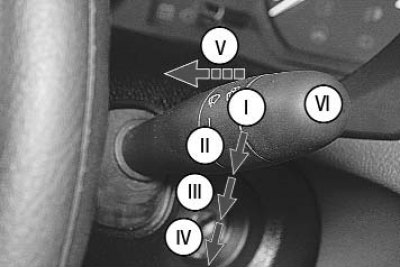
6 – windshield wiper and washer switch lever with trip computer display mode switching button. The switch turns on the electrical circuits when the ignition is on. The lever can take the following positions:
- I - windshield wiper off (fixed position);
- II - intermittent windshield wiper mode is enabled (fixed position);
- III - the first speed of the windshield wiper is on (fixed position);
- IV - the second speed of the windshield wiper is on (fixed position);
- V - by moving the lever towards you, the windshield washer is turned on (non-fixed position), the windshield wiper also turns on at the same time (depending on the configuration, the headlight washers are turned on simultaneously). When the lever is held in this position, the washer fluid is supplied; when released, the wiper blades perform several more cycles;
- VI - button for switching the display modes of the trip computer. On some models, the display modes of the trip computer can be switched by button 8 (see figure 1.8) reset the daily mileage counter.
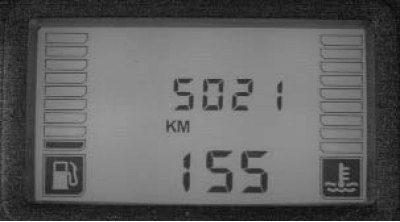
When you press button VI, the information displayed on display 2 of the on-board computer changes:
- total mileage counter;
- daily mileage counter.
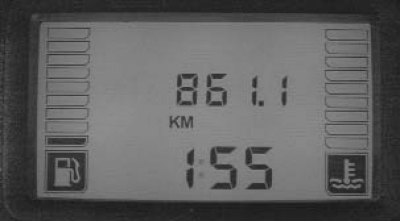
Depending on the vehicle's configuration, the following information may be displayed on the on-board computer:
- the amount of fuel consumed (in liters) since the last reset of the on-board computer readings;
- average fuel consumption (l/100 km) since the last reset of the trip computer (the value is displayed after the car has traveled 400 m);
- current fuel consumption (l/100 km), consumption is displayed when the vehicle is moving at a speed of more than 30 km/h;
- estimated range (km) on the remaining petrol in the fuel tank, the calculation takes into account the average fuel consumption;
- distance traveled (km) since the last reset of the trip computer;
- average speed (km/h) of the vehicle since the last reset of the trip computer.
7 – Hazard warning light switch. When the switch button is pressed, all direction indicators and their control lamps installed in the instrument cluster light up with a flashing light. When the button is pressed again, the alarm turns off.
Note: The hazard warning lights operate in any position of the key in the ignition switch (lock).
8 – place for installing a car radio.
9 – niche for small items.
10 – Glove box. It is used to store small items and is opened by pressing the lock handle up. On some cars, the glove box lock is opened or locked with the ignition key.
11 – control button for the electric window of the right front door.
12 – Central locking system switch. When you press the lower part of the button, the door locks are locked. To unlock the locks, you need to press the upper part of the button.
13 – Heating system control unit (air conditioning) and ventilation of the passenger compartment, see. "Heating (conditioning) and interior ventilation".
14 – ashtray.
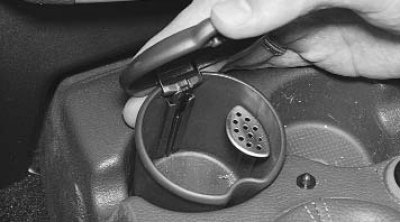
To use the ashtray, open its lid.
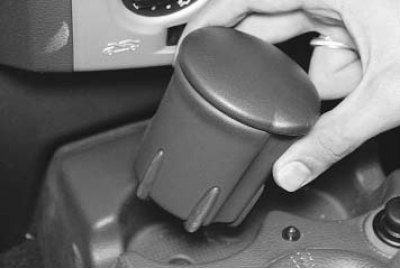
To clean, remove the ashtray from the floor tunnel lining.
15 – cigarette lighter. To use the cigarette lighter, press the button on its movable part. After the coil has heated for 10–20 seconds, the movable part will automatically return to its original position with a click and the cigarette lighter can be removed for use.
Attention! The cigarette lighter can be turned on again no earlier than after 20 seconds. Do not hold the cigarette lighter in the pressed position. Do not use the cigarette lighter socket to connect powerful electrical devices (electric coffee maker, etc.) – this may damage the vehicle's electrical equipment. If the cigarette lighter button does not return to its original position within 30 seconds after switching on, remove the cigarette lighter from the socket to prevent the coil from burning out.
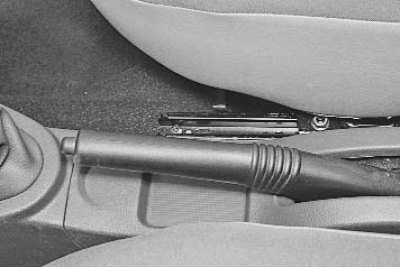
16 – parking brake lever.
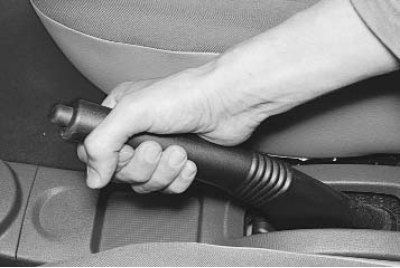
To apply the parking brake, lift the lever all the way up. The red indicator light 9 will light up in the instrument cluster (see figure 1.8).
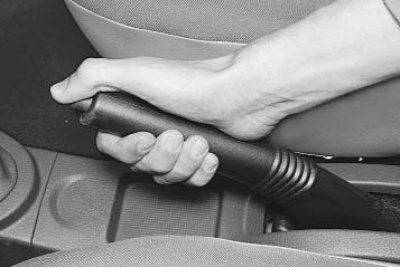
To release the brakes, pull the lever up slightly, press the button at the end of the lever handle and lower the lever all the way down. The indicator light should go out.
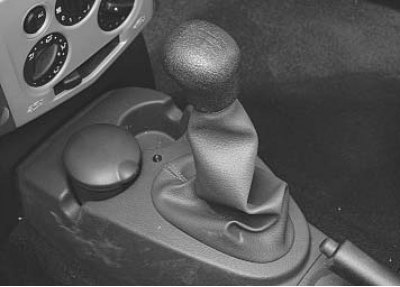
17 – gear shift lever. The handle has a gear shift diagram.
18 – Rear window heating switch. When you press the switch button (with the key in the ignition switch in position "M"), the rear window heating turns on, and the indicator lamp in the button lights up at the same time. Pressing the button again turns the heating off.
Warning! The heating element consumes a very large current. Therefore, to avoid excessive battery discharge, turn on the electric heating with the engine running only for the time required to eliminate fogging of the rear window. In order not to damage the heating threads, do not use scrapers or other sharp objects, as well as detergents with abrasives, to clean the inside of the rear window.
19 – left front door electric window control button.
20 – accelerator pedal.
21 – brake pedal.
22 – clutch pedal.
[Original publication on the website: RENAULTBOOK]
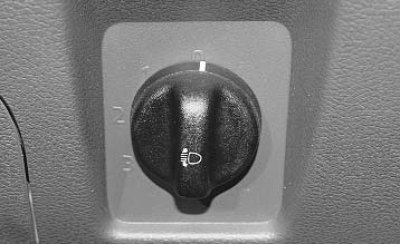
23 – headlight corrector regulator. By rotating the regulator handle, depending on the vehicle load, the angle of the headlight beam is changed in such a way as to avoid blinding oncoming drivers. Combining the mark on the regulator handle and the number on the scale ensures the appropriate adjustment of the headlight position for the following vehicle load options:
- 0 - one driver or driver and front seat passenger;
- 1 - all seats are occupied;
- 2 - one driver and cargo in the trunk;
- 3 - all seats are occupied and cargo is in the trunk.
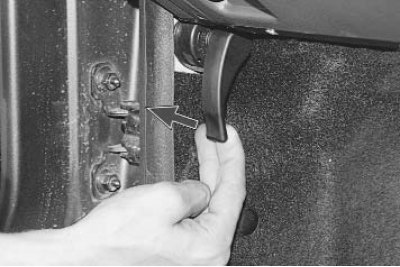
24 – hood lock actuator lever. By moving the lever towards you, you unlock the hood lock. At the same time, the front edge of the hood is raised, forming a gap for access to the hood lock safety hook handle. By pressing it towards the lock, you can open the hood.