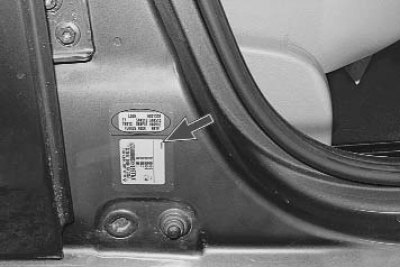
...located on the front passenger door pillar.
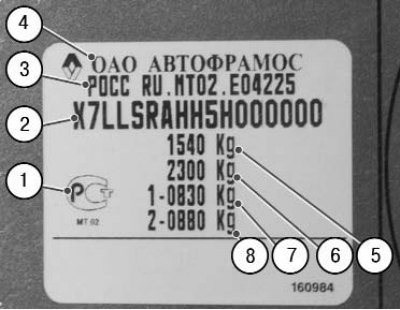
1.5. Identification sticker: 1 – mark of compliance with certification; 2 - vehicle identification number; 3 - code of the authority that issued the certificate and vehicle approval number; 4 - manufacturer; 5 - the maximum permitted weight of the car; 6 - the maximum permitted mass of a car with a trailer; 7 - permissible load on the front axle of the car; 8 - permissible load on the rear axle of the car
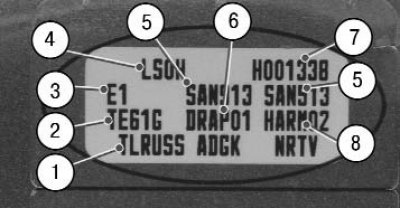
1.6. Vehicle version identification sticker: 1 - technical characteristics of the car; 2 - body color code; 3 - equipment level; 4 - type of car; 5 - code of special configuration; 6 - upholstery code; 7 - serial number; 8 - interior color scheme code
On fig. 1.5 and 1.6 show all the information about the car given in the identification sticker.
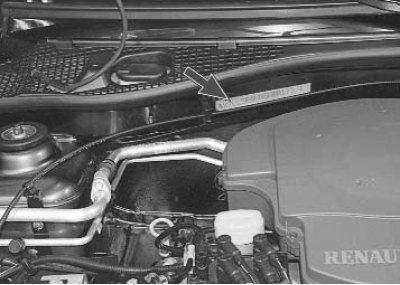
The vehicle identification number is stamped on the shield of the engine compartment. Depending on the configuration, the number can also be duplicated in the lower left part of the windshield glass.
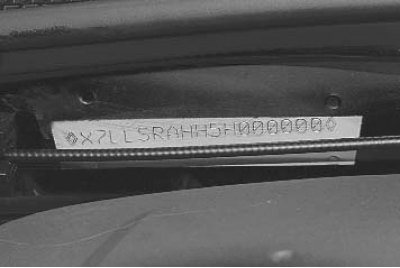
Deciphering the identification number, for example, X7LLSRAHH5H000000:
- X7L - international code of the manufacturer;
- L - body type (sedan);
- SR - internal designation of the car model;
- A - driver's airbag (4 - no pillow);
- HH - engine 1.6 l (GH - 1.4L engine);
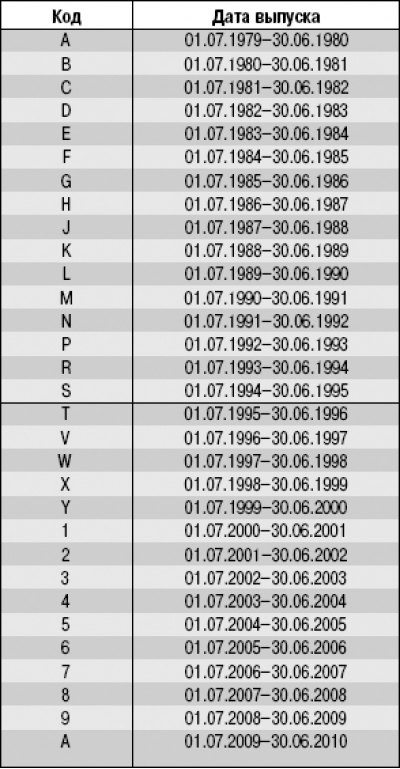
- 5 - model year code of the car (tab. 1.2);
- H000000 - body serial number.
Note. A model year is a period, on average equal to a calendar year, during which cars with the same design features are produced.
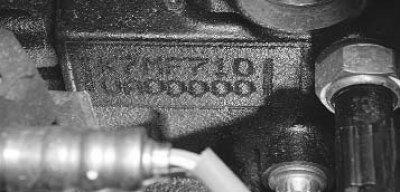
The engine model and number are stamped on the lug of the cylinder block at its left rear (next to the oil pressure warning light sensor):
- K7MF710 - engine model (8-valve; 1.6 l, multiport fuel injection system);
- UA00000 - engine number.
Table 1.2. Vehicle model year code