
English Русский
Български
Беларускі
Український
Српски
Hrvatski
Română
Polski
Slovenský
Magyar
Bookmark Contacts Articles Sitemap
Company vehicles Peugeot Company vehicles Opel Company vehicles Skoda Company vehicles Land Rover Company vehicles Mitsubishi Company vehicles Volkswagen Company vehicles Honda
RenaultBook.ru


Duster   Fluence   Kangoo   Laguna   Logan   Megane   Sandero   Scenic   Symbol   Clio   Other
Renault 19 (1988-1996) Espace I and II (1984-1996) Espace III (1996-2002)

Exhaust gas system (Renault Espace III)

  • Main
  • Renault
  • Espace III (1996-2002)
  • Power unit
  • Petrol engines F3R
  • Exhaust gas system
0
  • Hairpins (1, Fig. 1.98) the exhaust pipes of the exhaust system of cars with F3R engines have stops that determine the tension of the springs, so they should be tightened to the stop.
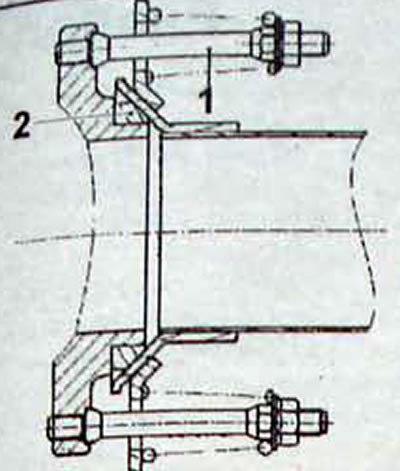
Fig. 1.98. Connection of the exhaust pipe of the exhaust system of vehicles with F3R engines: 1 -…

Fig. 1.98. Connection of the exhaust pipe of the exhaust system of vehicles with F3R engines: 1 - hairpin; 2 - ring


Attention: All removed clamps must be replaced with new ones.


Resonator and catalytic converter


  • Despite the fact that the resonator is connected to the muffler by a solid pipe, it is possible to replace these elements separately.
  • In this case, it is necessary to cut the pipe as follows.
  • Remove the resonator-muffler assembly.
  • Mark the cutting location.
  • The cutting area is marked by two punched dots on the exhaust pipe (on the left or right side of a straight section of pipe).
  • The distance between two marks is 90 mm.
  • To cut the pipe, you need to draw a line in the middle between the marks.
  • The marks may not be visible due to corrosion and dirt, in which case clean this section of the pipe with sandpaper.
  • Use the Mot. 1199 tool to cut the pipe. Position the Mot. 1199 tool at the desired location on the exhaust pipe. Loosen the chain as much as possible and wrap it around the pipe and attach the tool to the chain. Rotate the tool around the pipe, tightening the chain as you cut (do not tighten too much to avoid deforming the pipe when cutting).
  • Remove the element to be replaced.
  • Install and secure the repair pipe. To ensure the tightness of the exhaust system, it is important to install the pipe on the pipes correctly, i.e. so that the pipe rests against the protrusions inside the pipe. First, the pipe is installed on the old pipe and slightly pressed with a clamp.
  • Check that the pipe rests against the protrusions.
  • Install a new exhaust system component.
  • Before installing the pipe, apply a special mastic to the inner ring of the pipe to seal the connection.

Attention. To avoid contact with the body, the clamping bolt with the nut of the branch pipe must be oriented vertically on the left side of the pipe.


[Original of this article on the website: www.RenaultBook.ru]
  • Before finally tightening the nut, you must make sure that the catalytic converter and resonator are securely fastened to the bottom of the car
  • Once removed, the clamp cannot be reused.
  • The clamp nut has a groove (A. Fig. 1.99), to indicate the correct tightening torque. When the groove disappears during tightening, it makes a characteristic click, this means that the nut has been tightened to a torque of 25 N·m.
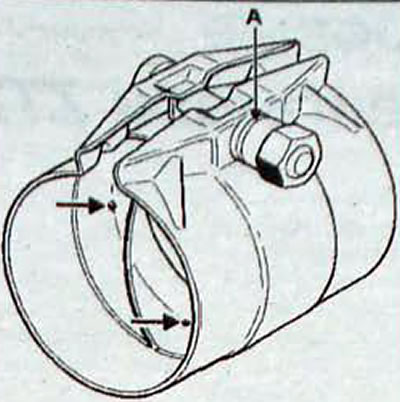
Fig. 1.99. Repair pipe of the exhaust system: A - groove that determines the tightening torque of…

Fig. 1.99. Repair pipe of the exhaust system: A - groove that determines the tightening torque of the nut


Note: For vehicles with F3R engines, 50mm diameter pipes must be used.

  • Before assembling the unit, make sure there are no contaminants or metal particles in the exhaust pipe up to the resonator
  • Replace the gasket at the outlet of the catalytic converter.
  • When installing the resonator-muffler assembly, release the catalytic converter-resonator connection to align the pipe.
  • After installation, make sure that the pipe does not touch the bottom anywhere.

Note: When working under the vehicle, check that all exhaust system heat shields are present and securely fastened.
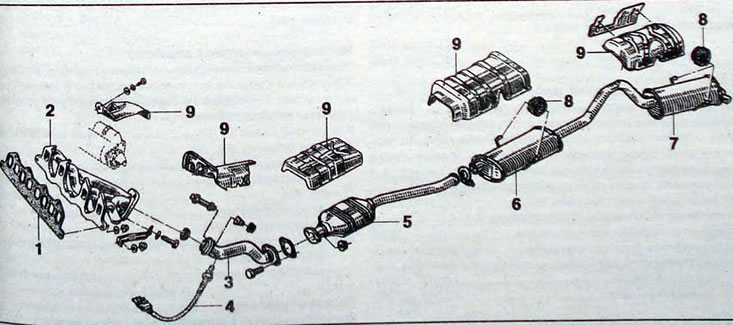


Fig. 1.100.Elements of the exhaust system: 1 - exhaust manifold gasket; 2 - exhaust manifold; 3-…

Fig. 1.100.Elements of the exhaust system: 1 - exhaust manifold gasket; 2 - exhaust manifold; 3- inlet exhaust pipe; 4 - oxygen concentration sensor; 5 - catalytic converter; 6 - front muffler; 7 - rear muffler; 8 - suspension; 9 - thermal protection screen
This article is available on: russian, bulgarian, belarusian, ukrainian, serbian, croatian, romanian, polish, slovak, hungarian
Article has been reviewed by editor: Trofimova Anastasia
Share with friends:
Previous
Espace III: Petrol engines F3R
 

Fittings for radiator hoses of interior heater
Set of cooling system elements together with a radiator
Radiator for gasoline engines
Replacing the water pump drive belt
Water pump
 
Other articles on other Renault models

➽ Location of components of the exhaust gas recirculation system… Renault Duster 1 (2009-2017)
➽ Exhaust gas system Renault Fluence 1 (2009-2020, petrol)
➽ Exhaust gas system Renault Kangoo 1 (1997-2007)
➽ Intake and exhaust system — general information Renault Laguna 2 (2001-2007)
➽ Checking the exhaust system Renault Logan 1 (2004-2012, petrol)
Link to this article in different formats
Reviews and comments of visitors
No comments yet


Add two numbers 50 + 20


Renault 19 (1988-1996) 
  • General information
  • Maintenance
  • Power unit
  • Engine repair
  • Exhaust system
  • Cooling system
  • Supply system
  • Single-point injection
  • Multi-point injection
  • Diesel injection system
  • Transmission
  • Clutch
  • Car gearbox
  • Chassis, running gear
  • Car suspension
  • Steering
  • Brake system
  • Wheels and tires
  • Body and interior
  • Exterior (external elements)
  • Interior (internal elements)
  • Heating and ventilation
  • Electrical equipment
  • Equipment and devices
  • Headlights and lighting
  • Ignition system
  • Power devices
  • Electrical circuits
Espace I and II (1984-1996) 
  • General information
  • Introduction to the guide
  • Troubleshooting
  • Power unit
  • Engine repair
  • Cooling system
  • Carburetor fuel system
  • Injection fuel system
  • Diesel fuel system
  • Ignition system
  • Transmission
  • Clutch
  • Car gearbox
  • Drive shafts
  • Chassis, running gear
  • Brake system
  • Steering
  • Front suspension
  • Rear suspension
  • Body and interior
  • Exterior (external elements)
  • Interior (internal elements)
  • Doors, locks and windows
  • Electrical equipment
  • Equipment and devices
  • Electrical circuits
Espace III (1996-2002) 
  • General information
  • Introduction to the manual
  • User manual
  • Power unit
  • Petrol engines F3R
  • Petrol engines Z7X
  • Diesel engines G8T
  • Diesel engines G9T
  • Transmission
  • Clutch
  • Mechanical gearbox
  • Automatic gearbox
  • Drive shafts
  • Chassis, running gear
  • Steering
  • Front suspension
  • Rear suspension
  • Brake system
  • Body and interior
  • Exterior (external elements)
  • Interior (internal elements)
  • Doors, locks and windows
  • Heating and ventilation
  • Electrical equipment
  • Equipment and instruments
  • Power devices
  • Electrical circuits
RenaultBook.ru © 2018–2026 | Mobile version | News and articles | Sitemap: EN BG BY UA RS HR RO PL SK HU | Administration | Site search | Bookmark
Duster 1 (2009-2017) | Fluence 1 (2009-2020, petrol) | Kangoo 1 (1997-2007) | Laguna 2 (2001-2007) | Logan 1 (2004-2012, petrol) | Logan 2 (2012-2020) | Megane 1 (1995-2002) | Megan 2 (2002-2009, petrol) | Sandero 1 (2007-2012, petrol) | Scenic 1 (1996-2003) | Symbol 1 (1999-2008, petrol) | Symbol 2 (2008-2013, petrol) | Renault 19 (1988-1996) | Espace I and II (1984-1996) | Espace III (1996-2002) | Clio 1 (1990-1998) |
We want your visit to be comfortable 😌 and use cookies 🍪 to do so.