



Contents: Selector lever positions 🠛 Moving the selector lever 🠛 Program "Sport" 🠛 Program "Hiver" (winter) 🠛
Selector lever positions
R. Parking
The drive wheels are automatically locked. The selector should only be set to this position when the vehicle is at a complete stop.
R. Reverse
It should only be switched on when the vehicle has come to a complete stop and the engine is idling.
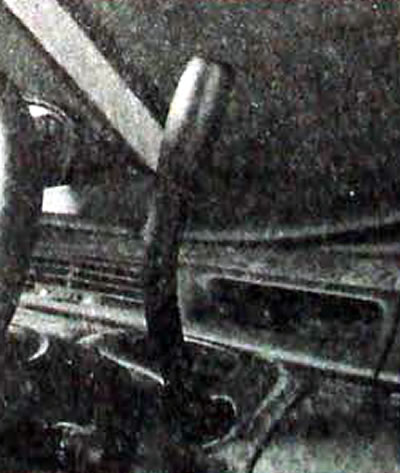
Selector lever location on cars with automatic transmission
In the "R" position with the ignition on, the reversing lights come on
N. Neutral position (idle position)
No gear is engaged. Engine start is possible.
D. Long forward movement
Four gears are automatically switched from low to high and vice versa, depending on the engine load, vehicle speed and the program activated.
Under certain driving conditions, it may be advisable to temporarily use one of the following positions.
3. Automatic switching to 1-2-3 steps
Recommended when, under certain driving conditions, with the selector in position "D", frequent shifting from 3rd to 4th gear and vice versa occurs. It is recommended to engage this position when driving the car on hilly terrain. 1st, 2nd or 3rd gear is automatically shifted up and down depending on the engine load and driving speed. 4th gear is locked. This also increases the efficiency of engine braking when the fuel supply is cut off.
2. Automatic switching to 1-2 steps
Recommended for long climbs and descents. Automatically shifts up and down 1st or 2nd gear depending on engine load and driving speed. 3rd and 4th gears remain locked to prevent unnecessary upshifts. This also increases engine braking efficiency.
1. Position for mountainous road sections with large slopes It is recommended to select this position when driving on steep ascents and descents. The car moves only in 1st gear. 2nd, 3rd and 4th gears are locked. to prevent unnecessary upshifts. At the same time, the maximum possible engine braking efficiency is achieved
Moving the selector lever
To select the desired position, move the selector lever toward the steering wheel. Before setting the selector lever to some positions, it is necessary to first pull the lever toward yourself. When starting the engine, the selector lever must be in the "P" or "N" position. Movements of the lever between the "D" or "R" positions must be performed with the vehicle stopped, the brake pedal pressed and the accelerator pedal released, which will exclude any movement of the vehicle.
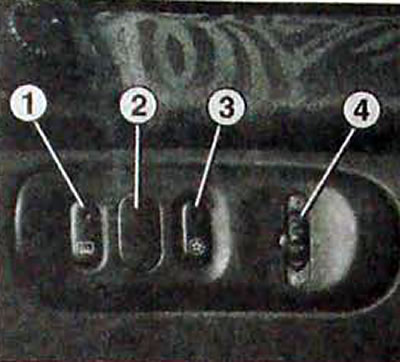
Switches located on the instrument panel: 1. Rear window and outside rear view mirror defroster switch; 2. Speed controller on/off switch; 3. "Hiver" (Winter) switch on cars with automatic transmission; 4. headlight corrector
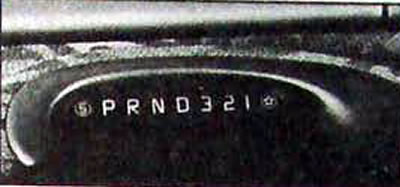
Selector lever position indicator on vehicles with automatic transmission
Position "P" - the drive wheels are automatically locked. To move the lever from the "P" position, you must first press the brake pedal. When the car is stopped, the selector lever must be set to the "P" position.
It is very important to set the selector lever to the "P" position when parking the vehicle on a slope.
When operating the vehicle under normal conditions, set the selector lever to the "D" position. The four gears are then automatically shifted from low to high and vice versa, depending on the engine load, vehicle speed and the selected driving style.
To save fuel when driving your vehicle, press the accelerator pedal smoothly and lightly, which will cause the vehicle to shift up to higher gears early and shift down to lower gears later.
If, with the selector in position "D", frequent shifting from 3rd to 4th gear and vice versa occurs, it is recommended to select position "3" or even "2".
It is not recommended to use positions 3, 2 and 1 and the "Hiver" (Winter) program outside of emergency situations.
Program "Sport"
When selecting the "sport" mode, the engine's power reserves are fully utilized due to a slight delay in upshifting. To activate this program, press the switch located at the end of the handle, and the "S" indicator lamp located on the left side of the selector lever position indicator will light up.
Program "Hiver" (winter)
When driving on a road with slippery sections or sections covered with ice and snow, switch on the "Hiver" program by pressing the button located on the switch block to the left of the steering wheel, while the indicator located on the right side of the selector lever position indicator lights up.
This position ensures that only 2nd gear is engaged, regardless of the position in which the selector lever is set. After overcoming a slippery section, be sure to turn off the "Hiver" program.
KICK-DOWN forced downshift device.
The device ensures maximum acceleration of the vehicle in the given driving conditions. After pressing the accelerator pedal to the stop, depending on the rotation frequency and driving speed, a shift to one of the lower gears occurs. The shift to the next higher gear will follow only when the maximum permissible value of the engine crankshaft rotation frequency is reached. On a slippery road, forced anticipatory shifting to a lower gear may cause slippage of the drive wheels.