
English Русский
Български
Беларускі
Український
Српски
Hrvatski
Română
Polski
Slovenský
Magyar
Bookmark Contacts Articles Sitemap
Company vehicles Peugeot Company vehicles Opel Company vehicles Skoda Company vehicles Land Rover Company vehicles Mitsubishi Company vehicles Volkswagen Company vehicles Honda
RenaultBook.ru


Duster   Fluence   Kangoo   Laguna   Logan   Megane   Sandero   Scenic   Symbol   Clio   Other
Renault 19 (1988-1996) Espace I and II (1984-1996) Espace III (1996-2002)

Ignition switch (Renault Espace III)

  • Main
  • Renault
  • Espace III (1996-2002)
  • General information
  • User manual
  • Ignition switch
0
Contents: 1. STOP position/anti-theft lock 🠛 2. Accessories 🠛 3. Ignition is on 🠛 4. Starting the engine 🠛
The ignition key is integrated with an anti-theft device.
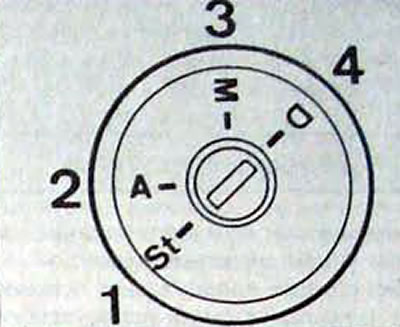
Key positions in the ignition switch with anti-theft lock

Key positions in the ignition switch with anti-theft lock


The key fits all locks and the remote control is for central locking (according to the version) is located in the head of the key. The key has a number that must be written down and kept in a safe place, as it can be used to order a duplicate of the lost key.

In addition to the anti-theft device, the key has an electronic engine start blocking system that de-energizes the ignition system, fuel system and starter until the ignition key is recognized by the electronic components of the car.

1. STOP position/anti-theft lock


If the key in the ignition does not turn or turns with difficulty to this position, you should slightly shake the steering wheel left and right - the wheel will be unlocked. To lock the steering, turn the steering wheel with the ignition key removed until the steering lock pin clicks into place.

2. Accessories


The ignition is off, but power is supplied to additional consumers (radio receiver, etc.).


3. Ignition is on


The ignition is on and, on vehicles with diesel engines, the engine preheating is enabled.

4. Starting the engine


As soon as the engine starts, immediately release the ignition key - the starter should not rotate with the engine

Before each new attempt to start the engine, it is necessary to return the ignition key to position 1. The starter re-engagement interlock device, located in the ignition switch, prevents the starter from engaging when the engine crankshaft is rotating, thereby protecting the starter from damage.

Until the engine has warmed up to normal operating temperature, do not allow high engine speeds or heavy engine loads.
This article is available on: russian, bulgarian, belarusian, ukrainian, serbian, croatian, romanian, polish, slovak, hungarian
Article has been reviewed by editor: Trofimova Anastasia
Share with friends:
Previous
Espace III: User manual
Next

Engine start interlock system
Engine bay
Opening and closing the hood
On-board computer
Instrument cluster
Starting the engine
Starting an engine with a discharged battery
Manual transmission
Automatic transmission
Speed control (Cruise control)
Other articles on other Renault models

➽ Ignition switch — removal and installation Renault Duster 1 (2009-2017)
➽ Starting the engine on a Fluens car with an ignition switch Renault Fluence 1 (2009-2020, petrol)
➽ Ignition switch Renault Kangoo 1 (1997-2007)
➽ Features of the ignition switch design Renault Logan 1 (2004-2012, petrol)
➽ Removal and installation the ignition switch Renault Megane 1 (1995-2002)
Link to this article in different formats
Reviews and comments of visitors
No comments yet


Add two numbers 15 + 19


Renault 19 (1988-1996) 
  • General information
  • Maintenance
  • Power unit
  • Engine repair
  • Exhaust system
  • Cooling system
  • Supply system
  • Single-point injection
  • Multi-point injection
  • Diesel injection system
  • Transmission
  • Clutch
  • Car gearbox
  • Chassis, running gear
  • Car suspension
  • Steering
  • Brake system
  • Wheels and tires
  • Body and interior
  • Exterior (external elements)
  • Interior (internal elements)
  • Heating and ventilation
  • Electrical equipment
  • Equipment and devices
  • Headlights and lighting
  • Ignition system
  • Power devices
  • Electrical circuits
Espace I and II (1984-1996) 
  • General information
  • Introduction to the guide
  • Troubleshooting
  • Power unit
  • Engine repair
  • Cooling system
  • Carburetor fuel system
  • Injection fuel system
  • Diesel fuel system
  • Ignition system
  • Transmission
  • Clutch
  • Car gearbox
  • Drive shafts
  • Chassis, running gear
  • Brake system
  • Steering
  • Front suspension
  • Rear suspension
  • Body and interior
  • Exterior (external elements)
  • Interior (internal elements)
  • Doors, locks and windows
  • Electrical equipment
  • Equipment and devices
  • Electrical circuits
Espace III (1996-2002) 
  • General information
  • Introduction to the manual
  • User manual
  • Power unit
  • Petrol engines F3R
  • Petrol engines Z7X
  • Diesel engines G8T
  • Diesel engines G9T
  • Transmission
  • Clutch
  • Mechanical gearbox
  • Automatic gearbox
  • Drive shafts
  • Chassis, running gear
  • Steering
  • Front suspension
  • Rear suspension
  • Brake system
  • Body and interior
  • Exterior (external elements)
  • Interior (internal elements)
  • Doors, locks and windows
  • Heating and ventilation
  • Electrical equipment
  • Equipment and instruments
  • Power devices
  • Electrical circuits
RenaultBook.ru © 2018–2026 | Mobile version | News and articles | Sitemap: EN BG BY UA RS HR RO PL SK HU | Administration | Site search | Bookmark
Duster 1 (2009-2017) | Fluence 1 (2009-2020, petrol) | Kangoo 1 (1997-2007) | Laguna 2 (2001-2007) | Logan 1 (2004-2012, petrol) | Logan 2 (2012-2020) | Megane 1 (1995-2002) | Megan 2 (2002-2009, petrol) | Sandero 1 (2007-2012, petrol) | Scenic 1 (1996-2003) | Symbol 1 (1999-2008, petrol) | Symbol 2 (2008-2013, petrol) | Renault 19 (1988-1996) | Espace I and II (1984-1996) | Espace III (1996-2002) | Clio 1 (1990-1998) |
We want your visit to be comfortable 😌 and use cookies 🍪 to do so.