



Contents: Range selector lever 🠛 Automatic Transmission Control Mode…🠛 Driving a car 🠛 Moving the car from a standstill 🠛 Special driving conditions 🠛 Intensive acceleration 🠛 Economical driving 🠛 Stopping the car 🠛
(can be installed, depending on the model configuration)
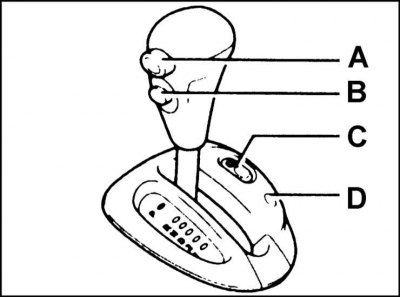
Range selector lever
The automatic transmission selector can be in one of seven positions:
- "R" - parking lot;
- "R" - reverse;
- "N" - neutral;
- "D" - movement in automatic gear shift mode (1st, 2nd, 3rd and 4th gears are automatically switched);
- "3" - automatic shift mode 1, 2, 3 gears (4th gear does not engage);
- "2" - automatic switching mode of 1st and 2nd gears (3rd and 4th gears do not engage);
- On some models, this mode is activated by pressing button B in position D of the selector. At the same time, indicator D3 lights up on the control lamp panel.
- "1" - movement in first gear.
For safety reasons, some positions of the selector lever can only be engaged by pressing button A, located on the handle.
Move the selector lever to the "D" (drive) or "R" position (reverse) only after the car has come to a complete stop, releasing the accelerator pedal and keeping the brake pedal pressed.
Automatic Transmission Control Mode Switch
The automatic transmission control system has two gear shift modes: "comfort" and "sport". Switch C allows you to select the desired control mode depending on your driving style. The mode is selected by pressing the switch C button.
In "comfort" mode higher gears are engaged at a relatively low engine crankshaft rotation speed. (When this mode is enabled, the control lamp D does not light).
In "sport" mode gear shifts occur at relatively higher engine speeds compared to the "comfort" mode. (When the "sport" gear shift mode is engaged, the control lamp C lights up).
Driving a car
When starting the engine, move the selector lever to the "P" or "N" position. Otherwise, the starter will not engage (engine start blocking for safety reasons).
Moving the car from a standstill
While pressing the brake pedal with your foot, move the selector lever from the "P" or "N" position to the "D" position. Move your foot from the brake pedal to the accelerator pedal. As a rule, in most cases under normal traffic conditions, no further manipulation of the selector lever is required: gear changes will occur automatically at the right time and at optimal engine speed. When changing gears, the automatic system takes into account the vehicle load, the road profile and the driving style you have chosen ("comfortable" or "sporty").
Special driving conditions
In hilly or mountainous terrain, if the longitudinal profile of the road and its winding do not allow driving for a long time in 4th gear, we recommend moving the selector lever to position "3" or even "2". In this case, gear changes will not occur too often, and the inclusion of 4th (selector position "3") and 3rd (selector position "2") gears will be blocked. Using the selector positions "3" and "2" in these driving conditions helps reduce the wear of the friction elements of the gearbox control. In particularly difficult driving conditions, you should move the selector lever to position "1". In this case, shifting to 2nd, 3rd and 4th gears will be blocked. In 1st gear, highly efficient engine braking is ensured.
When driving on long descents, we recommend turning the selector lever to position "3", "2" (or even "1") for more effective engine braking of the car and reducing heating and wear of the working brake mechanisms.
Intensive acceleration
For intensive acceleration of the car from a standstill or while driving at a steady speed, additionally press the accelerator pedal all the way down. This will activate the "kick-down" mode. The gearbox will automatically shift to a lower gear, which will provide the best acceleration dynamics of the car in these conditions.
Economical driving
When driving on the road under normal conditions, the selector lever should always be in the "D" position. Press the accelerator pedal lightly and smoothly to change gears at relatively low engine speeds.
Do not use positions "1", "2" and "3" of the automatic transmission selector lever under normal driving conditions.
Caution! In cold weather, after starting the engine, let the engine idle for a while before moving the selector lever from position "P" or "N" to position "D" or "R". Otherwise, the engine may stall. At an air temperature of -20°C, wait about two minutes, at 0°C - about 30 seconds.
If this indicator light comes on while driving, it indicates a malfunction.
Stopping the car
After the car has come to a complete stop, keep your foot on the brake pedal and move the selector lever to position P (park). This will put the gearbox into neutral and lock the drive wheels.
For added safety when parking on steep slopes, especially if the vehicle is fully loaded, additionally apply the parking brake.