



Contents: Removal 🠛 Installation 🠛
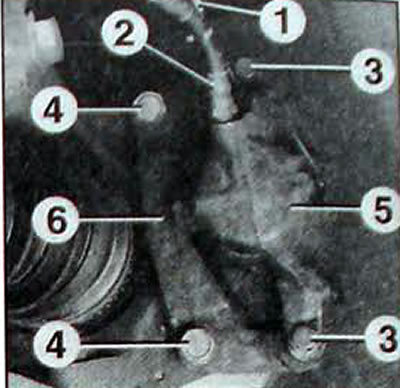
Fig. 12.6. Removing the floating bracket of the front disc brake caliper: 1 - brake pad wear sensor connector; 2 - brake hose; 3 - guide pin mounting bolt; 4 - caliper holder mounting bolt; 5 - support; 6 - caliper holder
Removal
- Be sure to replace the floating calipers of the front brake mechanisms in pairs, even if only one caliper has failed.
- Apply the parking brake and block the rear wheels with chocks.
- Loosen the front wheel mounting nuts. Raise the front of the car and place it on supports. Remove the front wheel.
- To limit the amount of brake fluid leaking out, install a pressure device on the brake pedal
- Disconnect the brake pad wear sensor connector.
- Loosen the brake hose on the slave cylinder.
- Remove the two bolts securing the floating caliper bracket.
- Remove the brake pads.
- Disconnect the brake hose from the slave cylinder by rotating the brake caliper bracket, taking measures to collect the leaking brake fluid. To prevent leakage of brake fluid, close the opening of the brake hose with a plug or a piece of rubber hose of a suitable diameter. If the caliper is removed to access other components, do not disconnect the brake hose from it.
- Check the condition of the brake hose and, if necessary, replace it.
- The brake hose must be replaced if the brake caliper bracket is replaced.
Installation
- Screw the caliper bracket onto the brake hose.
- Install the caliper bracket onto the steering knuckle, being careful not to twist the brake hose. Screw in and tighten the caliper bracket mounting bolts to the specified torque.
- Install the brake pads.
- Install the brake caliper floating bracket and new lower guide pin mounting bolt.
- Press the brake caliper and install the upper guide pin mounting bolt.
- Starting with the bottom bolt, tighten the guide pin mounting bolts to the specified torque.
- Connect the brake pad wear indicator lamp wire, ensuring that it is positioned correctly.
- Remove the pressure device from the brake pedal.
- Loosen the bleed screw on the working cylinder and wait until the fluid starts to flow out, making sure that the brake fluid level in the reservoir is high enough.
- Tighten the air bleed nipple.
- Check the condition of the brake pads and if they are oily, replace them.
- Bleeding of air from this circuit of the brake hydraulic drive is carried out only if the bottom of the tank was exposed during the work. If this happened, it is necessary to bleed both circuits of the brake hydraulic drive.
- Install the wheels and lower the car to the ground.
- Press the brake pedal several times to press the brake pads against the brake disc.
- Add brake fluid to the brake system reservoir.
Original version on our portal (renaultbook.ru)