



Checking the oil level
To accurately determine the oil level, it is necessary to place the car on a flat horizontal surface and turn off the engine for a long time.
To determine the exact oil level and to ensure that the maximum permitted oil level has not been exceeded (excessive oil level leads to engine failure), be sure to use the dipstick. See the following pages.
The warning light on the instrument panel display comes on only if the oil level is at its minimum.
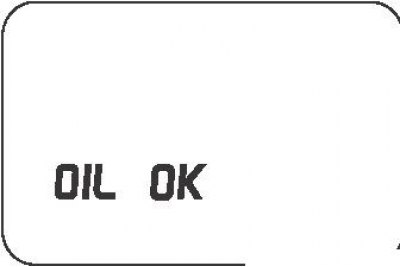
Message 1: Level above minimum
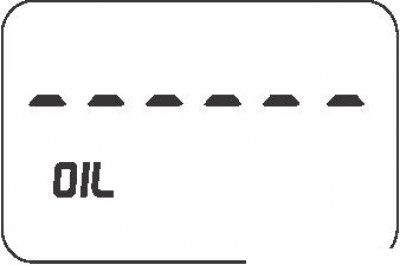
Message 2: Minimum level
Checking the oil level using the instrument panel readings
When the ignition is turned on and for approximately 30 seconds:
- if the oil level is above the minimum, the display shows "oil ok": display example 1.
This message refers to the oil level, not the quality.
For greater accuracy, press the trip odometer reset button.
The square divisions on the display indicate the oil level. As the oil level decreases, the square divisions are replaced by dashes.
- at the minimum permissible oil level: the message "ok" is not displayed on the display, the dashes and the message "oil" are flashing (message on display 2) and the warning light comes on on the instrument panel.
[This note was copied from the resource: www.Renaultbook.ru]
Urgently bring the oil level back to normal.
The indicator light on the display only lights up in the event of a minimum oil level; excess oil level is detected only using the oil dipstick.
Exceeding the maximum engine oil level.
The level is determined only by the oil dipstick, as indicated above.
If the maximum level is exceeded, do not start the engine and contact the manufacturer's service station.
If you notice an abnormal drop in the level, contact the manufacturer's service station.
Determining the oil level using a dipstick:
- remove the dipstick;
- wipe the dipstick with a clean, lint-free cloth;
- insert the dipstick all the way;
- remove the dipstick again;
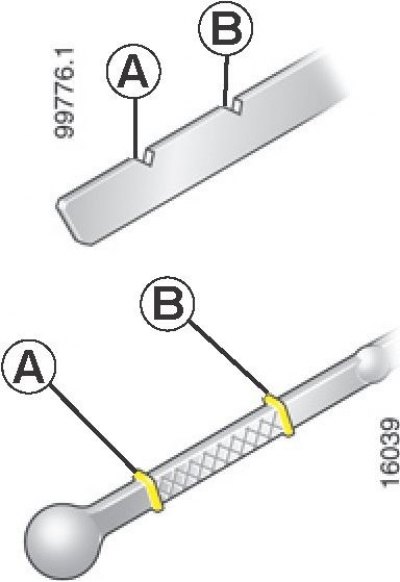
- check the oil level: the level should not be below the "mini" mark A or above the "maxi" mark B.
After completing the operation, insert the dipstick until it stops.
To avoid splashing, it is best to use a funnel to pour in the oil.
When refueling, make sure that the oil level does not exceed the maximum permissible level B. Exceeding it will damage the engine and catalytic converter.
When working in close proximity to the engine, be aware that it may be hot. Also remember that the cooling fan may turn on at any time.
There is a risk of injury.
Before inspecting the engine compartment, make sure the windshield wiper switch is in the off position.
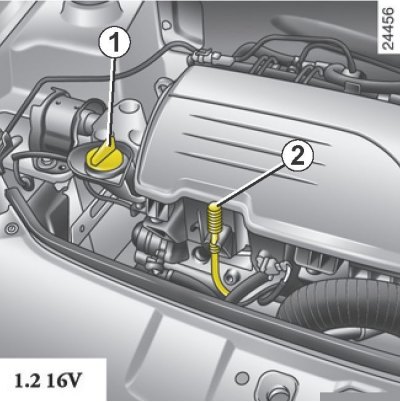
Engine oil level: Topping up, filling (1/2)
Adding oil/refueling
Car with a non-running cold engine (for example, before the first engine start of the day) must be located on a horizontal surface.
Type of motor oil
See the vehicle's service manual.
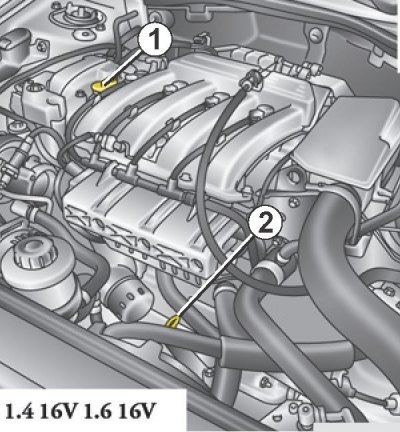
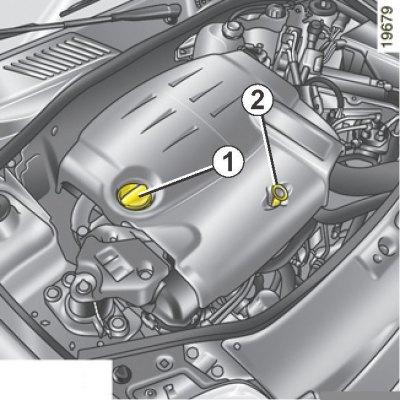
Do not exceed the "maxi" level and do not forget to replace plug 1.
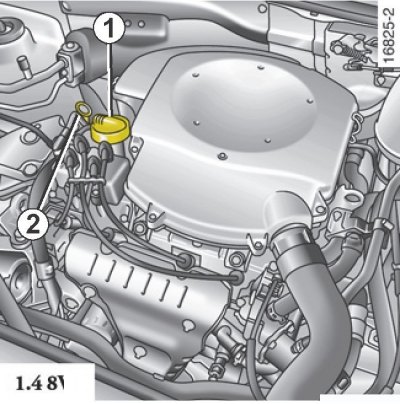
- unscrew plug 1
- add oil (for reference: the interval between the "mini" and "maxi" marks on dipstick 2 corresponds to a volume of 1.5 to 2 liters depending on the engine model);
- wait about 10 minutes for the oil to drain completely into the crankcase;
- check the oil level using the dipstick 2 (as stated above).
After completing the operation, insert the dipstick until it stops.
 |
 |
Engine oil change
Replacement frequency: see service book.
Average volume of oil added during oil change, including oil filter (for information):
- engine 1.2 16V: 4.0 l
- engine 1.4 8V: 3.1 l
- engine 1.4 16V: 4.8 l
- engine 1.6 16V: 4.8 l
- 1.5 DCi engine: 4.6 l
Type of motor oil
See the vehicle's service manual.
Filling: When adding oil, be careful not to spill it on engine parts, as this may cause a fire. Remember to tighten the cap correctly, otherwise a fire may occur if oil spills on hot engine parts.
It is prohibited to leave the engine running in a closed room, as the exhaust gases are toxic.
Before inspecting the engine compartment, make sure the windshield wiper switch is in the off position.
If you notice an abnormal drop in the level, contact the manufacturer's service station.
When working in close proximity to the engine, be aware that it may be hot. Also remember that the cooling fan may turn on at any time.
Oil change: If you change the oil on a hot engine, be careful not to burn yourself.