



Contents: Transportation of children 🠛 Using a child seat 🠛 Special pillows 🠛 Fixation with ISOFIX system 🠛 Installing a child seat 🠛 Child seat secured with seat belt 🠛 Child seat secured with ISOFIX…🠛
Transportation of children
Regardless of road conditions, a child, like an adult passenger, must be properly positioned in the seat and be buckled in. You are responsible for the children you are transporting.
A child is not a miniature adult. He is at risk of other injuries because his muscles and bones are still growing. A seat belt alone is not enough to transport a child. Buy the required child seat and install it correctly.
To prevent the doors from opening, use a child safety device (see section "Opening and closing doors" in Chapter 1).
Using a child seat
The level of protection a child seat offers depends on its ability to restrain your child and whether it is installed correctly. Incorrect installation will reduce your child's protection in the event of sudden braking or impact.
Before purchasing a child seat, make sure it complies with the regulations of your country of residence and can be installed in your vehicle. Contact the manufacturer's service station to get advice on child seats recommended for your vehicle.
Before installing the child seat, read and follow these instructions. If you have any difficulties with installation, contact the equipment manufacturer. Keep the instructions with the seat.
A car hitting an obstacle at 50 km/h is equivalent to falling from a height of 10 meters. Transporting a child without a seat belt is like leaving him to play without adult supervision on a fourth-floor balcony without railings!
It is forbidden to hold a child in your arms. In case of an accident, you will not be able to hold him, even if you are wearing a seat belt.
If your vehicle has been in an accident, replace the child seat and check the seat belts and ISOFIX anchorages.
Set an example by wearing your seat belt and teach your child:
- wear your seat belt correctly;
- enter and exit the vehicle from the side opposite to the direction of travel.
Do not use a used child seat or one without the instruction manual.
Make sure that no foreign object near the child seat interferes with its installation.
Never leave a child alone in a car.
Always check that your child is fastened and that the special child safety belt or seat belt is adjusted and fitted correctly. Never dress your child in clothes that are too large, as this will cause the belts to fit loosely against the body.
Do not allow your child to stick his head or arms out of the window.
Make sure your child maintains the correct position while in the car, especially while sleeping.
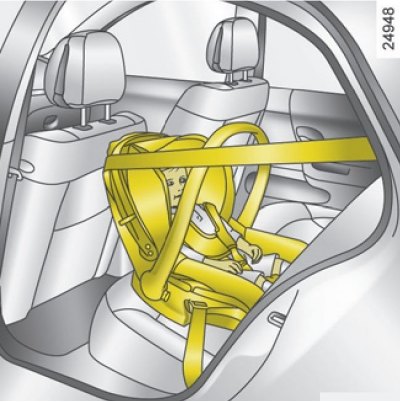
Rear facing child seat
A child's head is heavier in proportion to the body than an adult's head, so the neck is very fragile. Transport the child in this position for as long as possible (not less than 2 years). This position allows you to support the baby's head and neck.
Choose a wrap-around seat for better side protection, replacing it once your child's head is larger than the basket.
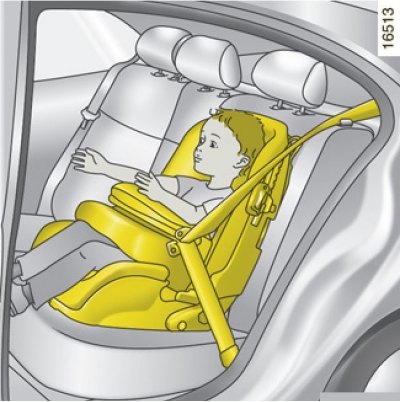
Child seats facing the direction of travel
Children's heads and abdomens should be protected first. A forward-facing child seat that is properly secured in the vehicle reduces the risk of head injuries. Place your child in a forward-facing seat with a child safety harness or shield as soon as their height allows. Choose a wrap-around seat for better side protection.
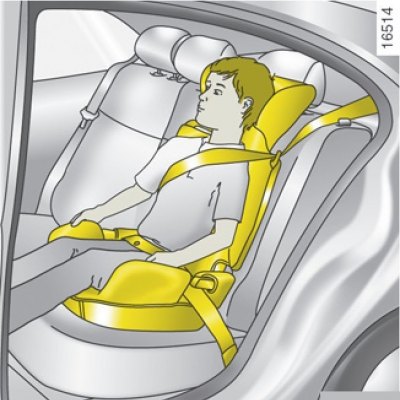
Special pillows
A child weighing over 15 kg or over 4 years of age may be transported on a special cushion that allows the seat belt to be adjusted to the child's body type. The special seat cushion should have guides that position the seat belt on the child's hips, not on the stomach. It is best to use a seat with a height-adjustable backrest and a seat belt guide that allows the seat belt to be positioned in the middle of the shoulder. The seat belt should never be around the neck or arm. Choose a wrap-around seat for better side protection.
There are two systems for securing child seats: the seat belt or the ISOFIX system.
Fastening with a seat belt
The seat belt must be adjusted correctly so that it will work in the event of sudden braking or impact.
Follow the belt lines specified by the child seat manufacturer.
Always check that the seat belt is fastened by pulling it, then tighten it as far as possible while holding on to the child seat.
Check the stability of the seat by moving it left/right and forward/backward: the seat should be well fixed.
Make sure the child seat is not installed sideways or resting against the glass.
Do not use a child seat that could release the seat belt that holds it in place: the base of the seat should not rest on the seat belt buckle and/or the seat belt lock.
The seat belt should never be loose or twisted.
Never pass the belt under your arm or behind your back.
Make sure the seat belt is not damaged by sharp edges. If the seat belt does not work properly, it will not protect the child. Contact the manufacturer's service station. Do not use this place until the seat belt is repaired.
Fixation with ISOFIX system
ISOFIX child seats approved for use are certified according to ECE-R44 in the following three cases:
- universal ISOFIX 3-point, forward facing;
- semi-universal ISOFIX 2-point;
- special.
Before installing the last two types of seats, make sure that this is possible by studying the list of cars on which their installation is permitted.
Secure the child seat with ISOFIX anchors if it is equipped with them. The ISOFIX system provides quick, easy and secure installation.
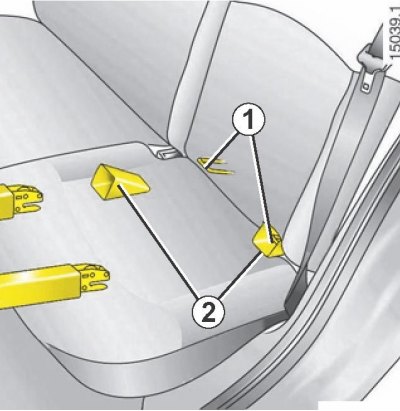
The ISOFIX system consists of 2 rings and in some cases there is a third ring.
It is strictly forbidden to make any changes to the design of the standard system elements: seat belts, ISOFIX system, seats and their fasteners.
Before using an ISOFIX child seat purchased for another vehicle, make sure that it is approved for installation. Contact the equipment manufacturer and check the list of vehicles in which the seat can be installed.
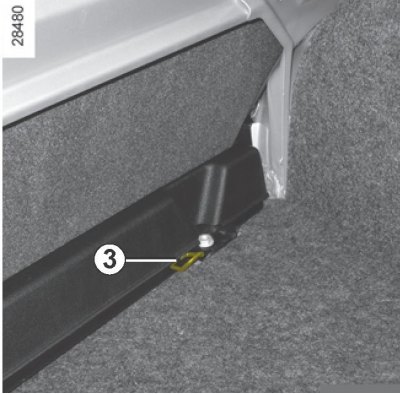
To access hook 3 from the rear seat, unlock the vehicle's rear seat backrest (see "Rear seat: functionality" section, Chapter 1), pass the belt through, then lock the backrest: make sure it is securely locked.
Fasten the belt hook into ring 3 and tighten the belt until the back of the child seat is flush with the back of the vehicle seat.
 |
 |
Two rings 1 are located between the backrest and the seat cushion and are marked.
To make it easier to install and lock your child seat in the rings 1, use the child seat access guides 2.
The third ring is used to secure the top tether on some child seats.
ISOFIX anchorages are designed exclusively for child seats with the ISOFIX anchorage system. Do not use these anchorages to secure other child seats, seat belts or other objects.
Make sure there are no foreign objects in the mounting areas.
If your vehicle has been in an accident, check the ISOFIX mountings and replace the child seat.
Installing a child seat
Not all passenger seats are approved for child seats. The diagram on the next page shows where a child seat can be installed.
The types of child seats listed may not be available commercially. Before using another child seat, check with the manufacturer to see if it can be installed.
Install the child seat in the rear seat of the vehicle.
Make sure that when installing the child seat in the vehicle, it will not come loose from the locking surface.
If it is necessary to remove the headrest, make sure it is stored in a safe place and will not become a projectile during sudden braking or an impact.
Securely fasten the child seat even when you are not using it to prevent it from becoming a projectile in the event of sudden braking or impact.
In the front seat
Carrying a child in the front passenger seat has its own specifics for each country. Check the current legislation and follow the instructions in the diagram on the next page.
Before installing a child seat on the front passenger seat (if allowed):
- lower your seat belt as much as possible;
- move the seat back as far as it will go;
- tilt the seat back slightly relative to the vertical (approximately 25°);
- if the vehicle is equipped with this system, raise the seat cushion as far as it will go.
Once the child seat has been installed, do not change the adjustments you have made.
DEATH OR SERIOUS INJURY: Before installing a child restraint system in the front seat of a vehicle, make sure the vehicle does not have a front passenger air bag.
On the rear side seat
The carrycot is installed across the vehicle and takes up at least two seats. Place your child with his or her head away from the door. Move the front seat of the vehicle as far forward as possible to install the child seat in a rear-facing position, then move the seat(s) in front of it according to the child seat instructions.
To ensure the safety of a child transported in a forward-facing child seat, do not move the front seat further than the middle of the sled travel, do not recline its backrest too much (25° maximum) and raise it as high as possible.
Make sure that the forward-facing child seat rests against the back of the vehicle seat and is not obstructed by the vehicle's headrest.
CHILD SAFETY: Installing a child seat (2/5) Without front passenger airbag.
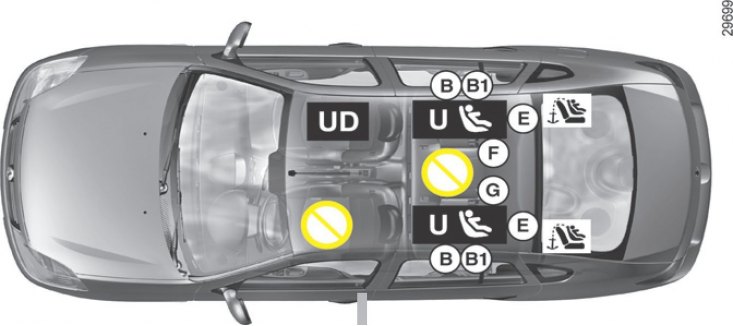
Child seat secured with seat belt
 The seat is suitable for securing a certified "universal" child seat with a belt.
 A place where only an approved universal rear-facing seat can be secured with a seat belt.
 Place prohibited for installing a child seat.
Using an inappropriate child restraint system in your vehicle will not adequately protect a newborn infant or child and could result in serious or fatal injury.
Child seat secured with ISOFIX mounting
 Place permitted for fixing ISOFIX child seat.
 The rear seats have anchorages that allow you to secure a universal ISOFIX child seat facing the direction of travel. The anchorages are located in the luggage compartment, on the lower part of the rear seat.
The size of the ISOFIX child seat is determined by the letter:
- B and B1: for group 1 seats (from 9 to 18 kg), installed with the back facing backwards;
- E: basket type seats, installed facing the direction of travel, category O or O+ (less than 13 kg);
- F and G: carrycots category O (less than 10 kg).
CHILD SAFETY: Installing a child seat (3/5) With front passenger airbag
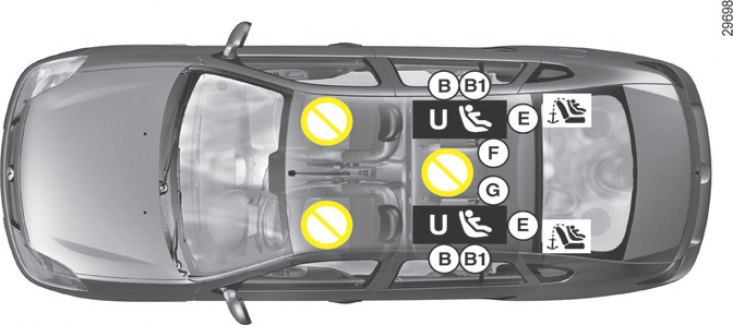
Child seat secured with seat belt
 The seat is suitable for securing a certified "universal" child seat with a belt.
 A place where it is prohibited to install a child seat facing the rear.
Child seat secured with ISOFIX mounting
 Place permitted for fixing ISOFIX child seat.
 The rear seats have anchorages that allow you to secure a universal ISOFIX child seat facing the direction of travel. The anchorages are located in the luggage compartment, on the lower part of the rear seat.
The size of the ISOFIX child seat is determined by the letter:
- B and B1: for group 1 seats (from 9 to 18 kg), installed with the back facing backwards;
- E: Basket type seats or rearward facing seats of group O or 0+ (less than 13 kg);
- F and G: carrycots category O (less than 10 kg).
DEATH OR SERIOUS INJURY: Never place a child seat in the front seat of a vehicle.
Using an inappropriate child restraint system in your vehicle will not adequately protect a newborn infant or child and could result in serious or fatal injury.
in accordance with legal regulations, the table below repeats in graphic form the information presented on the previous page.
| Type of child seat | Weight of the child | ISOFIX seat size (3) | Front passenger seat with airbag (1) | Front middle passenger seat without airbag (2) | Rear side seats | Rear middle seat |
| Cross cradle Group 0 | < 10 kg | F, G | X | X | and - IL (3) | X |
| Basket type seat/rear facing Groups 0, 0+ and 1 | < 13 kg and 9-18 kg | E | X | and | and - IL (4) | X |
| Forward facing seat Group 1 | 9- 18 kg | B, B1 | X | X | and - IUF - IL(5) | X |
| Special pillow for a child Groups 2 and 3 | 15-25 kg and 22-36 kg | - | X | X | and (5) | X |
(1) DEATH OR SERIOUS INJURY: Never place a child restraint system in the front passenger seat if the vehicle is equipped with a non-deactivatable air bag.
X = Place not approved for installation of a child seat.
and = A location approved for the installation of a separately sold, certified "universal" child seat with a belt. Make sure that the seat can be installed.
IUF/IL = Seat suitable for installation of an ISOFIX certified universal/semi-universal or special seat (for vehicles equipped with this system). Make sure installation is possible.
(2) For vehicles without a front passenger airbag, only a rear-facing child seat can be installed in this seat. Move the vehicle seat to its rearmost position, raise it to its maximum height, and slightly recline the seatback (approximately 25°). Reminder: Do not install a child seat in the front seat if the vehicle is equipped with a front passenger airbag.
(3) The carrycot is installed across the vehicle and takes up at least two seats. The child's head must be on the side opposite the vehicle door.
(4) Move the front seat of the vehicle as far forward as possible to install the child seat in a rear-facing position, then move the seat(s) in front of it in accordance with the child seat instructions.
(5) Position the child seat in the direction of travel so that the back of the child seat is against the back of the vehicle seat. Adjust the height of the head restraint or remove it if necessary, do not move the front seat more than halfway through the travel of the sled, and do not recline its back more than 25°.