



Contents: Headrests 🠛 Moving seats forward or backward 🠛 Driver's seat height adjustment 🠛 Adjusting the seat backrest tilt 🠛 Heated seats 🠛 Adjusting the driver's seat 🠛 Adjusting seat belts 🠛 Seat belts in the rear seats 🠛 Additional safety device 🠛
Headrests
Retracted position
If there is a passenger in the rear seat, do not leave the head restraint in the fully lowered position.
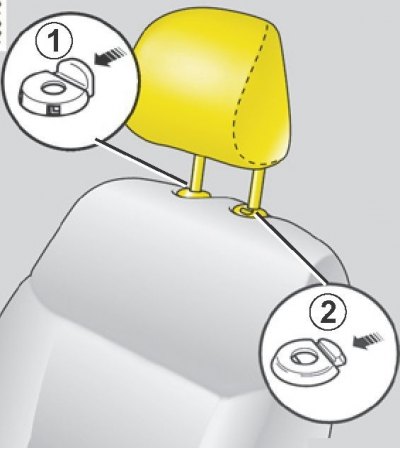
Height adjustment
Press the lock 1 and at the same time move the headrest.
Removal the headrest
Press the locks 1 and 2 of the headrest guides.
Installation
Insert the headrest rods into the holes in the guide bushings so that the grooves on the rods face the front of the vehicle and adjust the headrest to the desired height.
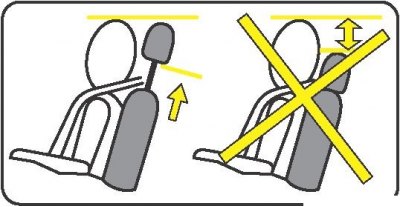
Since the headrest is one of the safety elements, make sure it is present and installed correctly: the top edge of the headrest should be as close to the top of the head as possible.
Moving seats forward or backward
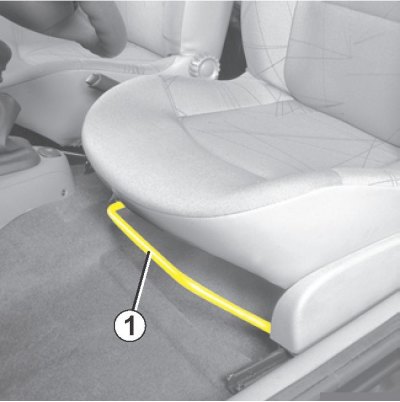
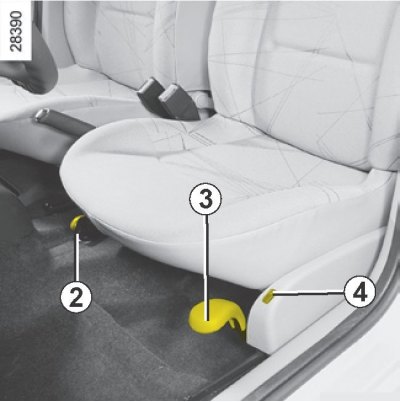
To unlock the seat, lift the bracket 1 or lever 3.
After setting the seat to the desired position, release the lever or bracket and check that the seat is securely fixed.
Driver's seat height adjustment
Use lever 2.
For safety reasons, make all adjustments with the vehicle stationary.
Adjusting the seat backrest tilt
 |
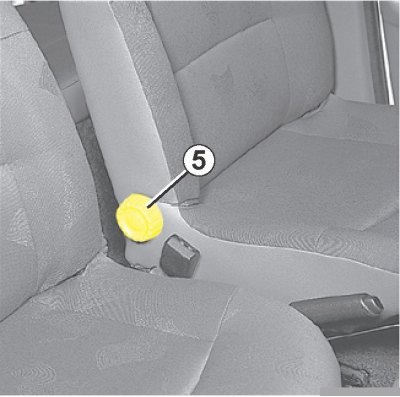 |
Turn knob 5 to set the seat back to the desired position.
Heated seats
(depending on the vehicle modification)
With the engine running, press switch 4. The signal lamp built into the switch will light.
The temperature stabilizing system determines whether heating is necessary or not
To avoid reducing the effectiveness of the seat belts, it is recommended not to recline the seat backs too far back.
On the floor (in front of the driver) there should not be any objects, because in case of sudden braking they can get under the pedals and prevent them from moving.
for your safety, always wear your seat belts while driving. Also, follow the traffic regulations of the country you are in.
Before starting the engine, adjust the driver's seat, then all passenger seats, and adjust the seat belts to ensure the best protection.
Incorrectly adjusted or twisted seat belts can cause injury in a crash.
Use the seat belt only for one person, child or adult.
Even pregnant women should wear a seat belt. In this case, you need to make sure that the pelvic branch of the belt does not press too hard on the lower abdomen, but does not sag either.
Adjusting the driver's seat
- Sit deep in the seat (taking off your coat, jacket, etc.). This is important for proper back position.
- Adjust the position of the seat relative to the pedals. The seat should be moved as far back as possible, but still allow you to press the clutch pedal all the way down. The seat back should be positioned so that your arms holding the steering wheel are slightly bent at the elbows.
- Adjust the position of the steering wheel.
- Adjust the position of the headrest. For maximum safety, the distance between your head and the headrest should be minimal.
- Adjust the seat height. This adjustment will give you the best view through the windshield.
Adjusting seat belts
Sit on the seat, leaning back fully.
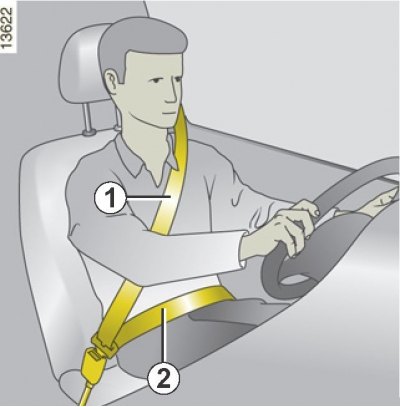
The shoulder branch of the 1st belt should be positioned as close as possible to the lower part of the neck, but not rest on it.
The waist branch of belt 2 should fit snugly against the hips and support the pelvis.
The seat belt should fit as tightly as possible to the body. For example, do not wear bulky clothing when riding in a car, do not put any objects under the belt, etc.
Driver's seat belt warning light

The lamp lights up with a constant light, when the speed reaches approximately 10 km/h the lamp flashes for approximately 90 seconds and a sound signal is emitted, then the lamp lights up with a constant light again.
Seat belts in the rear seats
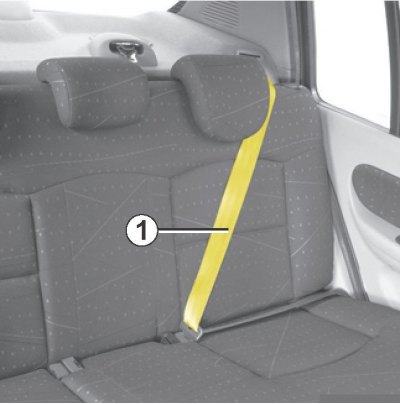
Rear side seat belts 1
Fastening, unfastening and adjusting the rear seat belts is the same as for the front seat belts.
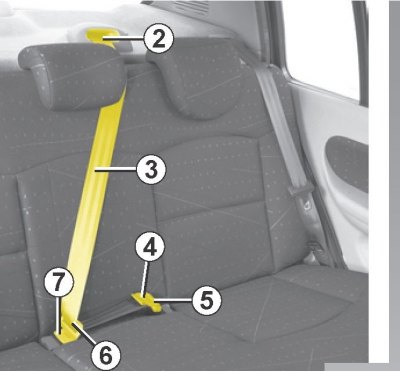
Rear center seat belt 3
Slowly pull belt 2 out of the socket.
Snap the black buckle 4 into the black lock 5.
Finally, snap the sliding buckle 6 into the red lock 7.
To ensure the effectiveness of the seat belts, make sure the seat is securely locked. See "Rear Seat: Functionality".
Additional safety device
The rear side seat belts are equipped with a force limiter.
This device is activated at a certain impact force to limit the force of the belt pressing on the torso.
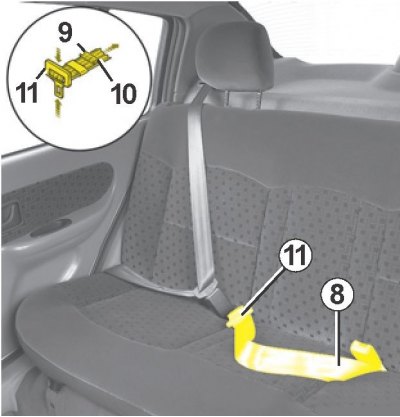
Lap branch of the seat belt with manual adjustment 8
The belt should fit snugly around your hips and support your pelvis.
The seat belt should fit as tightly as possible to the body. For example, do not wear bulky clothing when riding in a car, do not put any objects under the belt, etc. To tighten the belt, pull the free end 9 of the belt.
To loosen the belt tension, set the adjuster 11 perpendicular to the belt, press the adjuster towards the bracket and simultaneously pull the lap section of the belt 10.
The information below applies to the front and rear seat belts of your vehicle.
- It is strictly forbidden to make any changes to the design of the security system elements (belts and seats, as well as their fastenings), installed on the vehicle.
- Do not use anything to loosen the belt from your body (for example, clothespins, clamps, etc.): A seat belt that is too loose may cause injury in an accident.
- Never pass the shoulder strap under your arm or behind your back.
- Do not use the same belt to secure more than one person and never use the same belt with a child sitting on your lap.
- The seat belt must not be twisted.
- After an accident, check and replace the belts if necessary. Replacement should also be done if the belts show signs of wear or damage.
- When installing the rear seat, make sure the seat belts are threaded correctly so that they can be used for their intended purpose.
- While the vehicle is moving, adjust the position and tension of the belt if necessary.
- Make sure that the belt buckle is inserted into the appropriate lock.