



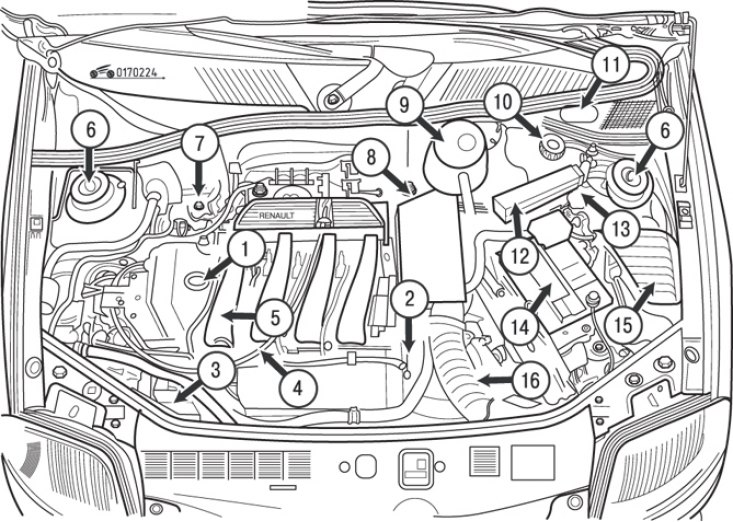
Fig. 2.24. Location of units and service points in the engine compartment: 1 – engine oil filler cap; 2 – oil dipstick; 3 – Power steering pump; 4 – accelerator pedal cable; 5 – inlet manifold; 6 – upper supports of the front suspension struts; 7 – brake system reserve tank; 8 – air filter; 9 – expansion tank of the engine cooling system; 10 – reserve tank of the power steering system; 11 – Windshield washer fluid reservoir; 12 – Electronic control unit (ECU); 13 – inertial fuel shut-off valve; 14 – battery; 15 – fuse box; 16 – air intake duct
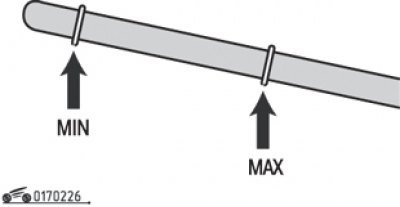
Fig. 2.26. Oil dipstick (lower part)
Stop the engine. After 5 minutes, remove the dipstick (see fig. 2.24), wipe its rod with a clean cloth and lower it back into the guide tube until it stops. Remove the dipstick again and check the oil level along the edge of the dipstick. It should be between the "MIN" and "MAX" marks (Fig. 2.26). About one liter of oil fits between these marks in the engine crankcase. If the oil level is low, open the oil filler cap and gradually, carefully, preferably through a funnel, add oil to the upper "MAX" mark on the dipstick.
Attention! Excess or lack of oil is unacceptable.
If you have to top up the oil too often, it may be due to increased wear of the valve stem seals and piston rings or leaks in the engine connections. If the engine surface is contaminated with oil, inspect the possible leak points:
Original of this article on the website [RenaultBook.ru]
- cylinder head cover gasket;
- oil separator gasket;
- cylinder head gasket;
- oil filter gasket;
- engine crankcase drain plug;
- engine crankcase gasket;
- front and rear crankshaft oil seals.
To accurately locate the oil leak, follow these steps:
- insulate the generator with plastic wrap;
- flush the engine with a special product to remove dirt and oil;
- sprinkle the possible leak areas with talc or ground chalk and remove the film from the generator;
- warm up the engine by driving 25-30 km at high speed;
- after stopping, wait 5 minutes for the oil to drain into the oil pan, and carefully inspect the engine for oil leaks.
Check the oil for cleanliness by removing the dipstick and passing it between your thumb and forefinger. If dirt or metal particles are found, the oil must be replaced.
Pay attention to the condition of the oil. If it is milky or if drops of moisture can be seen in its composition, this indicates a leak in the cylinder head gasket or a crack in the cylinder head or block.
Top up the oil that was poured into the engine (the same brand and quality).