
English Русский
Български
Беларускі
Український
Српски
Hrvatski
Română
Polski
Slovenský
Magyar
Bookmark Contacts Articles Sitemap
Company vehicles Peugeot Company vehicles Opel Company vehicles Skoda Company vehicles Land Rover Company vehicles Mitsubishi Company vehicles Volkswagen Company vehicles Honda
RenaultBook.ru


Duster   Fluence   Kangoo   Laguna   Logan   Megane   Sandero   Scenic   Symbol   Clio   Other
Symbol 1 (1999-2008, petrol) Symbol 2 (2008-2013, petrol)

Removal, checking and installation the front brake disc (Renault Symbol 1)

  • Main
  • Symbol
  • Symbol 1 (1999-2008, petrol)
  • Chassis, running gear
  • Brake system
  • Removal, checking and installation the front brake disc
0
To maintain uniformity and braking efficiency, it is recommended to replace both discs if at least one requires replacement. At the same time, the brake pads are also replaced with new ones.

Work order:
  • raise the front of the car and place supports under the body;
  • remove the wheel from the desired side;
  • remove the wheel caliper assembly from the brake disc as described above and tie it up away from the work area without putting tension on the brake hose;
  • mark the position of the brake disc on the hub in an accessible way;
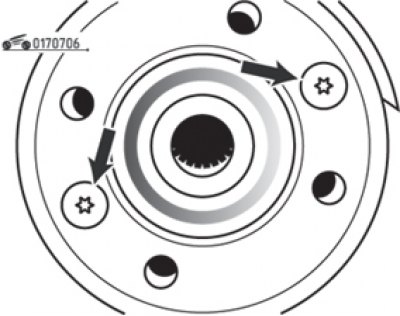
Fig. 7.6. Screws for fastening the brake disc to the wheel hub (arrows)

Fig. 7.6. Screws for fastening the brake disc to the wheel hub (arrows)

  • using a T40 socket wrench, unscrew the two screws securing the disc to the hub (Fig. 7.6) and remove the disc. If removing the disc is difficult, tap it with a rubber hammer;
  • clean the disk from dirt and rust;
  • check the brake disc. Measure the disc thickness in several places with a micrometer and compare it with the permissible one. If at least one place the disc thickness is less than the permissible one, both discs must be replaced;
  • minor scratches and grooves on the disc surfaces are allowed. In case of significant surface irregularities, the disc can be turned on a lathe, ensuring that the disc thickness does not exceed the permissible limits;
  • check the disc for cracks, which may appear in the area of the wheel mounting bolts. If cracks are found, replace both discs;
  • clean the mating surfaces of the disc and hub;
  • install the disk on the hub according to the marks made and tighten the mounting screws to the specified torque;
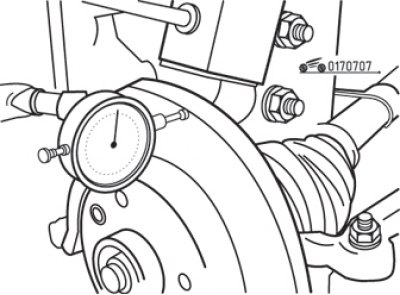
Fig. 7.7. Measuring the runout of the brake disc with a dial indicator

Fig. 7.7. Measuring the runout of the brake disc with a dial indicator


[View the original source on this resource: RENAULTBOOK.ru]
  • check the disk runout at several radii using a dial indicator (Fig. 7.7). If the disk runout exceeds the permissible limit, you can try moving the disk by 180°. Install the disk and check the runout again. If the runout exceeds the permissible limit, replace the disk;
  • perform the remaining operations in the reverse order of removal;
  • finally, press the brake pedal several times to allow the pads to move towards the disc and into working position.
This article is available on: russian, bulgarian, belarusian, ukrainian, serbian, croatian, romanian, polish, slovak, hungarian
Article has been reviewed by editor: Podkrepilov Maxim
Share with friends:
Previous
Symbol 1: Brake system
Next

Removal, installation and repair of the front brake caliper
Replacing the front brake pads
General information about the braking system
Removal and installation the front pressure regulator
Removal and installation rear brake drums
Removal, checking and installation rear brake pads
Removal and installation the rear wheel brake cylinder
Removal and installation the master brake cylinder
Other articles on other Renault models

➽ Front brake disc protective cover Renault Duster 1 (2009-2017)
➽ Front brake disc Renault Fluence 1 (2009-2020, petrol)
➽ Checking the brake disc Renault Logan 2 (2012-2020)
➽ Checking the front brake pads and discs Renault Megane 1 (1995-2002)
➽ Front Disc Brake Caliper — Removal and Installation Renault Espace I and II (1984-1996)
Link to this article in different formats
Reviews and comments of visitors
No comments yet


Add two numbers 34 + 20


Symbol 2 (2008-2013, petrol) 
  • General information
  • User manual
  • Maintenance
  • Power unit
  • Engine repair
  • Cooling system
  • Fuel system
  • Exhaust system
  • Ignition system
  • Transmission
  • Clutch
  • Mechanical gearbox
  • Automatic gearbox
  • Drive shafts
  • Chassis, running gear
  • Front suspension
  • Rear suspension
  • Steering
  • Brake system
  • Body and interior
  • Exterior (external elements)
  • Interior (internal elements)
  • Doors, locks and windows
  • Heating and ventilation
  • Electrical equipment
  • Equipment and devices
  • Headlights and lighting
  • Power devices
  • Electrical circuits
Symbol 1 (1999-2008, petrol) 
  • General information
  • User manual
  • Car care
  • Maintenance
  • Power unit
  • Engine repair
  • Cooling and lubrication system
  • Supply system
  • Exhaust system
  • Ignition system
  • Transmission
  • Clutch
  • Mechanical gearbox
  • Automatic gearbox
  • Drive shafts
  • Chassis, running gear
  • Car suspension
  • Steering
  • Brake system
  • Body and interior
  • Exterior (external elements)
  • Interior (internal elements)
  • Doors, locks and windows
  • Restoration and repair
  • Electrical equipment
  • Equipment and devices
  • Headlights and lighting
  • Power devices
  • Heating and ventilation
  • Electrical circuits
RenaultBook.ru © 2018–2026 | Mobile version | News and articles | Sitemap: EN BG BY UA RS HR RO PL SK HU | Administration | Site search | Bookmark
Duster 1 (2009-2017) | Fluence 1 (2009-2020, petrol) | Kangoo 1 (1997-2007) | Laguna 2 (2001-2007) | Logan 1 (2004-2012, petrol) | Logan 2 (2012-2020) | Megane 1 (1995-2002) | Megan 2 (2002-2009, petrol) | Sandero 1 (2007-2012, petrol) | Scenic 1 (1996-2003) | Symbol 1 (1999-2008, petrol) | Symbol 2 (2008-2013, petrol) | Renault 19 (1988-1996) | Espace I and II (1984-1996) | Espace III (1996-2002) | Clio 1 (1990-1998) |
We want your visit to be comfortable 😌 and use cookies 🍪 to do so.