
English Русский
Български
Беларускі
Український
Српски
Hrvatski
Română
Polski
Slovenský
Magyar
Bookmark Contacts Articles Sitemap
Company vehicles Peugeot Company vehicles Opel Company vehicles Skoda Company vehicles Land Rover Company vehicles Mitsubishi Company vehicles Volkswagen Company vehicles Honda
RenaultBook.ru


Duster   Fluence   Kangoo   Laguna   Logan   Megane   Sandero   Scenic   Symbol   Clio   Other
Megane 1 (1995-2002) Megan 2 (2002-2009, petrol)

Disassembling a manual gearbox (Renault Megane 2)

  • Main
  • Megane
  • Megan 2 (2002-2009, petrol)
  • Transmission
  • Mechanical gearbox
  • Disassembling a manual gearbox
0
Contents: Removal gears 🠛 Checking the details 🠛 Installing a group of gears 🠛
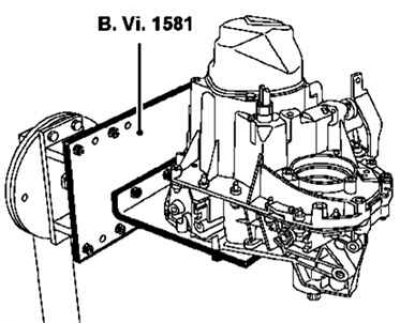
Install the mounting plate (B.Vi.1581) onto the stand (Desvil).

Fig. 3.55. Installing the gearbox on the mounting plate

Fig. 3.55. Installing the gearbox on the mounting plate


Install the gearbox on the mounting plate (B.Vi.1581) (Fig. 3.55).

Remove the clutch release slave cylinder.
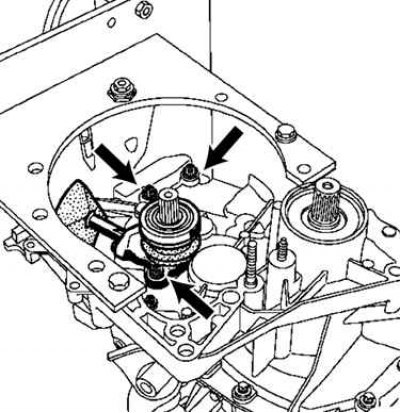
Fig. 3.56. Bolts located inside the crankcase

Fig. 3.56. Bolts located inside the crankcase


Unscrew the bolts located inside the crankcase (Fig. 3.56).
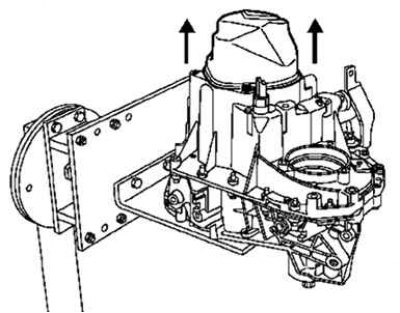
Fig. 3.57. Removing the rear casing

Fig. 3.57. Removing the rear casing


Remove the rear casing strictly along the horizontal axis of the box, as it includes a capsule with grease located in the hole of the primary shaft (Fig. 3.57).
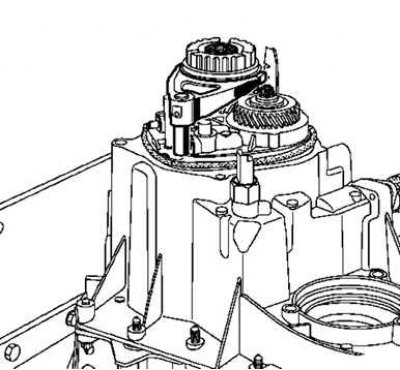
Fig. 3.58. Disengaging first and fifth gears

Fig. 3.58. Disengaging first and fifth gears


Engage first gear with the gear shift lever, and fifth gear by sliding its fork along the rod (Fig. 3.58).

Remove the secondary shaft bolt and the primary shaft nut.

Using a core (B.Vi.31-01), knock out the fifth gear fork pin.
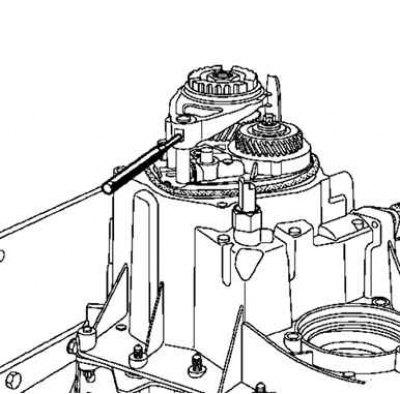
Fig. 3.59. Removing the fifth gear fork pin

Fig. 3.59. Removing the fifth gear fork pin


Remove the fifth gear fork and clutch.

Remove the fifth gear hub using the tool (B.Vi.1170).
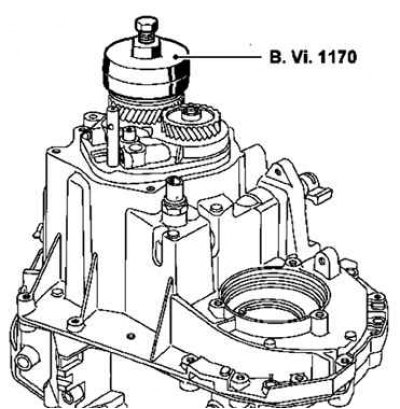
Fig. 3.60. Removing the hub

Fig. 3.60. Removing the hub


Set the toothed clutch of the device (B.Vi.1170) to the position of the engaged fifth gear, turning it so as to align the splines of the toothed clutch and the hub, and remove the device together with the hub (Fig. 3.60).
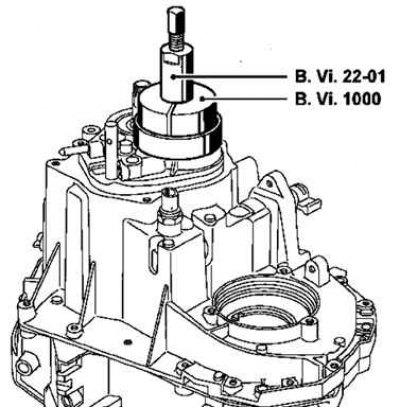
Fig. 3.61. Removing the fixed fifth gear pinion

Fig. 3.61. Removing the fixed fifth gear pinion


Remove the fixed fifth gear pinion using tools (B.Vi.22-01 and B.Vi.1000) (Fig. 3.61).

Remove the outer transmission case bolts.
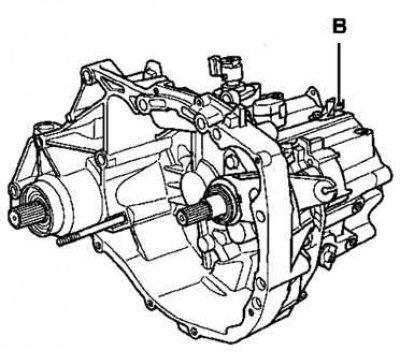
Fig. 3.62. Removing the speed sensor

Fig. 3.62. Removing the speed sensor


Remove the speed sensor B (for semi-automatic gearbox JH1) (Fig. 3.62).
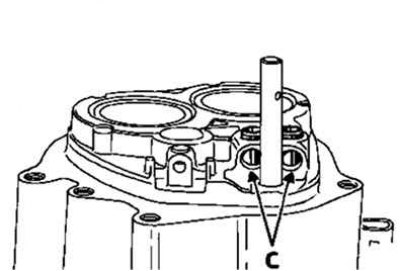
Fig. 3.63. Openings C that need to be covered

Fig. 3.63. Openings C that need to be covered


It is recommended to install two magnets or cover holes C in order not to lose the balls and springs that fix the 1/2 and 3/4 rods (Fig. 3.63).
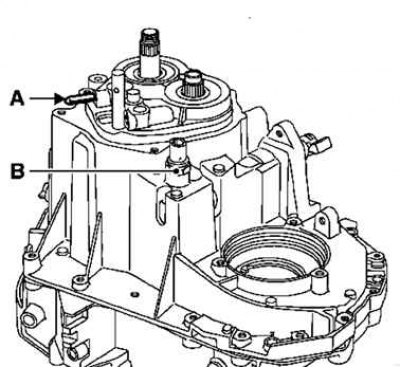
Fig. 3.64. Removing the rod and reverse contactor

Fig. 3.64. Removing the rod and reverse contactor


Remove the reverse rod A and the reverse contactor B (Fig. 3.64).

Press the shift rod outward.

Disconnect and remove the gearbox housing.
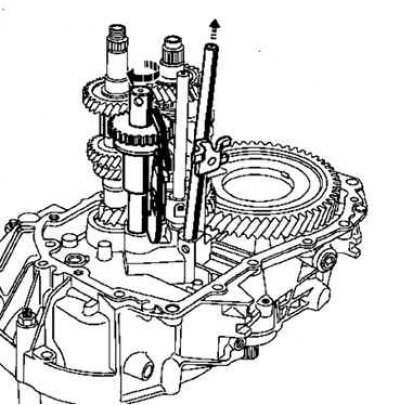
Fig. 3.65. Removing the shift fork rod «reverse/fifth gear »

Fig. 3.65. Removing the shift fork rod "reverse/fifth gear "


Turn the reverse gear shaft assembly to the left and remove the reverse/fifth gear shift fork rod (Fig. 3.65).
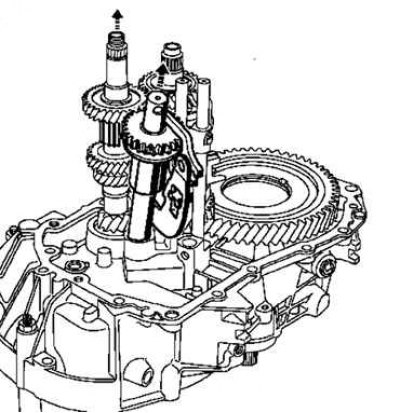
Fig. 3.66. Removing the reverse gear axle assembly

Fig. 3.66. Removing the reverse gear axle assembly


Slightly lift the input shaft and remove the reverse gear axle assembly (Fig. 3.66).

Disconnect the 3/4 fork pins using the tool (B.Vi.949) and remove the 3/4 fork and stem assembly.
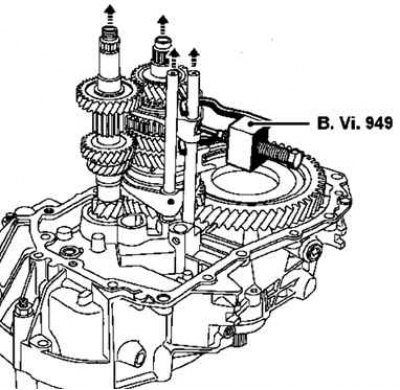
Fig. 3.67. Removing the assembly of the rod and fork 3/4, the primary and secondary shafts with the…

Fig. 3.67. Removing the assembly of the rod and fork 3/4, the primary and secondary shafts with the rod and fork 1/2


At the same time, remove the primary and secondary shaft assembly with the rod and fork 1/2 (Fig. 3.67).
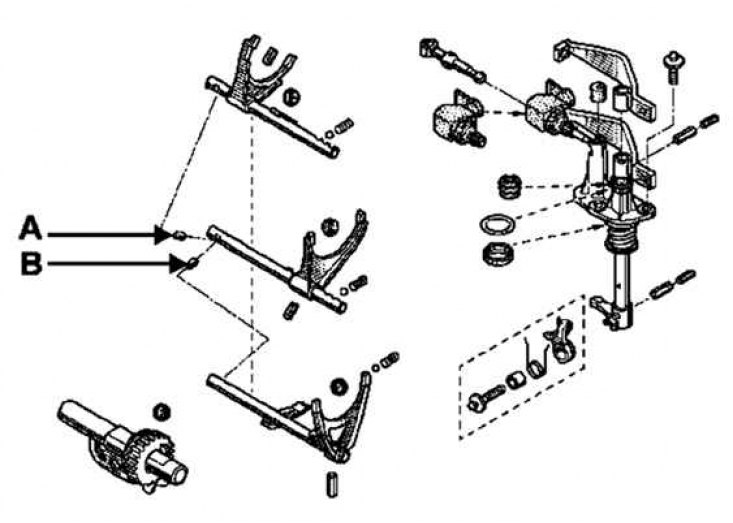
Fig. 3.68. Removing the locking pins

Fig. 3.68. Removing the locking pins


Remove locking pins A and B (Fig. 3.68).

Removal gears


Clamp the secondary shaft in a vice with jaws, then remove all gears.
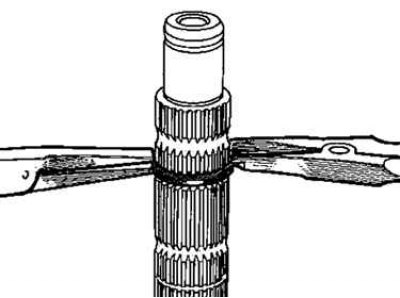
Fig. 3.69. Removing the retaining rings

Fig. 3.69. Removing the retaining rings


When removing and installing snap rings, use snap ring pliers on one end and flat-nose pliers on the other (Fig. 3.69).

Checking the details


The teeth of gears and couplings should not be too worn or have nicks.

Also, make sure that there are no signs of friction or excessive wear on the shaft surfaces and the inner surfaces of the gears.

It is recommended to mark the position of the gear couplings relative to the hubs.

Installing a group of gears


Perform installation in the reverse order of removal.

The retaining rings must be replaced regularly.
This article is available on: russian, bulgarian, belarusian, ukrainian, serbian, croatian, romanian, polish, slovak, hungarian
Article has been reviewed by editor: Kupriyanov Sergey
Share with friends:
Previous
Megan 2: Mechanical gearbox
Next

Removal and installation of a manual gearbox
Removal, replacing and installing the differential seal (ND0)
Removal, replacing and installing differential seal (JH3, JR5)
Precautions to take during work
Draining and filling oil
Replacing bearings in the gearbox housing
Removal and installation gears
Replacing the primary shaft bearings
Replacing the bearing on the clutch housing side
Adjusting the secondary shaft bearing pre-tension
Other articles on other Renault models

➽ Removal and installation of a manual gearbox Renault Laguna 2 (2001-2007)
➽ Disassembling the gearbox Renault Logan 2 (2012-2020)
➽ Manual gearbox — design features Renault Sandero 1 (2007-2012, petrol)
➽ Removal a manual gearbox Renault Symbol 1 (1999-2008, petrol)
➽ Camshaft oil seal on gearbox side Renault Duster 1 (2009-2017)
Link to this article in different formats
Reviews and comments of visitors
No comments yet


Add two numbers 28 + 42


Megan 2 (2002-2009, petrol) 
  • User manual
  • Introduction to manual
  • Controls and instruments
  • Salon equipment
  • Operation and driving
  • Maintenance and care
  • Power unit
  • Engine repair
  • Fuel system
  • Injection system
  • Intake and exhaust system
  • Starting and charging system
  • Cooling system
  • Decreased toxicity
  • Transmission
  • Clutch
  • Mechanical gearbox
  • Automatic gearbox
  • Wheel drive mechanism
  • Chassis, running gear
  • Suspension and wheels
  • Steering
  • Brake system
  • Body and interior
  • Exterior (external elements)
  • Interior (internal elements)
  • Doors, locks and windows
  • Heating and air conditioning
  • Electrical equipment
  • Equipment and devices
  • Headlights and lighting
  • Electrical circuits
Megane 1 (1995-2002) 
  • General information
  • User manual
  • Maintenance
  • Power unit
  • Petrol engines 1.4/1.6 l
  • Petrol engines 2.0 l
  • Diesel engines 1.9 l
  • Overhaul of engines
  • Cooling system
  • Fuel system (petrol)
  • Fuel system (diesel)
  • Decreased toxicity
  • Charge and launch systems
  • Ignition system (petrol)
  • Preheat system (diesel)
  • Transmission
  • Clutch
  • Mechanical gearbox
  • Automatic gearbox
  • Drive shafts
  • Chassis, running gear
  • Brake system
  • Car suspension
  • Steering
  • Body and interior
  • Exterior (external elements)
  • Interior (internal elements)
  • Doors, locks and windows
  • Electrical equipment
  • Equipment and devices
  • Electrical circuits
RenaultBook.ru © 2018–2026 | Mobile version | News and articles | Sitemap: EN BG BY UA RS HR RO PL SK HU | Administration | Site search | Bookmark
Duster 1 (2009-2017) | Fluence 1 (2009-2020, petrol) | Kangoo 1 (1997-2007) | Laguna 2 (2001-2007) | Logan 1 (2004-2012, petrol) | Logan 2 (2012-2020) | Megane 1 (1995-2002) | Megan 2 (2002-2009, petrol) | Sandero 1 (2007-2012, petrol) | Scenic 1 (1996-2003) | Symbol 1 (1999-2008, petrol) | Symbol 2 (2008-2013, petrol) | Renault 19 (1988-1996) | Espace I and II (1984-1996) | Espace III (1996-2002) | Clio 1 (1990-1998) |
We want your visit to be comfortable 😌 and use cookies 🍪 to do so.