



Loosen the wheel mounting bolts.
Raise the car.
Release the parking brake.
Make sure that the wheel is not deformed due to impacts (if there are any deformations, replace the damaged parts).
Turn the wheel with the valve facing up.
Install the wheel wrench.
Loosen the mounting bolts and remove the wheel.
Be sure to clean the bearing surfaces of the wheel and disc (or brake drum).
Keep the balancing stand support surface and all centering elements clean (ring, pusher pad, etc.).
Take precautions to avoid scratching the wheel rim (made of light alloy) device for fixing the wheel.
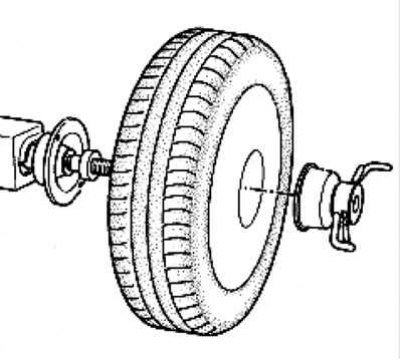
Fig. 4.11. Installing the wheel on the stand
Place the wheel on the stand (Fig. 4.11).
Some light-alloy wheels require a 200 mm diameter adapter to secure them securely.
Secure the wheel.
When turning on the balancing stand and entering the wheel parameters, turn on the "FIN" (precise) balancing mode.
If necessary, remove small stones from the tire tread pattern.
Enter individual wheel parameters when turning on the balancing stand.
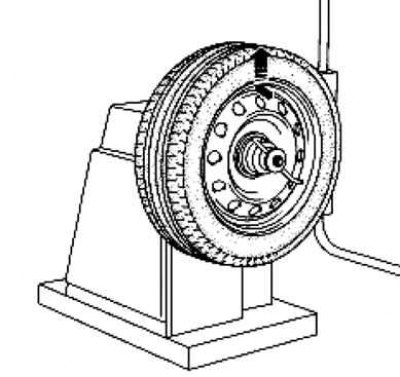
Fig. 4.12. Wheel balancing
Turn on the stand and check the wheel imbalance, which should be equal to 0 g in each plane of the wheel (Fig. 4.12).
If the imbalance exceeds the specified values, remove the previously installed balancing weights from the wheel and rebalance the wheel so that the imbalance does not exceed 0 g in each plane of the wheel.
Caution: To prevent the balancing weights from coming off, use only weights that match the vehicle's wheel rims.