



1. Pistons
The piston pin is pressed into the upper head of the connecting rod and rotates freely in the piston bosses.
Installation direction: arrow points towards flywheel.
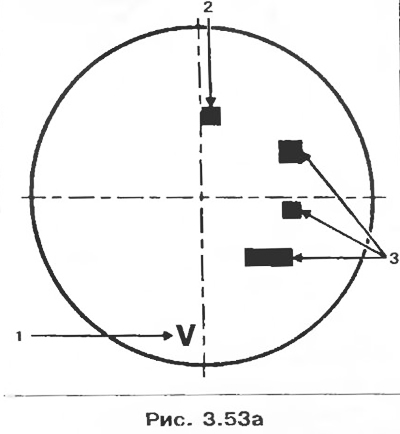
SMP piston
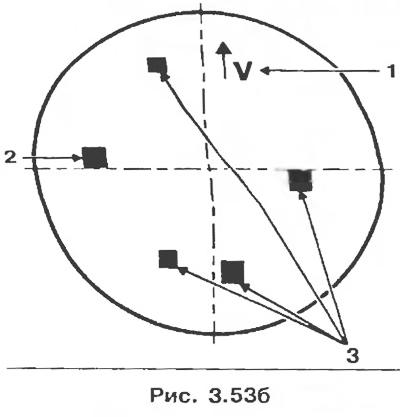
Metal Level Piston
Arrow 1 indicates the installation direction towards the flywheel.
The piston size group is indicated by mark 2 (piston group A-B-C).
Tags 3 are for the supplier.
Table 3.2. Selection of pistons to cylinder liners
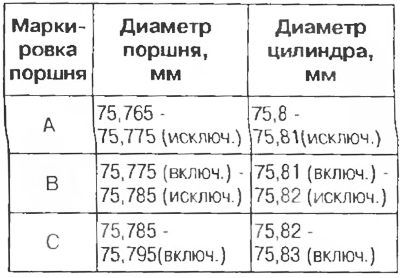
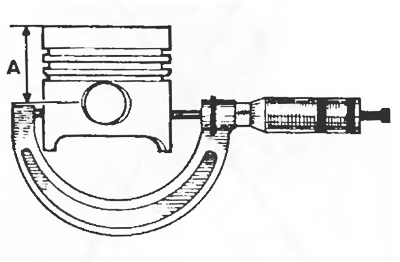
The piston diameter should be measured at a distance A = piston bottom.
2. Piston pins
Control dimensions, mm:
- length 60;
- outer diameter 19;
- inner diameter 11.
3. Piston rings
Thickness, mm:
- upper compression ring 1.5;
- lower compression ring 1.75;
- oil scraper ring 3.
4. Connecting rods
Lateral clearance of the lower connecting rod head, mm: 0.310-0.572.
Table 3.3

Caution! To avoid cracks in the connecting rod, do not use a center punch for marking. Use a permanent pencil.
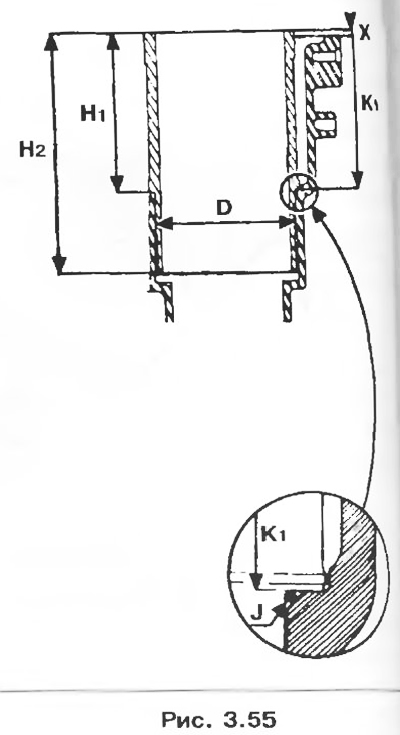
5. Cylinder liners
Use wetted type cylinder liners. They are fitted with J-rings of circular cross-section at the base.
Control dimensions, mm:
- height of sleeves: H2 = 130;
- inner diameter: 75.8+0.030;
- centering diameter D = 80.6;
- protrusion of sleeves without seal, X = 0.02-0.09;
- sleeve height H1 = 91.5+0.035+0.005;
- cylinder block depth: k1 = 91.5-0.015-0.055.
6. Crankshaft
Number of main bearings 5.
Axial clearance, mm:
- 0.045-0.852 with wear;
- 0.045-0.252 without wear.
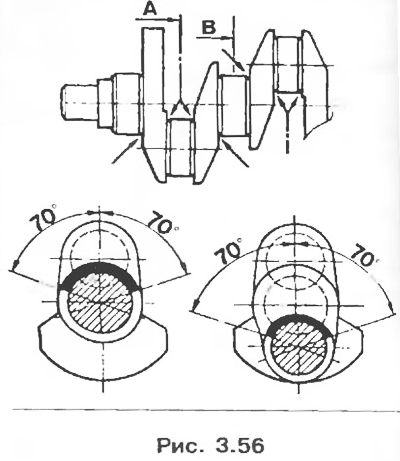
There are thrust half rings of different thicknesses.
When grinding, the fillets on the surface must remain intact in areas that form an angle of 140° (figure 3.56, arrows)
7. Parts that must be replaced when removed
All sealing cuffs and gaskets.
- Flywheel mounting bolts.
- Connecting rod cap mounting bolts.
- Crankshaft support mounting bolts.
Disassembly
1. Remove the power unit.
2. Secure the engine to the support plate Mot. 792-03 using rods Mot.1132. (figure 3.15, 3.16).
3. Drain:
- oil from the engine.
- coolant from the cylinder block (if there are drain plugs).
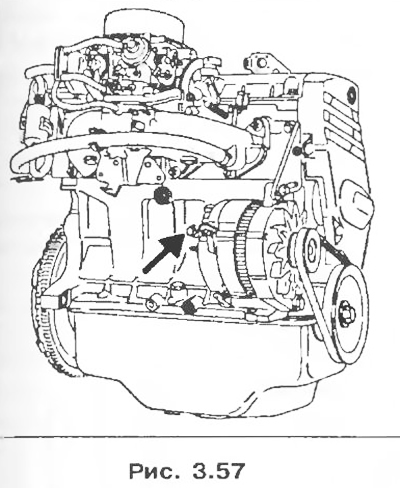
4. Tighten the drain plugs.
5. Remove:
- engine wiring;
- generator and its belt.
2. Remove the cylinder head (see section "Cylinder head gasket").
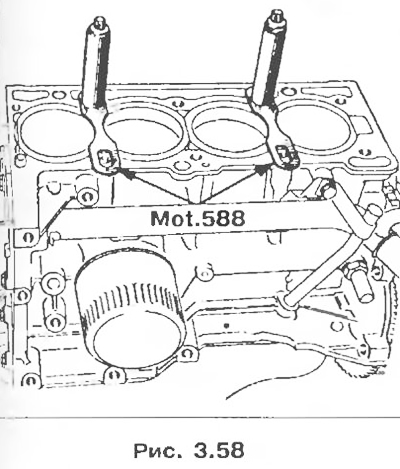
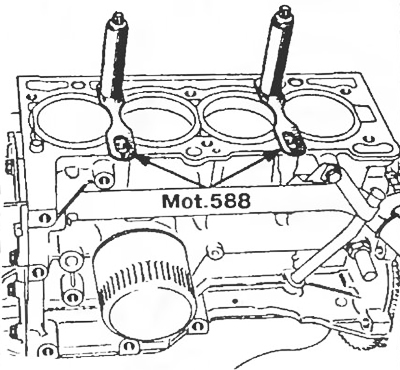
3. Fit flanges Mot. 588 to hold the cylinder liners.
4. Remove:
- coolant pipe and dipstick guide; they are equipped with O-rings that must be replaced after each removal;
- clutch mechanism and driven wheel;
- flywheel, locking it with device Mot. 582-01.
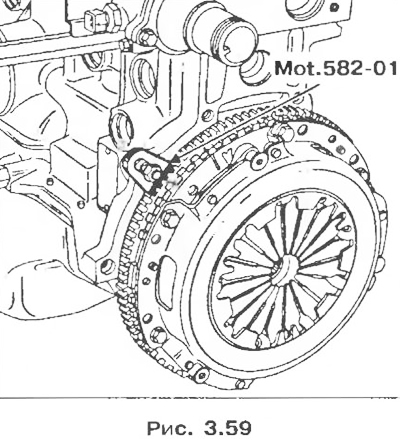
5. Remove the oil pan
6. Remove the crankshaft timing pulley. If necessary, use a locally fabricated tool together with the Rou shaft protector. 15-01.
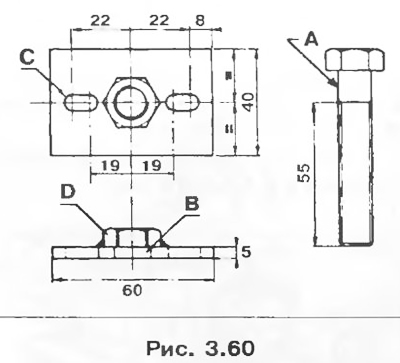
- And the bolt has a diameter of 12 mm, thread pitch of 1.75 mm.
- In one hole, diameter 13 mm.
- With two holes, diameter 6.5 mm.
- D welded nut with a diameter of 12 mm, thread pitch 1.75 mm.
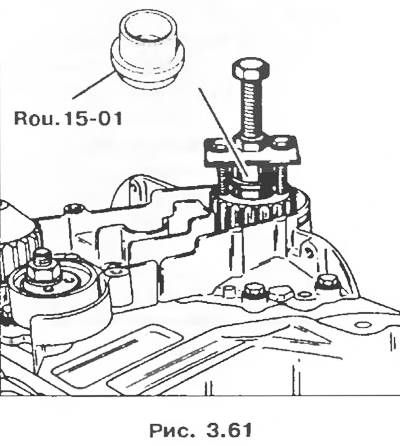
Note: The crankshaft timing pulley can be installed in one of two ways (the two fasteners are not interchangeable):
- - pulley with a keyway on the crankshaft;
- - a pulley with a keyway in the pulley itself.
7. Remove the crankshaft oil seal cover.
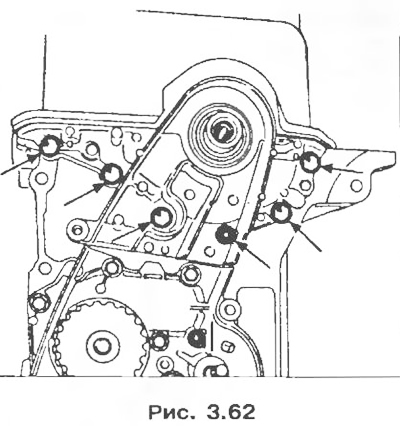
8. Remove:
- tension roller;
- coolant pump.
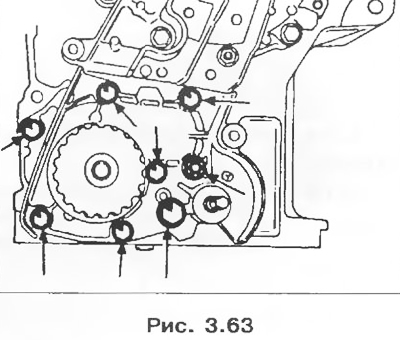
9. Remove:
- three bolts securing the oil pump drive gear, then the gear and chain;
- oil pump.
Mark the connecting rod caps in relation to their rods.
Caution! To prevent cracks in the connecting rods, do not use a center punch for marking. Use a permanent pencil.
10. Remove:
- connecting rod lower head caps and liners;
- flanges for holding cylinder liners Mot. 588;
- "cylinder-piston-connecting rod" group;
- main bearing caps with their liners (mark them);
- crankshaft (save the side thrust half rings).
2. Secure the cylinder liners using tool Mot. 588.
3. Install the bearing shells. The connecting rod bearing shells are identical. The crankshaft main bearing shells have grooves and are installed on the cylinder block. The upper bearing shell #5 is special and also has a groove.

The text is available on this website: RENAULTBOOK.ru
4. Install the crankshaft and side thrust half rings.
5. Lubricate the connecting rod and main journals of the crankshaft with engine oil.
6. Install the crankshaft main bearing caps.
7. Apply a thin layer of RHODORSEAL 5661 sealant to bearing #1 in area K (figure 3.77) and tighten the mounting bolts to a torque of 25 Nm, then turn further to an angle of 43±6°.
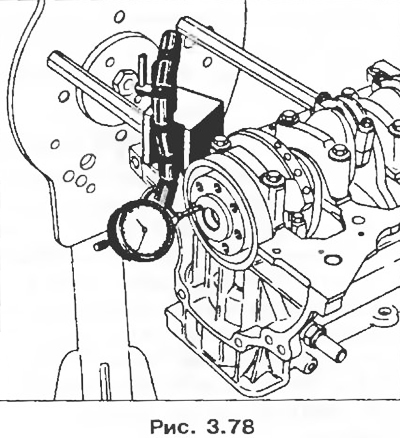
8. Check the crankshaft axial clearance:
- 0.045-0.852 mm if there is wear;
- 0.045-0.252 mm without wear.
The spare parts warehouse supplies thrust half rings of the following thickness, mm: 2.80; 2,85; 2,90; 2,95.
9. Install the connecting rod bearing caps and tighten the nuts to 42 Nm.
10. Check:
- connecting rod axial clearance;
- correct rotation of the crank mechanism.
11. Install:
- oil pump, making sure that the centering bushings are present, and tighten the bolts to 25 Nm;
- two gears and the oil pump drive chain, tighten the three gear-to-hub mounting bolts to a torque of 10 Nm.
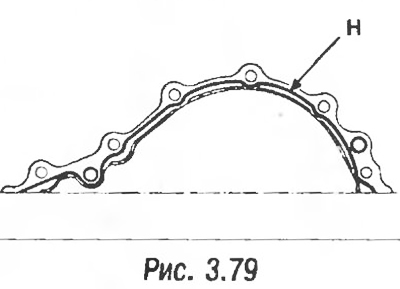
12. Install the crankshaft nose cover, securing it with Loctite 518 sealant. The bead of sealant H should have a width of 0.6 mm to 1 mm (figure 3.79).
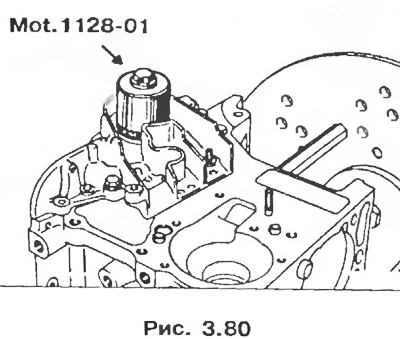
13. Install the crankshaft oil seal using tool Mot. 1128-01, lubricate the working edge and the outer surface of the seal with oil. Turn over the spacer sleeve if there is wear on the bearing surface of the crankshaft nose at the installation site of the old seal.
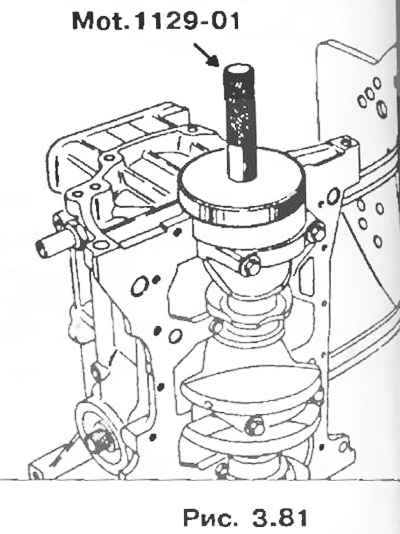
14. Install the crankshaft oil seal (bearing no. 1) using tool Mot. 1129-01 this tool allows you to align the seal contact points with the crankshaft. Lubricate the working edge and the outer surface of the oil seal.
15. Install the oil pan and tighten the mounting bolts to 10 Nm.
Note. The crankcase pan is sealed with special gaskets provided for after-sales service, with the exception of the E7J 764 engine, which uses RHODORSEAL 5661 sealant for sealing. The sealant roller should have a width of.
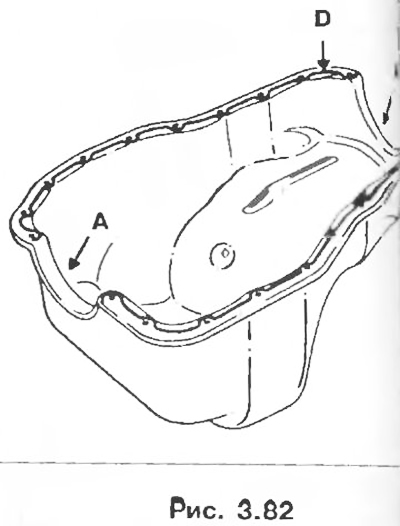
Don't forget to replace the two semi-circular sealing gaskets in sections A with new ones and apply AUTOFORM sealant to the flywheel/crankshaft bearing surface.
16. Install the flywheel and lock it with tool Mot. 582-01. Apply a drop of Loctite FRENETANCH sealant and tighten them to a torque of 50-55 Nm.