



Contents: Oil specifications 🠛 Oil viscosity 🠛 Which oil to buy? 🠛 High performance oils 🠛 Motor oil additives 🠛
For Renault 19 engines, the manufacturer recommends oil of the "HD" brand, according to the CCMC designation (Committee of Common Market Automobile Constructors = association of European automobile manufacturers). Along with this designation, there is another one - the American Petroleum Institute (aPI system with SG/CD), general Motors and the US Army (MIL).
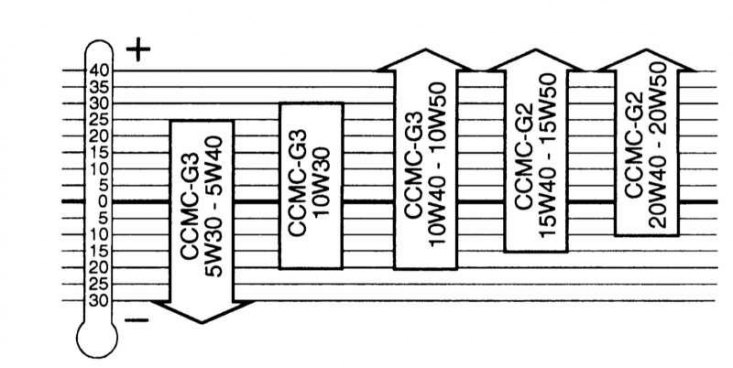
The table shows the recommendations of Renault 19 manufacturers depending on the viscosity of the oil. You can determine that at our latitude, it is sufficient to use oil of class 10 W-30 viscosity, since the minimum and maximum temperature values indicated in the table should be considered as long-term. Short-term changes in this temperature range do not play any role.
Oil specifications
Renault 19 engine oil must have one of the following designations:
- CCMC-G2 or CCMC-G3 for internal combustion engines and, respectively, CCMC-PD1 for diesel engines;
- SG/CD API (currently the highest quality);
- MIL-L-46 152 A or MIL-L-46 152 B.
- You can buy oil with this marking without any fear, even if it is significantly cheaper than the brand of oil you know.
Oil viscosity
The fluidity characteristics of oil (viscosity) - whether it is thick or liquid - determine the following important points:
[This article is taken from the website www.RenaultBook.ru]
- will the starter be able to turn over a cold engine;
- are all rubbing surfaces lubricated immediately after starting a cold engine?;
- whether the oil film is maintained at high temperatures and engine speeds. The Society of Automotive Engineers has classified oils according to their viscosity into the following classes:
- liquid winter oils SAE 5 W, 10 W, 15 W;
- medium viscosity - SAE 20 W/20;
- thick summer oils SAE 30, 40 and 50;
- the cheapest, however, is single-component oil. For perfect lubrication of the engine, it should be thick or liquid, depending on the season. This means that in the fall, winter oil should be poured into the engine, and in the spring, summer oil;
- multi-component oil is significantly more expensive to produce and, accordingly, its retail price is much higher. This oil has a viscosity index (VI-), and its structure consists of long molecular chains that increase when heated and contract again when cooled. Due to this, the oil precisely matches temperatures and, according to its characteristics, fits several viscosity classes. For example, SAE 15 W-50 oil corresponds to viscosity class 15 W at a temperature of -15°C, and to class 50 at 100°C. The problem is that over time, the length of the molecular chains decreases. This means that the oil does not correspond to the upper viscosity class and is not as temperature-resistant as before.
Which oil to buy?
The table above shows which oil viscosity is required at what temperature. Renault recommends using a multi-component oil. For the Central European climate, viscosity grade 10 W-30 is sufficient throughout the year. Only at extremely high or low temperatures over a long period of time should another viscosity grade be used. Renault recommends the "ELF" grade of oil, but it is not necessary to adhere to this. The most important thing is to use oil of the required viscosity and specification.
High performance oils
This term refers to gasoline-saving and easy-running semi-synthetic oils, as well as synthetic multi-component oils. The difference between them is rather conditional. In any case, such oil is more expensive than mineral multi-component oil. These oils are recommended for use primarily due to their high resistance to oil sedimentation:
- very liquid when cold oil serves to ensure easy engine operation during warm-up and short-distance travel. It is possible to actually talk about reducing oil consumption by about 3%. Detergent additives are added to these types of oils.
- fully synthetic oils are the most expensive. They have a long service life and easily withstand high loads.
Motor oil additives
Most car manufacturers are very critical of the use of additives in lubricating oils. The use of additives often violates the manufacturer's recommendations for vehicle operation and may result in a refusal to perform warranty repairs.