



Contents: Repair location 🠛 Car jack 🠛
An important condition for servicing your Renault 19 is the availability of a suitable place and the necessary tools. A hard surface is a must if the vehicle needs to be lifted. It is also necessary to take care of the disposal of waste, such as old engine oil.
Repair location
The best place to service your car is a well-lit garage with enough space. In warm, dry weather, a site with hard ground in the fresh air is also suitable. Before work, you should sweep the area you have chosen thoroughly so as not to get dirty again and to be able to find small parts if they fall on the site.
Be careful when working with gasoline and oil on soil and asphalt. These liquids have a destructive effect on these surfaces. In addition, asphalt can soften under the sun's rays, causing dents from the jack and other devices. If there is a drain or manhole nearby, you should cover it during work, otherwise some small parts may get there. If you have an inspection pit, you should pay attention to the following: gasoline and other volatile substances can cause an accumulation of harmful gases in a poorly ventilated room. Be careful when working with open fire and when smoking! Also remember that when the engine is running, exhaust gases enter the inspection pit, which can lead to carbon monoxide poisoning.
Note: Often after work, traces of oil remain on the soil. To remove them, use dishwashing detergents. Special oil stain cleaners cope with this problem even better.
Attention! Always secure the vehicle in a stationary position!
Car jacks are designed only to lift the vehicle. They are in no way a reliable enough support for work under the bottom of the car. Therefore, never work under the bottom of the car without additional support! Otherwise, the repair may cost you your life. To properly secure the car, it is necessary, among other things, to put chocks under the wheels so that the car cannot roll.
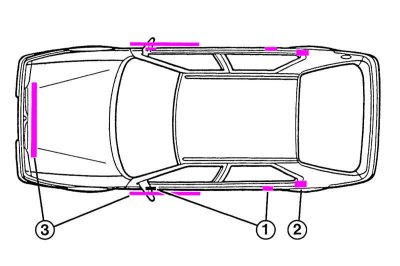
- 1 - support points for a car jack and lift, as well as additional support points, such as tripod mountings;
- 2 - support points for the mobile jack (be sure to place a hard board or rubber under the door threshold to distribute the pressure);
- 3 - support points for a mobile jack with a crossbar for distributing the load. In this case, special attention should be paid to the fact that protruding parts of the engine, such as, for example, the exhaust pipe and the crossbar do not touch. Therefore, a corresponding recess should be made on the crossbar.
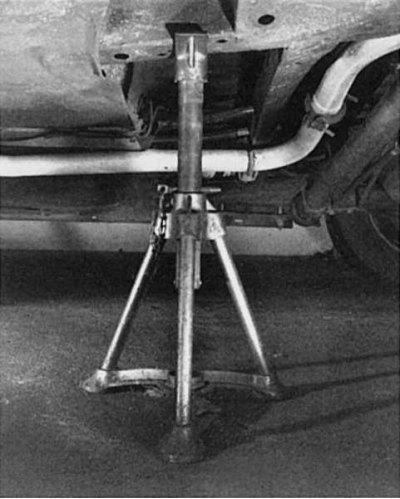
Tripod stands are an addition to the jack. Other devices for lifting the car can cause the car to fall towards the tripod. The best position for the tripod is when one of its supports is outside and the other two are inside relative to the edge of the car body. When buying, pay attention to the fact that the area on which the tripod rests is not too small. Be careful not to damage the metal of the car body when using tripods.
Original publication on the portal RENAULTBOOK.ru
Using a repair ramp is the most reliable way to install a car for repairs. The car is very secure in this case. It is also important that the ramp provides a good view and allows you to move the car back or forward if necessary. The disadvantage is that the front spoiler can be damaged when driving onto the ramp. To ensure additional safety, the ramp should have recesses for fixing the wheels. Cheap ramps often do not have these recesses.
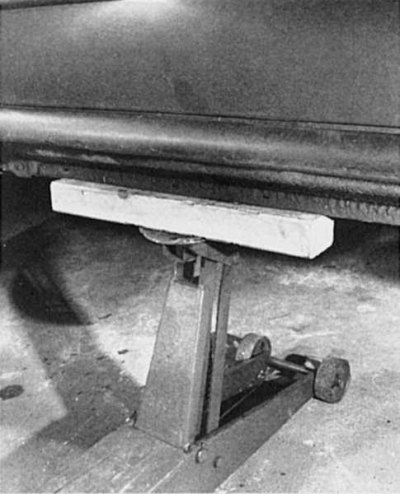
Left: For large installation jobs, use a sliding tripod. This is a good, but not entirely reliable, support. Set the tripod so that one of its legs is perpendicular to the car body to prevent tipping (as shown in the photo on the right): When using a mobile jack "outside" the prescribed support point, be sure to place a wooden block between the jack and the door threshold to evenly distribute the load and avoid deformation of the threshold.
 |
 |
Car jack
Standard car jack: with its help you can lift your Renault 19 to the height necessary for most repair works. By placing something under the jack you can increase the lifting height even more.
When installing the jack, it is necessary to place a small board under it so that its heel does not press through the soil.
Screw car jack: it makes sense to buy only a good jack of this type. Such a car jack is suitable primarily when the body at the jack support points is damaged.
Hydraulic Car Jack: it is really worth buying. The obvious advantage is that the hydraulic jack can quickly lift the car. Before buying, it is recommended to check the lifting height of the jack. If it is small, you will not be able to lift the wheels off the ground, and if you buy a jack that is too big, you will not be able to insert it under the bottom of the car.
Mobile car jack: If you decide to buy a jack of this type, it is important to choose a jack with an additional foot pedal for high lifting. For those who decide to repair their car themselves, a short, small jack of this type will do, which can easily be inserted under the bottom of the car. It should be noted that a jack with small wheels will not be able to move easily under load. It is also necessary to securely fasten the jack under the bottom of the car so that it can be maneuvered with it.