



Convergence: when stationary, the front wheels on a Renault are narrower at the back than at the front. They roll in different directions from each other. The fact that the rear parts of the wheels are closer than the front ones allows the drive forces to be balanced, which tend to bring the wheels together.
When cornering, this type of wheel arrangement works with the trapezoidal steering system so that the wheel moving along the inside curve of the turn turns more than the outside wheel. This makes cornering easier because the wheel moving along the inside curve travels a shorter distance than the wheel moving along the outside curve.
Front wheel camber angle
This is the name given to the installation of the front wheels at a slight angle - at the top of the Renault 19 wheel arch they are located further apart than at the bottom on the ground. In the language of specialists, this is called "positive" camber. Camber reduces the impact of impacts due to road irregularities on the control units and also reduces the force required to turn the steering wheel and the friction of the wheels on the ground.
Angle of transverse inclination of the kingpin axis: this term refers to camber. The term refers to the slight tilt of the steering axle so that the entire wheel suspension rotates when the steering wheel is turned. Both steering axles have a smaller interval at the top than at the bottom relative to each other. Camber and caster angle also prevent wheel vibration. In addition, they create a wheel rotation and provide a "counter-torque" due to which the steering wheel returns to its original position after turning.
Longitudinal inclination of the kingpin axis: this term refers to the installation of the steering axle at an angle to the longitudinal direction of the vehicle's movement. This position stabilizes the rectilinear movement by inertia and prevents angular oscillation of the front wheels. In addition, it helps return the steering wheel to its original position after turning.
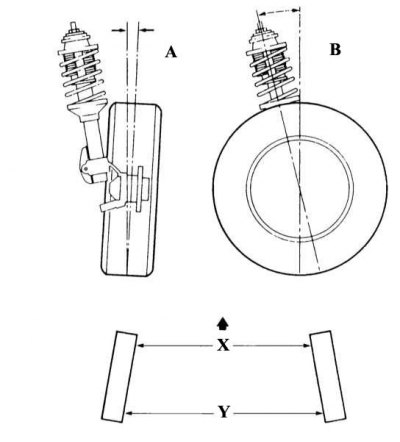
To explain the meaning of wheel alignment terms, we provide this figure:
A — Front wheel camber angle;
B — Longitudinal tilt of the kingpin axis;
The difference between X and Y is the toe-in of the front wheels.