



Checking the progress
1. The clutch pedal assembly includes an automatic regulator, the operation of which can be checked as follows.
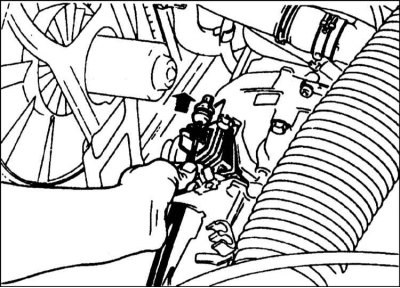
2. First, measure the clutch cable free play: without pressing the clutch pedal, pull the transmission-facing end of the cable out of its housing and measure the length of the exposed section. If the mechanism is working properly, the cable free play should be at least 20 mm. If not, check whether the toothed segment of the adjuster is jammed.
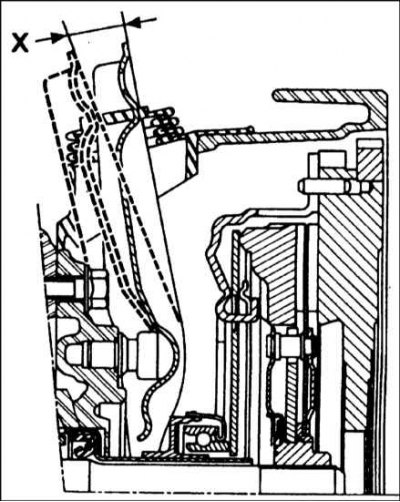
3. Have an assistant fully depress and release the clutch pedal and measure the total travel of the release fork end. If the mechanism is working correctly, the fork travel should be 27.4 - 30.7 mm (refer to the accompanying illustration). If this is not the case, inspect the automatic adjuster teeth for damage and check to see if the spring is weak. Also check to see if the cable is jammed in the housing.
Removal
1. Disconnect the ground cable from the battery (on Scenic models, refer to Chapter Engine electrical equipment).
Attention! If the car radio in your car is coded, make sure you know the code before disconnecting the battery.
2. On all engines except the E7J, remove the air cleaner assembly and its ducts (refer to Chapter Power and exhaust systems).
Text provided by an online resource (www.Renaultbook.ru)
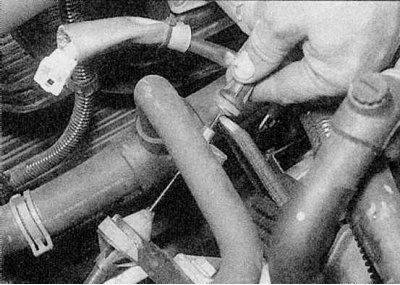
3. While working in the engine compartment, disconnect the end of the cable from the clutch release fork on the transmission.
4. Loosen the mounting screws and remove the lower steering column cover to gain access to the clutch pedal assembly.
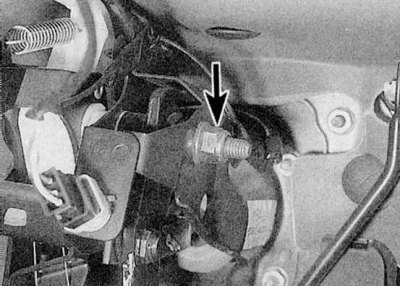
5. Loosen and remove the nut and washer from the pedal pivot shaft (refer to the accompanying illustration). Where applicable, remove the mounting nut/bolt and remove the bracket from the end of the axle.
6. Partially remove the clutch/brake pedal pivot shaft so that the clutch pedal can be removed together with the pivot bushings and spacer. Note the position of the pivot bushings to ensure correct pedal installation later.
7. Disconnect the clutch cable from the top end of the pedal, then unhook it from the toothed segment and remove the pedal assembly from the vehicle. Push the pedal pivot back into the operating position.
8. Inspect the pedal assembly for damage and signs of wear, paying particular attention to the automatic adjuster. Do not attempt to disassemble the assembly - its individual components are not sold. If the pedal assembly is damaged, it must be replaced as a whole. Replace the pivot bushings if they are worn or damaged.
Installation
1. Apply a small amount of general purpose grease to the working surfaces of the pedal bushings and spacer, as well as to the surfaces of the adjuster teeth.
2. Install the bushings onto the pedal, each in its original position. Make sure that the mounting protrusion of each bushing is aligned with the corresponding recess in the pedal, place the spacer in its working position.
3. Place the pedal assembly under the dashboard. Attach the end of the clutch cable to the adjuster, then move the pedal to the operating position.
4. Make sure the clutch cable is positioned correctly on the adjuster toothed segment, then install the bracket (where is available) and tighten its nut/bolt only by hand for now.
5. Push the pivot axle all the way into the working position, then install the washer and nut. Tighten the axle nut and bracket nut/bolt.
6. Attach the transmission end of the cable to the clutch release fork.
7. Press the clutch pedal several times, monitoring the position of the cable on the toothed segment. This will allow the automatic regulator to set the required free pedal travel.
8. Check the operation of the regulator as described above.
9. Install the lower steering column cover, air cleaner assembly and its ducts (where are there) and connect the ground cable to the battery.