



Contents: Engine F8Q 620 🠛 F8Q engines with turbocharger 🠛 F9Q Engines 🠛 Examination 🠛 Engine F8Q 620 🠛 Engines F8Q with turbocharger and F9Q 🠛
Engine F8Q 620
The system consists of glow plugs screwed into swirl chambers, a control unit mounted on a bulkhead in the engine compartment, and a coolant temperature sensor attached to the thermostat housing.
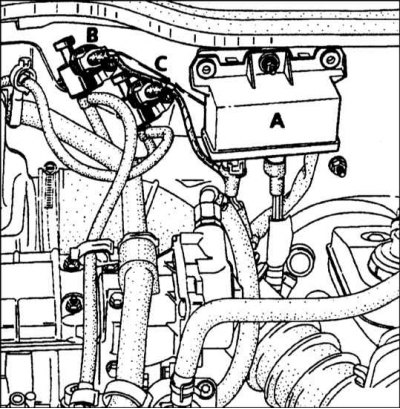
The glow plugs are fed by a control unit, which is also controlled by a fast idle solenoid valve (on models with air conditioning) and exhaust gas recirculation valve (refer to the accompanying illustration).
If preheating is necessary, it begins at the moment the ignition is turned on and partially continues until the engine is fully warmed up as follows.
When the ignition is turned on, the control lamp on the instrument panel lights up and power is supplied to the glow plugs, depending on the coolant temperature. (If the coolant temperature sensor is defective, the spark plugs are automatically energized for 14 seconds). In the second phase, after the indicator lamp goes out, power continues to be supplied to the glow plugs for another 8 seconds or until the engine starts. The glow plugs are powered continuously as long as the starter operates.
After the engine has started, all glow plugs receive current for another 10 seconds. Then the power supply depends on the coolant temperature and the engine load. Glow is temporarily interrupted if the control unit receives a "maximum load" signal from the microswitch on the fuel pump, and resumes if the microswitch contacts open again. Glow is completely switched off when the coolant temperature reaches 65°C, or after 30 seconds if the coolant temperature sensor is defective.
F8Q engines with turbocharger
The pre-glow system is controlled by the same ECU that controls injection timing, fast idle and EGR. The unit controls the glow plug relay and is located in the engine compartment.
When the ignition is turned on, the control lamp on the instrument panel lights up and power is supplied to the glow plugs, depending on the coolant temperature and altitude (the control unit contains a height sensor). After the indicator lamp goes out, power continues to be supplied to the glow plugs for another 8 seconds or until the engine starts. The glow plugs are powered continuously as long as the starter operates.
After the engine starts, all glow plugs receive current for another 10 seconds. Then the power supply depends on the coolant temperature, engine speed and load. Glow is temporarily stopped if the control unit receives a "maximum load" signal from the throttle lever potentiometer on the fuel pump; and resumes if the load is reduced again. The glow is switched off completely when the coolant temperature reaches 65°C, or after 190 seconds.
F9Q Engines
The pre-heating system is controlled by the injection system ECU, which is installed in the right front part of the engine compartment, near the fuel filter.
When the ignition is switched on, the indicator lamp on the instrument panel lights up and the glow plugs are supplied with power, depending on the coolant temperature. (If the coolant temperature sensor is defective, the glow plugs are automatically supplied with power for 14 seconds. After the indicator lamp goes out, the glow plugs are supplied with power for another 8 seconds, or until the engine starts. The glow plugs are supplied with power continuously as long as the starter operates, but not longer than 20 seconds and as long as the coolant temperature is below 60°C.
After the engine starts, all glow plugs are energized depending on the coolant temperature and engine speed. Glowing stops temporarily if the engine speed exceeds 2500 rpm, and permanently if the coolant temperature exceeds a certain value.
Examination
1. When a malfunction occurs in the system, checking the serviceability ultimately comes down to replacing it with known good units, but some preliminary checks can be performed as follows.
2. Connect a voltmeter or 12V test lamp between the glow plug supply cable and ground (engine or car body).
3. Have an assistant turn on the ignition and check that power is supplied to the glow plugs. Note the time the indicator lamp remains lit and the total time power is supplied before the system shuts off. Turn off the ignition.
4. At a temperature in the engine compartment of 20°C, the average time should be as follows: the control lamp should light for 5-6 seconds, and after it goes out, power should be supplied to the spark plugs for another 4-5 seconds (if the starter is not turned on). The indicator lamp will burn longer at lower temperatures, and vice versa.
5. If there is no power at all, the relay or associated wiring is faulty.
6. To identify a faulty glow plug, disconnect the power cable and attach a piece of wire to the center terminal of the glow plug. Be careful not to drop the nuts and washers.
7. Check the resistance between each glow plug terminal and ground. A good glow plug will have very low resistance (less than 1 ohm), and if the tester shows high resistance, the glow plug needs to be replaced.
8. If an ammeter is available, you can measure the current drawn by each glow plug. After the initial surge of 15-20A, the plug should draw about 10A. If the plug draws much less current, it is probably defective.
9. For a final check, the glow plugs can be removed and inspected as described in Section Removal, inspection and installation of glow plugs.
Engine F8Q 620
Pre-Glow Control Unit - Engine F8Q 620
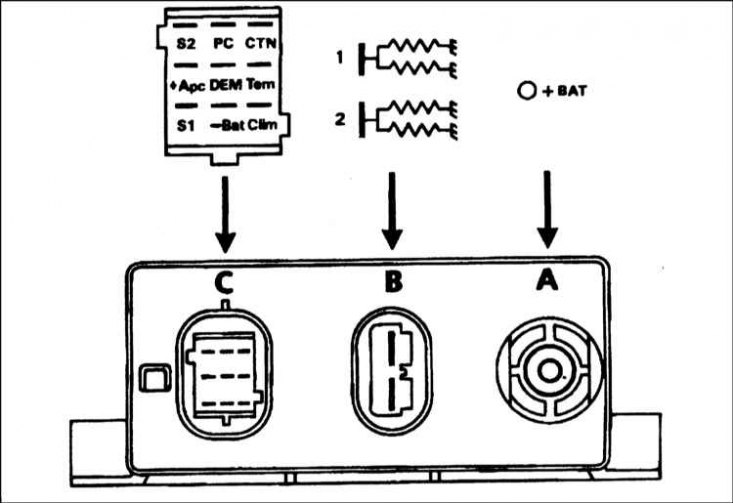
Connector A + battery: constant power supply
Connector B
1 - Power supply for glow plugs 1 and 3
2 - Power supply for glow plugs 2 and 4
Connector C
A1/S2 — Boost control solenoid valve
A2/RS - Signal from the microswitch on the throttle lever
A3/CTN - Signal from the coolant temperature sensor
In 1/+ APC - Ignition Controlled Positive Supply
B2/DEM - Starter signal
B3/Tem — Control of the heating indicator lamp (through the ground)
C1/S1 - Not used
C2/-Bat — Mass
C3/Clim — Control mechanism of the electromagnetic valve of the fast idle speed during preheating
1. If a control unit malfunction is suspected, the next steps depend on which of the following symptoms are present:
- a) The glow plug indicator light on the instrument panel does not work.
- b) The glow plug indicator lamp lights up briefly.
- c) No fast idle mode when the engine is not warmed up (models with air conditioning).
- d) The engine malfunctions (it is difficult to start from a cold state, it runs unstably after starting.
2. If the glow plug indicator lamp does not light, disconnect the "C" connector of the control unit. Short-circuit the connector of the glow plug indicator lamp (contact B3/Tem) with ground using a 2A fuse (refer to the illustration above). Turn on the ignition. If the fuse blows, there is a short circuit in the instrument cluster warning light wiring and it must be repaired. If the fuse does not blow but the light does not light, the light itself is blown or its wiring is defective.
3. Then check the positive battery supply (+BAT) at connector "A", the ignition control supply (B1/+Apc) at connector "C" and the battery ground (C2/-Bat) at connector "C". If all is OK but the problem persists, replace the glow plug control unit.
4. If the glow plug indicator lamp lights up briefly only when switched on, disconnect connector "B" and switch the ignition on again. If the indicator lamp now lights up and voltage is present at the connector "B" outputs, check the glow plug circuit (refer to the paragraphs above). If no fault is found in the circuit, check the glow plugs (refer to Section Removal, inspection and installation of glow plugs). If the test lamp lights up but there is no voltage at the terminals of connector "B", replace the pre-glow control unit. If the test lamp lights up for only a few seconds, check the positive battery supply at connector "A".
5. If there is no fast idle when the engine is cold, turn on the air conditioner. If the fast idle now works, check the glow plug control unit connector "C". Check for an open in the wiring between the C3/Clim terminal of the "C" connector and terminal 1 of the solenoid valve connector. If there is no open, replace the glow plug control unit (make sure the indicator light is working properly). If the fast idle mode does not turn on even when the fast idle valve operates, repair the circuit between the vacuum pump, the solenoid valve and the vacuum motor. If the valve does not open, check the voltage between the two terminals of its connector. If there is 12V, replace the solenoid valve after checking the connector. If there is no voltage, check the circuit between terminal 2 of the valve connector and ground.
6. If the engine fails (difficult to start, runs unevenly in idle mode, etc.), check the main power supply circuit of the pre-glow control unit (connector "A"), the ignition controlled positive power supply (connector "C") and the ground at the C2/-Bat terminal of connector "C". Also check the current at the fuel pump connector.
7. Check the resistance of the coolant temperature sensor (refer to Specifications). Check the adjustment and operation of the preheating microswitch (refer to Section Adjustment, testing, removal and installation of the glow microswitch).
8. If the engine still misfires after these checks, contact a diesel engine specialist.
Engines F8Q with turbocharger and F9Q
1 A special device is required to check the glow plug system (Renault XR25), which is included in the diagnostic clutch. With this device, you can quickly and easily determine the location of the fault in the system by reading the fault codes recorded in the computer's memory.