
English Русский
Български
Беларускі
Український
Српски
Hrvatski
Română
Polski
Slovenský
Magyar
Bookmark Contacts Articles Sitemap
Company vehicles Peugeot Company vehicles Opel Company vehicles Skoda Company vehicles Land Rover Company vehicles Mitsubishi Company vehicles Volkswagen Company vehicles Honda
RenaultBook.ru


Duster   Fluence   Kangoo   Laguna   Logan   Megane   Sandero   Scenic   Symbol   Clio   Other
Logan 1 (2004-2012, petrol) Logan 2 (2012-2020)

Checking the oil (Renault Logan 2)

  • Main
  • Logan
  • Logan 2 (2012-2020)
  • General information
  • Daily checks
  • Checking the oil
0
The service life of motor oil is determined by many factors: the mileage of the car, the quality of the oil itself, the time of year and the conditions under which the car is operated. Winter, urban cycle, heavy loads and frequent unsuccessful engine starts have a detrimental effect on the condition of the oil. The need to change the oil is determined by many indicators: change in viscosity, alkalinity, decrease in flash point, content of pollutants (water, fuel) and insoluble impurities, the value of dispersing properties. The critical values of these indicators are given in the table below for reference.

Viscosity change, % 20-25
Insoluble impurities, % 1,0
Alkaline number, mg KOH/g (not less than) 0,5-2,0
Flash point decrease,°C 20
Water content,% 0,5
Fuel content, % 0,8
Dispersing properties (DP) by the oil spot method, conventional units. 0,3

It should be noted that most of the rejection indicators of oil service life can only be determined in laboratory conditions, but such parameters as changes in oil viscosity and the value of dispersing properties (DP) are available even to a simple car enthusiast.

With changing viscosity, everything is simple: if the oil becomes too thin during operation (when checking the level, it flows from the dipstick like water), it is obvious that its physical properties have changed and it is not able to fully perform its functions.

To determine the DS, the oil stain method is used, which consists of the following:
  • Immediately after stopping the engine, remove the dipstick and wipe it twice to ensure that any condensation has been completely removed from the dipstick surface. Insert the dipstick back until it stops and remove it again, then place a drop of oil from the dipstick on filter paper (blotter) or a coffee filter (filter used for coffee makers).
  • Place the paper or coffee filter on a flat horizontal surface so that the oil stain is evenly distributed over the test material. After 30 minutes, you can judge the condition of the engine oil.
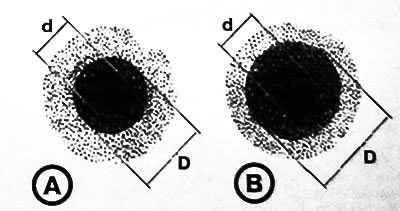
A) Oil with low dispersant properties.

A) Oil with low dispersant properties.

B) oil with a high level of dispersing properties.


[This note was copied from the resource: RENAULTBOOK.ru]
  • A distinction is made between the central core (d), corresponding to the spread of oil, and the zone (D) of diffusion of oil-insoluble contamination products around the central core.

A decrease in the diffusion zone width indicates the activation of additives or the presence of water in the oil. The DS of the oil is determined by the formula:
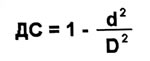
A DS value of less than 0.3 conventional units is considered unsatisfactory; in this case, an oil…

A DS value of less than 0.3 conventional units is considered unsatisfactory; in this case, an oil change is necessary.

Example
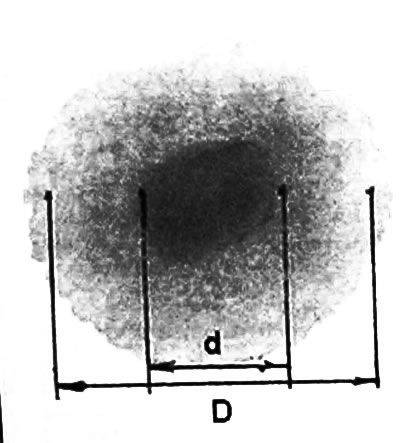
Example


in this example, the diameter of the central region (d) is 18 mm, and the diameter of the outer region (D) is 41 mm.

Substituting these values into the formula, we get: DS = 1 (18²/42²) = 1 - (324/1681) = 1 - 0.19 = 0.81.


The obtained value corresponds to the permissible range from 0.3 to 1, therefore, the condition of the oil is quite satisfactory.
The obtained value corresponds to the permissible range from 0.3 to 1, therefore, the condition of…


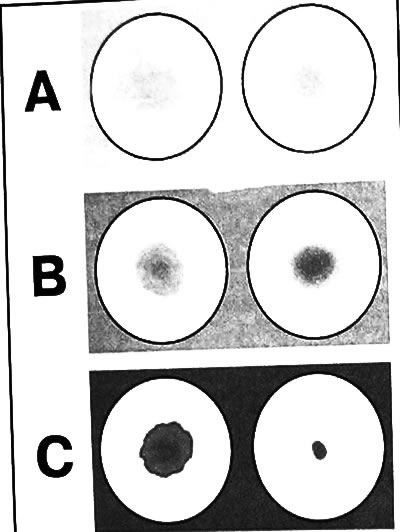
The presence of large insoluble particles can also be visually assessed by the oil stain. Area A corresponds to the normal state of the oil: oil stains in area B indicate that the oil will soon need to be replaced; oil stains in area C indicate that the oil is heavily contaminated and must be replaced.
This article is available on: russian, bulgarian, belarusian, ukrainian, serbian, croatian, romanian, polish, slovak, hungarian
Article has been reviewed by editor: Petrovsky Roman
Share with friends:
Previous
Logan 2: Daily checks
Next

Types of tire tread wear
Diagnostics and cleaning of fuel injectors
Determining engine faults by the condition of spark plugs
While moving
Start of movement
Operation of the car in winter
Tire storage
Trip to the service station
Technical information of the car
Controls and instrument panel
Other articles on other Renault models

➽ Checking oil pressure Renault Duster 1 (2009-2017)
➽ Checking for a cylinder leak Renault Fluence 1 (2009-2020, petrol)
➽ Checking the engine oil level Renault Kangoo 1 (1997-2007)
➽ Checking, draining and filling oil Renault Laguna 2 (2001-2007)
➽ Checking the vehicle's readiness for operation Renault Megane 1 (1995-2002)
Link to this article in different formats
Reviews and comments of visitors
No comments yet


Add two numbers 10 + 47


Logan 2 (2012-2020) 
  • General information
  • Faults en route
  • Daily checks
  • Governing bodies
  • Maintenance
  • Power unit
  • Petrol engines 1.2 l
  • Petrol engines 1.6 l
  • Diesel engines 1.5 l
  • Cooling system
  • Lubrication system
  • Power and control system
  • Intake and exhaust system
  • Engine electrical equipment
  • Transmission
  • Clutch
  • Car gearbox
  • Drive shafts
  • Chassis, running gear
  • Suspension and wheels
  • Brake system
  • Steering
  • Body and interior
  • Exterior (external elements)
  • Interior (internal elements)
  • Safety system
  • Heating and air conditioning
  • Electrical equipment
  • Equipment and devices
  • Wiring diagrams (sedan)
  • Wiring diagrams (wagon)
Logan 1 (2004-2012, petrol) 
  • General information
  • Vehicle device
  • User manual
  • Faults en route
  • Daily maintenance
  • First maintenance
  • Second maintenance
  • Driver tips
  • Power unit
  • Engine repair
  • Lubrication system
  • Cooling system
  • Power and exhaust system
  • Transmission
  • Clutch
  • Car gearbox
  • Drive shafts
  • Chassis, running gear
  • Front suspension
  • Rear suspension
  • Steering
  • Brake system
  • Wheels and tires
  • Body and interior
  • Exterior (external elements)
  • Interior (internal elements)
  • Doors, locks and windows
  • Body Care
  • Electrical equipment
  • Equipment and devices
  • Headlights and lighting
  • Power devices
  • Electrical circuits
RenaultBook.ru © 2018–2026 | Mobile version | News and articles | Sitemap: EN BG BY UA RS HR RO PL SK HU | Administration | Site search | Bookmark
Duster 1 (2009-2017) | Fluence 1 (2009-2020, petrol) | Kangoo 1 (1997-2007) | Laguna 2 (2001-2007) | Logan 1 (2004-2012, petrol) | Logan 2 (2012-2020) | Megane 1 (1995-2002) | Megan 2 (2002-2009, petrol) | Sandero 1 (2007-2012, petrol) | Scenic 1 (1996-2003) | Symbol 1 (1999-2008, petrol) | Symbol 2 (2008-2013, petrol) | Renault 19 (1988-1996) | Espace I and II (1984-1996) | Espace III (1996-2002) | Clio 1 (1990-1998) |
We want your visit to be comfortable 😌 and use cookies 🍪 to do so.