
English Русский
Български
Беларускі
Український
Српски
Hrvatski
Română
Polski
Slovenský
Magyar
Bookmark Contacts Articles Sitemap
Company vehicles Peugeot Company vehicles Opel Company vehicles Skoda Company vehicles Land Rover Company vehicles Mitsubishi Company vehicles Volkswagen Company vehicles Honda
RenaultBook.ru


Duster   Fluence   Kangoo   Laguna   Logan   Megane   Sandero   Scenic   Symbol   Clio   Other
Renault 19 (1988-1996) Espace I and II (1984-1996) Espace III (1996-2002)

Spark plugs (Renault Espace I)

  • Main
  • Renault
  • Espace I and II (1984-1996)
  • Power unit
  • Ignition system
  • Spark plugs
0
Contents: Normal candle 🠛 The spark plug is covered with dry…🠛 The spark plug is covered with oily…🠛 The candle is overheating 🠛
Spark plugs have a screw thread diameter of 14 mm. Use the manufacturer's recommended and specified types of spark plugs with the appropriate heat range.

The gap between the electrodes is different for each spark plug (see specifications). Spark plugs should be cleaned at least every 10,000 km. At the same time, adjust the gap between the electrodes according to the specification. When setting the gap, do not bend the central electrode, as this may crack the porcelain insulator. The location for measuring the gap is shown in Figure 4.1.
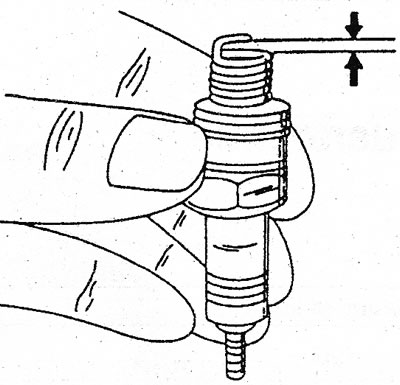
4.1 The spark plug gap is measured between the arrows

4.1 The spark plug gap is measured between the arrows


Before removing the spark plugs, make sure that no foreign bodies can get into the holes. Washers, bolts, stones, etc. that get into the spark plug hole can damage the valves, valve seats or cylinder head when the engine is first started. The appearance of the spark plug can be used to judge the suitability and flawless operation of the spark plugs, combustion, condition of the working mixture and the general condition of the engine (wear of pistons, piston rings, cylinders, oil leakage into combustion chambers, etc.).


Normal candle


The thermal cone of the central electrode insulator is covered with a dust-like coating from a weak, gray-yellow to brown color. The electrodes are visible despite the coating. The inner surface of the housing is light brown, or from yellow/gray-yellow to black-brown. With this type of spark plugs, the engine is in order. The glow number of the spark plug is selected correctly.

The spark plug is covered with dry carbon deposits


The thermal cone of the insulator, electrodes and housing are covered with a thick layer of powdery dark gray carbon. The reason for this is too rich a working mixture, a large gap between the electrodes, a high glow number of the spark plug. To eliminate the malfunction, install a spark plug with a suitable glow number.

The spark plug is covered with oily carbon deposits


The thermal cone of the insulator, electrodes and body of the spark plug are covered with black oily carbon. This may be caused by engine oil penetrating into the combustion chamber or worn cylinders and pistons.

The candle is overheating


The thermal cone of the insulator is covered with a glassy or rough coating from dark brown to dark gray, and may even be melted. The electrodes are burnt, especially the central one. The cause may be a lean mixture, poorly closing valves or a spark plug with a low heat rating, which overheats due to improperly set ignition. The deposits between the porcelain insulator of the central electrode and the spark plug body must be cleaned using a sandblasting machine. Before installing the spark plug, thoroughly clean its threads.

Since spark plugs are usually changed every 15,000 km, cleaning should be done every 10,000 km. Do not overtighten the spark plug during installation, as this may damage the sealing washer. The tightening torque should not exceed 15-20 Nm.
This article is available on: russian, bulgarian, belarusian, ukrainian, serbian, croatian, romanian, polish, slovak, hungarian
Article has been reviewed by editor: Fedoseev Denis
Share with friends:
Previous
Espace I and II: Ignition system
 

Ignition adjustment
Ignition distributor — removal and installation
General description of the ignition system
Ignition system specification
 
Other articles on other Renault models

➽ Spark plugs Renault Fluence 1 (2009-2020, petrol)
➽ Ignition system with static voltage distribution across spark… Renault Laguna 2 (2001-2007)
➽ Engine diagnostics by the appearance of spark plugs Renault Logan 1 (2004-2012, petrol)
➽ Replacing spark plugs and checking the ignition system Renault Megane 1 (1995-2002)
➽ Diagnostics of engine condition by external condition of spark… Renault Sandero 1 (2007-2012, petrol)
Link to this article in different formats
Reviews and comments of visitors
No comments yet


Add two numbers 45 + 15


Renault 19 (1988-1996) 
  • General information
  • Maintenance
  • Power unit
  • Engine repair
  • Exhaust system
  • Cooling system
  • Supply system
  • Single-point injection
  • Multi-point injection
  • Diesel injection system
  • Transmission
  • Clutch
  • Car gearbox
  • Chassis, running gear
  • Car suspension
  • Steering
  • Brake system
  • Wheels and tires
  • Body and interior
  • Exterior (external elements)
  • Interior (internal elements)
  • Heating and ventilation
  • Electrical equipment
  • Equipment and devices
  • Headlights and lighting
  • Ignition system
  • Power devices
  • Electrical circuits
Espace I and II (1984-1996) 
  • General information
  • Introduction to the guide
  • Troubleshooting
  • Power unit
  • Engine repair
  • Cooling system
  • Carburetor fuel system
  • Injection fuel system
  • Diesel fuel system
  • Ignition system
  • Transmission
  • Clutch
  • Car gearbox
  • Drive shafts
  • Chassis, running gear
  • Brake system
  • Steering
  • Front suspension
  • Rear suspension
  • Body and interior
  • Exterior (external elements)
  • Interior (internal elements)
  • Doors, locks and windows
  • Electrical equipment
  • Equipment and devices
  • Electrical circuits
Espace III (1996-2002) 
  • General information
  • Introduction to the manual
  • User manual
  • Power unit
  • Petrol engines F3R
  • Petrol engines Z7X
  • Diesel engines G8T
  • Diesel engines G9T
  • Transmission
  • Clutch
  • Mechanical gearbox
  • Automatic gearbox
  • Drive shafts
  • Chassis, running gear
  • Steering
  • Front suspension
  • Rear suspension
  • Brake system
  • Body and interior
  • Exterior (external elements)
  • Interior (internal elements)
  • Doors, locks and windows
  • Heating and ventilation
  • Electrical equipment
  • Equipment and instruments
  • Power devices
  • Electrical circuits
RenaultBook.ru © 2018–2026 | Mobile version | News and articles | Sitemap: EN BG BY UA RS HR RO PL SK HU | Administration | Site search | Bookmark
Duster 1 (2009-2017) | Fluence 1 (2009-2020, petrol) | Kangoo 1 (1997-2007) | Laguna 2 (2001-2007) | Logan 1 (2004-2012, petrol) | Logan 2 (2012-2020) | Megane 1 (1995-2002) | Megan 2 (2002-2009, petrol) | Sandero 1 (2007-2012, petrol) | Scenic 1 (1996-2003) | Symbol 1 (1999-2008, petrol) | Symbol 2 (2008-2013, petrol) | Renault 19 (1988-1996) | Espace I and II (1984-1996) | Espace III (1996-2002) | Clio 1 (1990-1998) |
We want your visit to be comfortable 😌 and use cookies 🍪 to do so.