



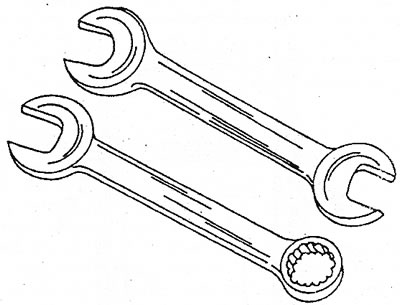
4.1 Double-ended open-end wrench (top) and open-end and ring-end wrench
Repair work should be carried out in a clean, well-lit area, and you should also have a workbench and a vice. Provide yourself with enough space to put the various parts and not have to put them away again and again. Of course, you will need a set of high-quality tools, if possible. The basis of the tool set is an open-end wrench, which is easy to put on every accessible part of the car. A ring wrench is especially indispensable for removing jammed bolts and nuts.
To reduce costs, you can use a combination spanner with a ring jaw, which has an open jaw on one end and a ring of the same diameter on the other (see illustration 4.1). A replaceable socket head will also come in handy. Provided that the outer diameter of the head is not too large, it can be used to remove nuts and bolts that are in an inaccessible place.
You will also need a Phillips-head screwdriver, pliers, and a mallet.
In addition to the basic equipment, you can purchase a few more special tools that will be of invaluable help, especially if you need to perform a certain repair over and over again. For example, the punch screwdriver mentioned here, without which it is impossible to remove factory-tightened bolts without damaging them. It can also be used for tightening to ensure tightness of oil and gas line connections.
A snap ring plier is also often needed because gearbox sprockets, shafts, and other similar parts have the most snap rings, which are difficult to remove with a screwdriver. There are two types of pliers: for outer rings and for inner rings. They come with straight and beveled teeth.
One of the most useful tools is a torque wrench, a type of spanner that can be set so that it slips when a certain torque is reached. This type of wrench also comes with an arrow that indicates the torque reached. Torque values are listed in specifications or in every modern repair manual. However, there are a number of different jobs that are best left to a professional.
Before carrying out repair work, it is recommended to read the following instructions in order to avoid any kind of violations in the future:
- A car jack does not guarantee you 100% safety when working under a car. Therefore, always install an additional lift. If there is no lift, the car can be placed on two wheels placed on top of each other.
- Never loosen the wheel nuts or hub nuts while the vehicle is jacked up.
- Never remove the expansion tank cap when the engine is hot. As a last resort, wrap the cap in a thick cloth and turn it to the first stop to release the steam.
- Never drain the engine oil while the engine is still hot.
- Protect the car's paintwork from contact with brake fluid or antifreeze. Drops that fall on the paint surface leave stains that are almost impossible to remove.
- Avoid breathing in dust from worn brake pads. Although the linings and brake pads themselves are now mostly asbestos-free, it is still harmful to health. When cleaning brake components with compressed air, it is necessary to protect your respiratory system from dust.
- Any oil or grease that gets on the floor must be wiped off immediately to prevent you or anyone else from slipping.
- Do not use the wrong size wrench to loosen a jammed nut or screw. A slipping wrench could injure you.
- Do not attempt to lift a very heavy vehicle part on your own; call someone for help.
- Children or pets should never be near the vehicle while it is being repaired.
- If you are working on the exhaust system, allow it to cool down first.
- When drilling and grinding, it is necessary to wear protective glasses. Such glasses will also be useful when working under the car.
- It is also recommended to use hand protection cream. In addition to making it easier to wash your hands, they will be protected from oil and other toxic substances.
- It is better to remove ties, sleeves, long hair, as well as rings, bracelets, and chains that can become conductors of electric current.
- There should be no unnecessary objects in your workplace.
- When doing renovations, you should never rush.
- Do not allow fire near the vehicle. When repairing the fuel system, first disconnect the battery. Contact of metal objects causes a short circuit, which can lead to sparking. Keep a fire extinguisher at hand just in case.
- The ignition system is under high voltage. Never touch the wiring with bare hands. This should be taken into account especially by people who use a pacemaker.
- To ensure better illumination, do not place the light on the engine. Because the light generates a lot of heat, which can cause engine parts to catch fire.
(Original of this article on the website: renaultbook.ru)