



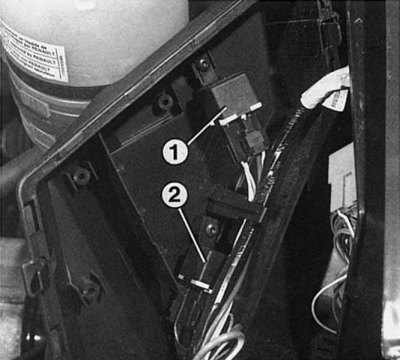
1 - relay for fuel pump; 2 - injection system protection relay.
For someone familiar with German designations, the relay markings would indicate that on some French-made relays the German markings do not correspond to the French terminal markings. Thus, you see, for example:
- Terminal 1 = 86;
- Terminal 2 = 85;
- Terminal 3 = 30;
- Terminal 4 = 87a;
- Terminal 5 = 87.
The vehicle's electrical system uses a number of relays, which are mounted on the relay platform in the fuse boxes or on separate holders, for example, in the engine compartment (fuel pump relay, injection, fog lights, ABS, etc.).
- A simple relay is used for powerful current consumers. If the electric current passes through a long connection of wires to the switch, then energy is lost. In addition, the contacts of the switch are overloaded with a strong electric current.
- When the relay is connected, switches are used only for low-power electric current, and it is not the consumer itself that is connected, but its relay.
- Some relays can perform additional functions. For example, a light relay switches light pulses, and a windshield wiper intermittent relay controls the windshield wiper interval.
Relay operation
- When the corresponding consumer is switched on, the current arriving at terminal 1 (in most cases the yellow wire) the "turn-on" electric current closes the circuit to terminal 2.
- As a result, the electromagnet coil attracts a powerful contact, overcoming the resistance of the spring, and thus closes the electrical circuit for the "working electric current".
- The working electric current is supplied via a short path directly to terminal 3 to avoid voltage drop (in most cases, the red wire) relay and is transmitted from there, when the switch contacts are closed, to the current consumer.
Relay - Troubleshooting
1. Terminal 3 should always be live. To check, remove the relay and touch the test lamp needle to terminal 3.
2. Remove the relay, connect terminal 1 to the positive terminal of the battery and terminal 2 to ground. The solenoid coil will pull the relay contact with a characteristic sound, otherwise the relay is faulty.
Help with a faulty relay
1. Remove the relay from the holder or, respectively, from the fuse box or disconnect the connector.
2. Close the terminals 3 and 4 or 5 at the relay mounting location in the fuse box and, accordingly, the connector with a piece of insulated wire. With this holder, the corresponding consumer will receive electric current.
3. To disconnect, remove the connecting jumper, since the corresponding switch is bypassed in this case.
Note. Recommendation: since Renault terminal markings differ from German terminal markings and different consumers can be connected to them, you must be absolutely sure that you install the jumper correctly, otherwise the consumers connected to the relay may be damaged due to a short circuit. If you suspect that the relay is faulty, insert a new relay for testing - this is what car repair shops do - or remove a relay of the same type from another socket and insert it for testing into the socket of the probably faulty relay.
[Original publication on the portal: www.RENAULTBOOK.ru]