



Contents: Minus in the "mass" 🠛 Marking and purpose of wires 🠛 Wires 🠛 Fuse box 🠛 Fuses and fuses 🠛 Replacing fuses 🠛
The wire harnesses from which the colored cables come out and end in multi-pin connectors will tell you in this chapter, using electrical diagrams, how much and where the electric current comes from and where it goes, respectively.
Minus in the "mass"
Electric current can only flow in a closed circuit. If you turn on a switch at home, the light comes on.
The same thing happens in a car; from the battery or generator, electric current flows through the appropriate consumers, back to the battery or generator.
Most of the current consumers in Renault 19 are connected to two wires. But only one of them goes directly to the battery or, respectively, to the three-phase alternator. The other wire, in most cases, is screwed to the steel sheet of the body.
It is important to know that metal parts of the body, engine and, accordingly, gearbox also conduct electric current. In automotive electrical engineering, they are referred to as "ground". They ensure the return of current to the negative pole of the battery. Rule to remember: minus in ground.
If the current consumer is located directly on the metal, then it requires only one connecting wire, but in today's plastic-rich car, there are almost always connections that make contact between the consumer and the "ground".
Recommendation: if the current consumer does not work, this often happens because there is no connection to the ground. The missing contact with the ground leads to the consumer falling out of the circuit. In this case, it is necessary to restore the contact.
Marking and purpose of wires
The motley jumble of wires in the car is actually very well organized, since the color of the wire can be used to determine its purpose. In addition, most connections are numbered in multi-pin sockets and relays. The internal Renault standard is followed when numbering. When choosing the color of the wire, the "Renault standard" in Renault 19 coincides with most of the standards known to us.
Below are the wire colors and their basic functions:
Red constantly transmits electric current from the positive pole of the battery and, accordingly, when the engine is running, from the generator. Careless handling of the tool can lead to a short circuit or spark discharge if the negative cable of the battery is not removed. On Renault 19, this is always a conductive cable; if necessary, additional colored stripes are applied to it.
Yellow only supplies electrical current when the ignition is on; in this case, in addition to the ignition coil, electric current is supplied to those consumers that should receive electric current only when the engine is running. For certain current consumers, there may also be colored stripes on the cable.
Black is intended for direct connections to the "ground". The current consumer must be connected to the "ground" of the vehicle with a black wire so that the electrical circuit is closed.
Blue is intended for electrical circuits for status indication and recognition.
Wires
You only see the ends of the individual colorful wires, as they are pulled through black protective hoses.
When connecting additional equipment independently, it is important that the cable cross-section is selected correctly, depending on the power (electric current strength) the corresponding consumer. For control lamps, a 0.5 mm cross-section is sufficient, the starter needs a 16 mm wire. Too thin a wire heats up, and the voltage drops. If, for example, only 10 V or even 9.5 V is supplied to an additional headlight instead of the required 12 V, its light will be dim.
Fuse box
All wires are combined into a specific chain of lines. They all go from the fuse box, on the right under the instrument panel to individual consumers. The fuse box contains 29 fuses and 12 relays. In addition, in the engine compartment next to the left shock absorber strut, depending on the equipment, there are additional relays and fuses in relay boxes in different quantities and orders.
If, when searching for a fault, it turns out that the supply wires, the corresponding fuse and, accordingly, the relay are not damaged, then the fault should be looked for in the fuse box.
Fuses and fuses
If a short circuit occurs due to a defect in the consumer or wire (which is nothing more than a significant increase in the current in the circuit) or additional consumers are connected to an already overloaded electrical circuit, the electrical circuit is overloaded. The wires and the generator winding begin to heat up, and the electrolyte may boil - all this would happen if the fuses were not included in the electrical circuit. When the circuit is overloaded, the thin wire of the fuse burns out in a split second and breaks the electrical circuit.
In order that the Renault 19 does not remain completely without power supply in the event of such a malfunction, the fuses are distributed among various electrical circuits. Of course, the connections between the starter, battery, generator and ignition switch are not equipped with fuses. You will not find the cause of the malfunction of these devices in the fuse box. The injection system and all other electrical units are equipped with fuses.
Renault 19 is equipped with so-called flat-type fuses. In the painted plastic part there are two flat connectors, which are connected by a fuse wire. You can recognize a blown fuse by the burnt fuse wire and the broken or melted plastic shell. To distinguish their permissible load, fuses, in addition to the description, are marked with color: 3 A = purple; 5 A = brown; 10 A = red; 15 A = blue; 20 A = yellow; 25 A = colorless; 30 A = green.
Replacing fuses
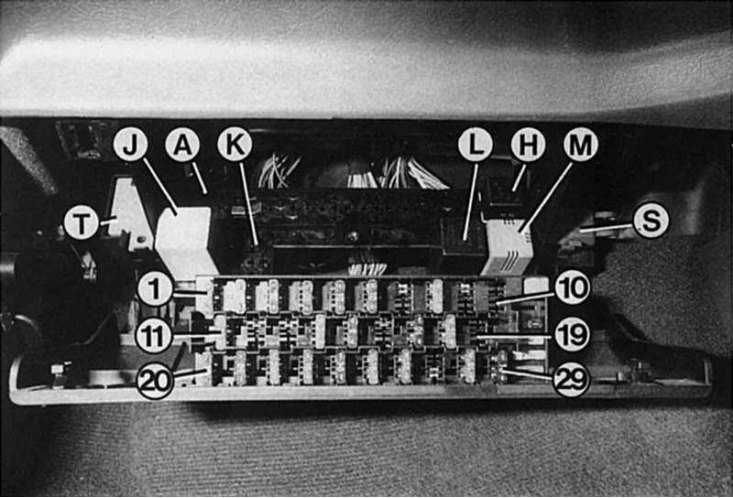
The fuse box on the front passenger side looks different depending on the equipment and the modification. After unscrewing both screw locks by a quarter turn, on the left and right, the fuse box can be lowered down.
If you do not have a fuse of the correct rating when changing a fuse,
You may temporarily insert a stronger or weaker fuse, but be sure to replace it with the fuse specified for that circuit as soon as possible.
Fuses can be replaced in the fuse box on the front passenger side. Relays can also be replaced there. You can get to the relay box in the engine compartment by opening the hood.
1. To remove the fuse, you must have thin pliers or tweezers.
2. If the new fuse blows immediately, check to see if you have installed a fuse that is too weak.
3. If the appropriate fuse has been inserted, then using the fuse table, determine which consumers are connected to this circuit and check them individually. The corresponding electrical diagram will also help you with this.
4. If in doubt, disconnect all consumers and reconnect them one by one. The consumer on which the fuse blows is faulty.