



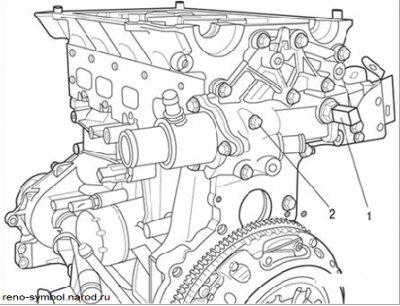
Figure 3.80. Location of the coolant temperature sensor (1) and the air bleed nipple (2) on the thermostat housing
This system is equipped with a single coolant temperature sensor, which sends a signal to the fuel injection system control unit, the electric fan and the coolant temperature gauge on the instrument cluster.
System operation
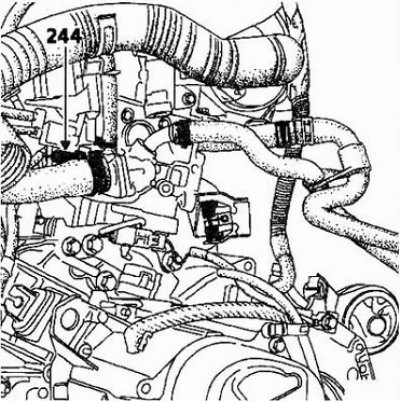
Sensor 244 reports the coolant temperature value to the injection system control unit. Taking this into account, the injection system and the engine cooling system fan relay are controlled.
- The electric fan unit turns on at low speed when the coolant temperature is above 99°C and turns off when the temperature is below 96°C.
- The electric fan unit turns on at high speed when the coolant temperature becomes higher than 102°C and turns off when the temperature becomes lower than 100°C.
- The electric fan unit can be switched on at high speed to prevent overheating and at low speed when the air conditioner is running.
Engine overheat indicator
The indicator is switched on by the electronic control unit of the injection system if the coolant temperature rises above 120°C.
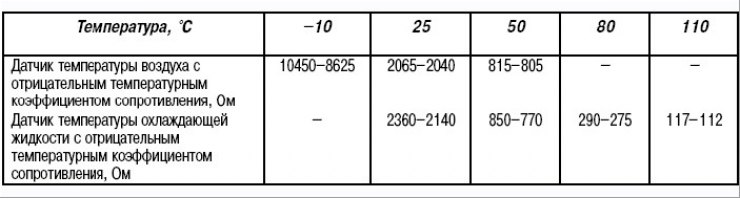
The sensor is installed in the thermostat housing (see Figure 3.80). It is a resistor with a negative temperature coefficient of resistance, i.e. as the temperature of the liquid increases, the electrical resistance of the sensor decreases (Table 3.6).
Table 3.6. Sensor resistance dependence on temperature
Verification procedure:
- if the coolant temperature gauge needle in the instrument cluster constantly shows a low temperature, although the engine is warm, disconnect the contact connector from the sensor and connect it to the "ground" - a metal part of the engine. With the ignition on, the needle should move to the high temperature area on the instrument. Otherwise, the faulty sensor must be replaced. If the needle does not move even when the wire is connected to the "ground", remove the Instrument panel, as described in the section "Body", and check the condition of the circuit between the sensor connector and the device, as well as the power supply to the device. If the circuit is in good condition and voltage is supplied, the device is faulty and must be replaced;
- if the instrument needle shows a high temperature when the engine is cold, disconnect the connector from the sensor. If the needle returns to the low temperature area when the ignition is on, the sensor is faulty. If the needle still does not move, check the circuit condition as described earlier.
Removal
- drain some of the coolant as described above;
- disconnect the contact connector and unscrew the sensor.
Install in the reverse order of removal, apply sealant to the sensor threads.