



The gearbox is installed in the engine compartment transversely to the longitudinal axis of the engine and is attached to it with bolts. The advantage of this arrangement is that it provides the shortest possible (from possible) transmission paths to the front wheels. In addition, this allows for optimized cooling due to the fact that the gearbox is located in the air flow moving through the engine compartment.
The torque from the crankshaft is transmitted through the clutch to the input shaft of the gearbox.
The gear shift drive is designed to allow the driver to control the gearbox from inside the vehicle.
The gear selection is performed by means of a gearshift lever mounted on the floor of the passenger compartment, which is connected to the gearbox by a gear engagement rod. The rod actuates a series of forks located inside the gearbox, which are mounted in the cutouts of the sliding synchronizer clutches. The clutches are locked on the gearbox shafts, but can slide along them in the axial direction due to the presence of ground hubs that press against the locking rings, bringing them into contact with the corresponding gears. The conical surface of the locking ring and gear plays the role of a friction clutch, which gradually equalizes the speed of the sliding synchronizer clutch (and, therefore, the gearbox shaft) and the gear speed. The locking pin, which enters the shaped cutout of the locking ring, prevents the synchronizer clutch ring from engaging with the gear until their speeds become equal. This ensures smooth gear shifting and reduces noise and wear caused by rapid gear changes. Torque is transmitted to the driven gear of the main gear, which transmits rotation through the planetary gear satellites to the differential gears and drive shafts. The rotation of the satellites on their axes allows the inner wheel of the car to rotate at a lower speed than the outer one when turning. The main gear and differential are installed in the same housing in such a way that disassembling one unit inevitably leads to disruption of the other unit. Adjustment and repair of the main gear require the use of a number of special tools and devices.
(This note was copied from the resource: renaultbook.ru)
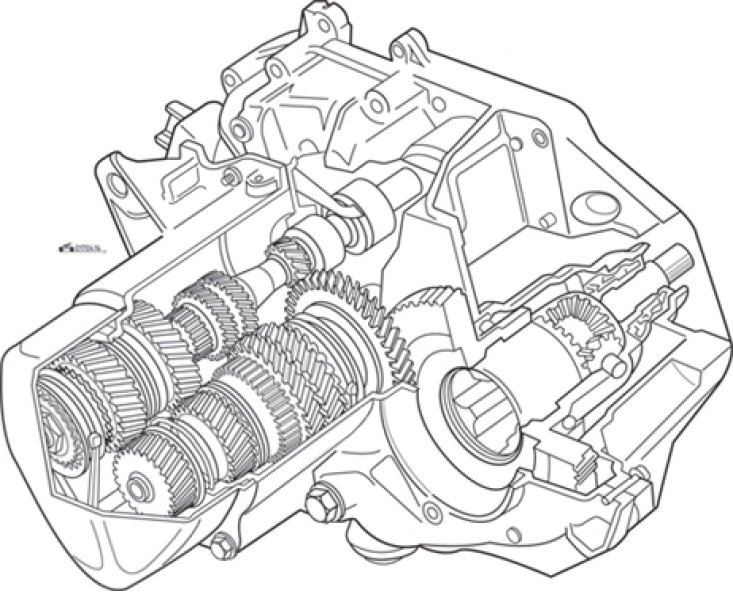
Fig. 4.14. View of a mechanical gearbox
The appearance of a mechanical gearbox is shown in Fig. 4.14.