Contents: General scheme of diagnostics 🠛 Malfunctions 🠛 Description of the injection system 🠛 Communication via multiplex network…🠛 Air conditioning control 🠛 Control of immersion heaters 🠛 Speed limiter and speed controller…🠛 EGR control 🠛 Control of signal lamps (instrument…🠛 BBSD Management 🠛 Purpose of contacts of diagnostic…🠛
General scheme of diagnostics
To save energy, the vehicle's central electronic control system stops supplying "+" voltage after the ignition switch after 3 minutes.
To diagnose the ECU, you can force "+" after the ignition switch for 1 hour. To do this, you need to do the following:
- press the card lock button;
- insert the card into the reader;
- press the start button (exit from the "+" supply mode after the ignition switch with a time delay*);
- press and hold the start button for 5 seconds until the electronic engine immobilizer system indicator light starts flashing at a high frequency (4 Hz).
This forced supply mode of "+" after ignition switch is valid for 1 hour. When the engine start button is pressed or the card is removed from the reader, the forced supply of "+" after ignition switch is stopped, but the time delay of the forced supply mode of "+" after ignition switch continues to operate. Until the hour has elapsed, when the "+" after ignition switch is turned on, the forced supply mode of "+" after ignition switch is activated again for the remaining time.
Malfunctions
Faults are defined as present or stored (appeared under certain conditions and then disappeared or continued to exist but are not detected under current conditions).
The "present fault" or "remembered fault" status should be considered when connecting the diagnostic device after the "+" is applied after the "ignition" switch (without affecting the elements of this system).
If the fault is not confirmed, check:
- electrical circuits related to a faulty device or impaired function;
- connectors of these circuits (for the absence of traces of oxidation, bent terminals, etc.);
- resistance of a certain faulty element;
- condition of wires (is there any melted or cut insulation, traces of friction, etc.).
Troubleshooting Algorithm
If no faults are detected during the diagnostic test, but the fault remains, then the fault should be eliminated based on the complaint of the car owner.
Checking the electrical wiring (difficulties in diagnosis)
By disconnecting connectors and/or moving wire harnesses, the cause of the malfunction can be eliminated immediately.
Voltage, resistance and insulation resistance measurements usually give correct values of the measured quantities, especially if the fault is not present at the time of testing (is remembered).
Visual inspection
Look for signs of damage in the engine compartment and interior.
Carefully check the protective covers, the integrity of the insulation and the correct routing of the wire harnesses.
Identify traces of oxidation.
Touch test
When moving and twisting the wire harnesses, use the scan tool to determine when the fault changes from stored to present.
Make sure the connectors are securely fastened.
Wiggle the connectors slightly.
Twist the wire harness.
If the fault status has changed, try to determine its cause.
Checking individual elements
Disconnect the connectors and check the condition of the clamps and contacts, as well as their crimping (there should be no traces of crimping on the insulation).
Check that the clips and contacts are securely seated in the connector sockets.
Make sure that the clips and contacts do not get squeezed out when connecting the connector.
Check the contact pressure of the clamps using a contact terminal of the appropriate type.
Resistance check
First check the integrity of the entire circuit, then check individual sections. Determine if there is a short circuit to ground, to +12 V or to another wire.
If a fault is found, repair it or replace the wiring.
Security measures
When working on any system elements, it is necessary to observe safety rules to prevent damage to material parts and injuries:
- make sure that the battery is well charged to avoid malfunction of the ECU if the battery is not sufficiently charged;
- use only equipment and devices that are in good working order and intended for this type of work.
Description of the injection system
The high-pressure fuel injection system provides a precisely metered supply of fuel at a specific point in time.
The ECU of the system is 112-channel BOSCH brand and type EDC15C13.
The system includes:
- manual booster pump or booster electric pump in the low-pressure circuit if the engine is equipped with a high-pressure fuel pump SRZ;
- booster electric pump, if the engine is equipped with a SR1 fuel injection pump;
- fuel filter;
- Fuel injection pump SR1 or SRZ;
- electromagnetic valve for regulating high pressure installed on the injection pump;
- fuel distribution rail;
- fuel pressure sensor built into the rail;
- four electromagnetic injectors;
- fuel temperature sensor;
- coolant temperature sensor;
- incoming air temperature sensor;
- camshaft position sensor;
- engine crankshaft position and speed sensor;
- boost pressure sensor;
- exhaust gas recirculation solenoid valve;
- fuel Pedal Position Sensor;
- atmospheric pressure sensor built into the injection system ECU;
- mass air flow sensor;
- boost pressure limiting solenoid valve;
- electromagnetic valve for controlling the pneumatic drive of the engine stop valve;
- electromagnetic valve for controlling the pneumatic drive of the air swirl flap.
The common rail high pressure direct fuel injection system is a sequential injection system that operates on the principle of multipoint injection used on gasoline engines.
This injection system, thanks to the method of preliminary injection used in it, ensures a reduction in engine noise, the content of solid particles and the toxicity of exhaust gases and provides significant engine torque, starting from a low engine crankshaft speed.
The high-pressure fuel pump supplies fuel under high pressure to the fuel distribution rail. The fuel supply regulator installed on the pump regulates the amount of fuel supplied, the value of which is set by the ECU. From the fuel distribution rail, the fuel is supplied to the injectors through steel fuel lines.
ECU
The ECU determines the injection pressure value required for normal engine operation and sends the corresponding signals to the pressure regulator.
The ECU controls the pressure value based on the analysis of signals generated by the fuel pressure sensor installed on the fuel distribution rail.
The ECU determines the injection duration required to supply a sufficient amount of fuel and the injection start time. After determining these two values, the ECU individually controls the operation of each injector by sending electrical signals.
The amount of fuel supplied to the engine is determined depending on the coolant:
- duration of the control signal to the injector;
- pressure in the fuel distribution rail. regulated by the injection system ECU;
- injector valve opening and closing speeds;
- injector valve needle stroke values (the constant value depends on the type of injectors used);
- nominal hydraulic performance of the nozzle (specific to this injector only).
The ECU controls:
- engine idle speed control;
- the amount of exhaust gases directed into the intake manifold;
- fuel supply (injection advance, fuel supply and rail pressure);
- electric fan of the engine cooling system;
- operation of the air conditioning system (cooling capacity);
- speed controller and limiter;
- pre- and post-heating system;
- by switching on signal lamps via a multiplex network.
Fuel is supplied to the high-pressure fuel pump under low pressure from the built-in fuel pump (transfer pump).
The high-pressure fuel pump supplies fuel to the fuel distribution rail, the pressure in which is controlled during injection by the fuel supply regulator, and during drainage by the injector valves. In this way, pressure fluctuations in the rail are smoothed out.
The fuel supply regulator ensures that the injection pump supplies the amount of fuel necessary to maintain the pressure in the rail. Due to this, heat generation is reduced and engine output is improved.
To reduce the pressure in the ramp using the injector valves, short electrical pulses are sent to the valves:
- short enough not to cause the injector to open (passing through the drain circuit coming from the injectors);
- long enough for the valves to open and the pressure in the rail to drop.
View the original on the specified resource: www.RENAULTBOOK.ru
Communication via multiplex network between vehicle ECUs
The electronic systems installed in the vehicle are connected together with a multiplex network. This ensures the exchange of information between the vehicle's ECUs. As a result:
- control of the switching on of the fault indicator lamps on the instrument panel is carried out via a multiplex network;
- information about detected faults is received via the multiplex network;
- the speed sensor on the gearbox has been eliminated.
The vehicle speed information is transmitted to the instrument panel via a wired connection from the ABS ECU. Then, the instrument panel sends the information to the 8-multiplex network. The injection system ECU and the airbag ECU are the main consumers of vehicle speed information.
Some vehicles are equipped with a water-in-fuel sensor located in the filter. If there is water in the fuel, an orange warning light for a malfunction of the injection system and pre- and post-heating lights up.
Caution! The engine must not be operated using diesel fuel containing more than 10% diester or gasoline, even in very small quantities.
The system provides fuel injection under pressure up to 1350 bar. Before each operation, make sure that the fuel rail is not under pressure and that the fuel temperature is not too high.
When performing any work on the high-pressure injection system, the cleanliness and safety instructions given in this document must be followed.
Disassembling the fuel injection pump and injectors is prohibited. Only the fuel supply regulator, fuel temperature sensor and bypass valve are subject to replacement.
For safety reasons, it is strictly forbidden to loosen the high-pressure fuel line fittings while the engine is running.
In order to prevent contamination of the circuit, it is prohibited to separate the pressure sensor from the fuel rail. If the pressure sensor is faulty, it is necessary to replace the sensor itself, the rail and high-pressure fuel lines.
It is strictly forbidden to remove the fuel injection pump pulley with number 070 575. If the pump is replaced, its pulley must also be replaced.
Do not apply +12V power directly to any system element. Do not remove carbon deposits or clean using ultrasound.
Never start the engine if the battery is not connected properly. When welding on the vehicle, disconnect the wiring harness from the injection system ECU.
Air conditioning control
On vehicles with an air-conditioning system, the EDC15 system allows you to turn off the air-conditioning system via the CEC under certain operating conditions:
- if it is turned off by the driver;
- during engine start;
- when the engine overheats (to reduce the load on the engine);
- at very high crankshaft speed (to protect the compressor from destruction);
- in transient conditions (when the crankshaft speed increases significantly during overtaking, when increasing the speed to prevent the engine from stalling and when starting off). These conditions are taken into account only if they are not of a periodic nature, in order to prevent disruption of the system's stability (spontaneous shutdowns);
- when some faults are detected.

Control of the air conditioner refrigeration circuit
The control function of the air conditioner refrigeration circuit is distributed between several ECUs. The injection system ECU performs the following:
- gives permission to turn on the air conditioner depending on the coolant temperature and engine speed;
- issues a request to turn on the electric fan of the engine cooling system at low or high speed depending on the driving speed, coolant pressure and coolant temperature.
The driver switches on the air conditioner with the fan switch connected to the switch. Depending on the measured pressure value, this request for cooling the air entering the cabin is fulfilled or not fulfilled. If the pressure value is outside the operating range, the cooling capacity control algorithm is not activated.
The injection system ECU gives permission to turn on the air conditioner 2-8 seconds after the engine starts.
The compressor must not be turned on under the following conditions.
Control of immersion heaters
To facilitate starting a cold engine, the vehicle is equipped with immersion heaters.
The immersion heaters are controlled by the UEC. The injection system ECU issues permission or prohibition to switch on the immersion heaters depending on the operating mode and required engine power.
The number of heaters switched on simultaneously does not exceed four; their activation depends mainly on the temperature of the coolant and air.
Speed limiter and speed controller control
The cruise control function ensures, when activated, that a pre-selected vehicle speed is maintained regardless of driving conditions. The driver can increase or decrease the vehicle speed using the switches.
If desired, you can exceed the set speed, to do this:
- by pressing the accelerator pedal to exceed the set speed (when the pedal is released, the initially set speed value is automatically restored);
- press the system control switches.
The speed control function can be disabled:
- system control switches;
- speed controller switch;
- when detecting control actions such as pressing the brake or clutch pedal;
- when system errors are detected, including discrepancies between the set and actual speed of movement.
The speed control function can be temporarily disabled when the driver increases the speed by pressing the accelerator pedal. The set speed value is restored after the driver releases the accelerator pedal. In this case, the vehicle speed will gradually return to the set value.
After disabling the speed control function, you can turn the speed controller back on and restore the last set speed value (if the ECU power supply was not disconnected).
The speed limiting function allows you to turn it on (switch) limit the vehicle speed to a pre-selected level. The driver controls the vehicle speed with the accelerator pedal to the set speed.
If the driver attempts to exceed the set speed, the system does not react to the movement of the accelerator pedal and continues to maintain the set speed, as it does when the speed controller is engaged, provided that the pedal is held in a certain position.
As with the speed controller, you can change the set speed by pressing the switches briefly or long presses.
For safety reasons, it is possible to exceed the set speed by pressing the accelerator pedal so that the pedal moves beyond the position corresponding to the limited speed. In this case, the driving speed will be determined only by the position of the accelerator pedal until the speed falls below the set speed threshold, after which the speed limitation system is activated again.
If desired, you can exceed the set speed, to do this:
- press the accelerator pedal past the point of resistance at the end of its stroke;
- set the desired speed limit by pressing the pedal briefly or long enough.
The speed limit function can be disabled:
- system control switches;
- turning off the speed limiter;
- when detecting control actions such as pressing the brake or clutch pedal;
- when system errors are detected, including discrepancies between the set and actual speed of movement.
EGR control
The EGR system includes an EGR valve.
The system also includes a potentiometric valve position sensor.
The operation of the exhaust gas recirculation valve is controlled by feedback based on the air flow rate determined by the mass air flow sensor.
The potentiometric sensor is used to determine the position of the EGR valve.
Control of signal lamps (instrument panel indication)
The ECU controls the display of certain information related to engine operation on the instrument panel. This applies to the functions:
- pre- and post-heating indicator lamp;
- coolant temperature alarm;
- 1st degree of severity malfunction alarms (non-critical faults);
- 2nd degree of severity malfunction alarms (requiring immediate cessation of movement);
- european On-Board Diagnostics (EOBD) warning light.
These five types of functions are displayed by three warning lights and/or as messages on the trip computer.
Orange pre- and post-heating/non-critical fault indicator lamp "SEFMCE" (1st degree of severity)
This warning light is used both as a system operation light and as an indicator of a fault in the system.
If the lamp lights up continuously with a "+" after the ignition switch, this means that the pre-heating plugs are on.
If the lamp is constantly on and a message is displayed "injection a controler" ("Check the injection system"): then this indicates the presence of a 1st degree fault (in this case the injection system switches to a reduced efficiency mode).
The owner must correct the faults as soon as possible.
Red coolant temperature warning light/immediate stop "STOP" (2nd degree of severity)
This warning lamp is simultaneously used as a warning lamp for system operation and as an indicator of the presence of a malfunction in the system: The lamp lights up for 3 seconds when the "ignition" is turned on (the automatic check procedure carried out by the instrument panel is in progress):
If the lamp lights up continuously, this indicates that the engine is overheating (the driver has a choice: to stop the car or continue driving).
When the lamp turns on, a message appears with a constant light "injection defaillante" ("Injection system faulty"): indicates a grade 2 malfunction (in this case, fuel injection automatically stops after a few seconds).
The owner must correct the faults as soon as possible.
Orange warning lamp for exceeding the exhaust gas toxicity level permitted by the on-board diagnostic system (OBD)
This light with the engine icon lights up for about 3 seconds when the ignition is switched on. This warning light will come on if there are one or more faults in the system detected by the OBD.
The malfunction indicator lamp warns the driver that there is a malfunction in the injection system that leads to increased emissions or that the on-board diagnostics (EOBD) system is disabled. The injection system ECU sends a request to turn on the OBD indicator lamp if a malfunction is present during three consecutive trips.
Visual inspection for 3 sec when voltage is applied (automatic check procedure performed by the instrument panel) is provided by the injection system ECU.
BBSD Management
On-board diagnostic system (On Board Diagnostic) detects faults that reduce the effectiveness of vehicle emission control systems (exceeding OBD EURO IV toxicity standards).
This system must function properly throughout the entire service life of the vehicle.
Conditions for detecting faults by the on-board diagnostic system
The on-board diagnostic system detects a malfunction after 3 vehicle driving cycles, and the following parameters are recorded in the ECU memory:
- engine load;
- vehicle speed;
- air temperature;
- coolant temperature;
- boost pressure;
- fuel distribution ramp pressure;
- air flow;
- vehicle mileage in km since the warning light turned on "OBD (on-board diagnostic system)".
In this way, the driver receives information about the presence of a malfunction that directly affects the toxicity level.
System faults detected by the on-board diagnostic system
The on-board diagnostic system detects only a few faults:
- DF038 "ECU";
- DF040 "Cylinder 1 Injector Circuit" only with characteristic 2. DER
- DF041 "Cylinder 2 injector circuit" only with characteristic 2. DER
- DF042 "Cylinder 3 Injector Circuit" only with characteristic 2. DEF;
- DF043 "Cylinder 4 Injector Circuit" only with characteristic 2. DER
- DF209 EGR valve position sensor circuit.
After some types of repairs, programming must be performed to ensure the normal operation of some important elements of the system.
In particular, programming should be performed if the EGR valve or injectors are replaced.
Conditions for deleting faults detected by the on-board diagnostic system from the memory
Deleting faults detected by the on-board diagnostic system from the memory occurs in several stages.
A fault identified by the diagnostic tool as present is moved to the stored category (after renovation) only after 3 vehicle movement cycles.
The on-board diagnostic system warning light goes out only after 3 vehicle driving cycles.
The lighting of the 8 warning light on the instrument panel does not always indicate a fault in the system.
To delete from the ECU memory the faults detected by the on-board diagnostic system and the parameters of their occurrence, it is necessary to perform 40 engine warm-up cycles.
The engine warm-up cycle is the vehicle driving cycle in which:
- the coolant temperature reaches a value of at least 71.1°C;
- the change in coolant temperature relative to its value at the moment of engine start is not less than 22.2°C.
If one of the above conditions is not met, the fault detected by the on-board diagnostic system is permanently stored in the memory of the injection system ECU as present or stored.
Purpose of contacts of diagnostic connectors of ECU
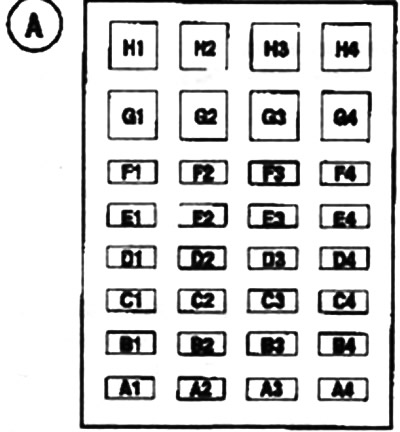
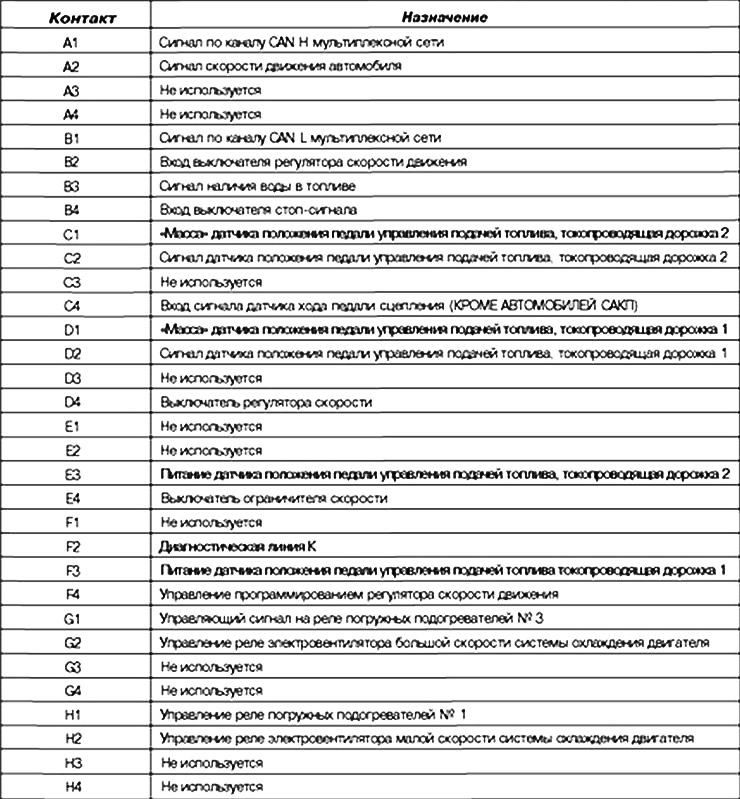
32-pin black connector A
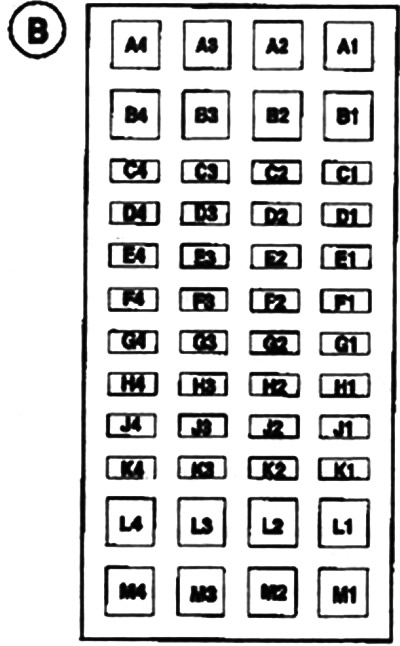
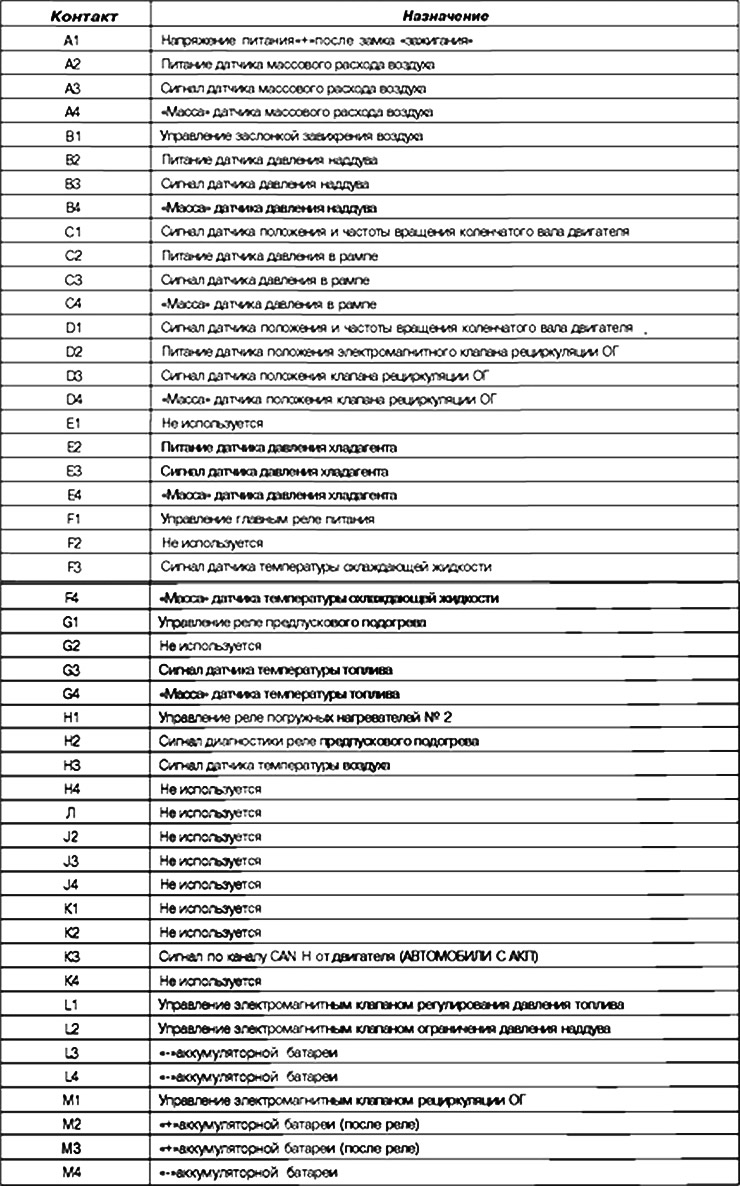
48-pin connector B brown
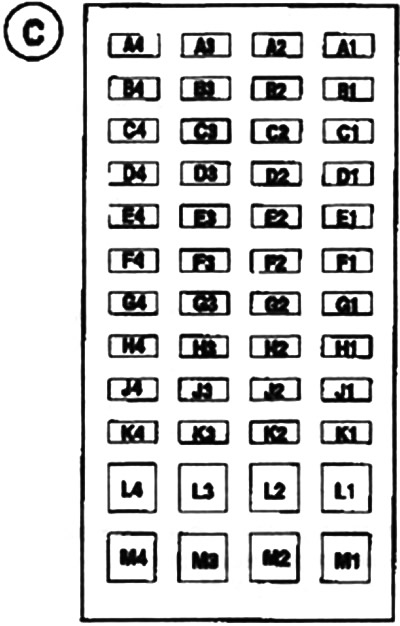
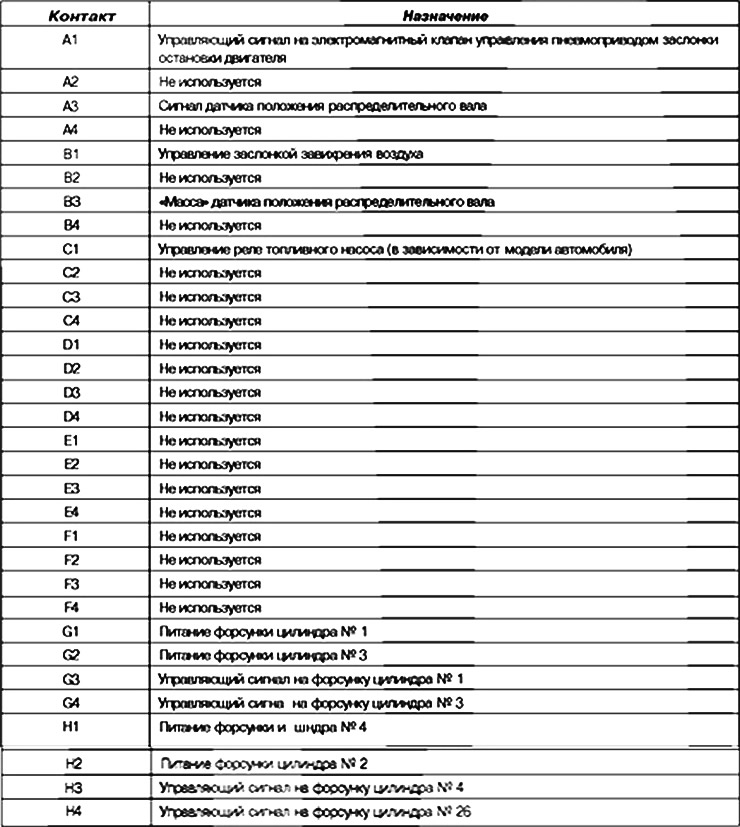
32-pin connector C gray