



Contents: Safety regulations 🠛 Operating principle 🠛
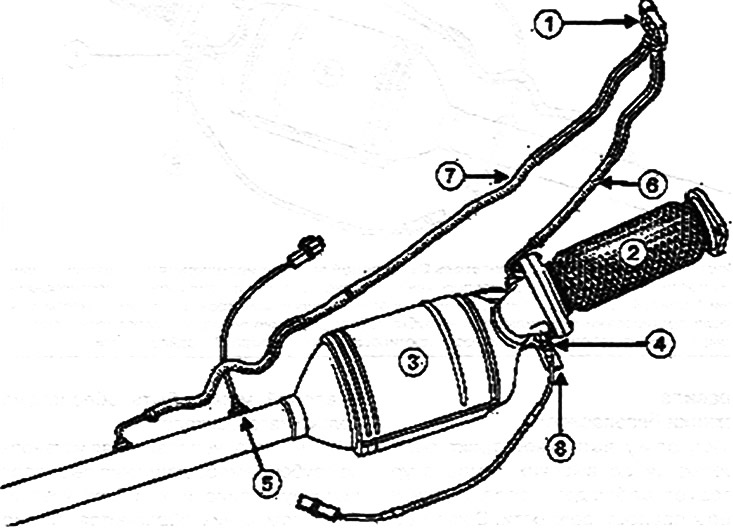
Anti-particulate filter (f9Q engine): 1 - the particulate filter pressure sensor is located in the engine compartment); 2 - bellows; 3 - diesel particulate filter: 4 - temperature sensor before diesel particulate filter: 5 - temperature sensor after diesel particulate filter: 6 - pressure intake pipe before diesel particulate filter; 7 - pressure intake tube after the diesel particulate filter; 8 - silent block
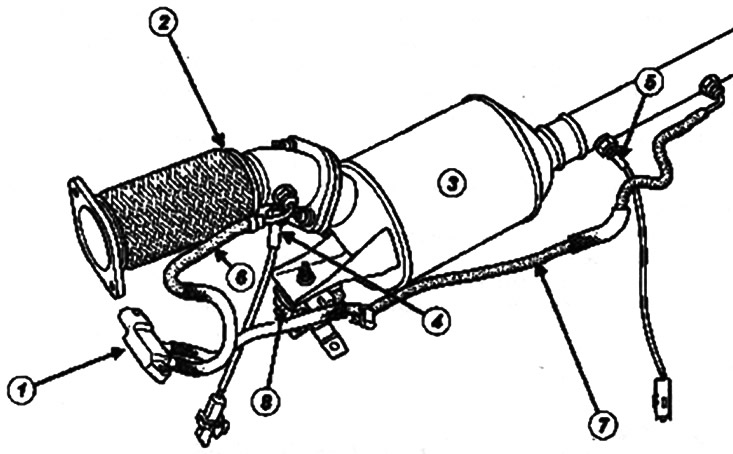
Anti-particulate filter (g9T engine, first version)
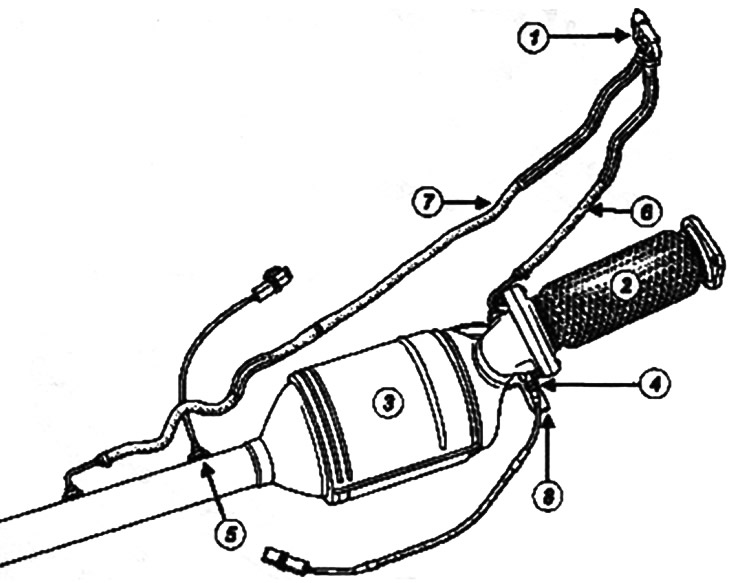
Anti-particulate filter (g9T engine, second version): 1 - the particulate filter pressure sensor is located in the engine compartment); 2 - bellows: 3 - particulate filter; 4 - temperature sensor before the diesel particulate filter; 5 - temperature sensor after the particulate filter; 6 - pressure intake tube before the diesel particulate filter; 7 - pressure intake tube after the diesel particulate filter; 8 - silent block
Safety regulations
Since the exhaust system reaches high temperatures, certain precautions must be taken. In particular, it is prohibited to open or disconnect the pressure measurement circuit, except for its connection to the exhaust system (the tightness of the pressure measurement circuit can only be ensured by the manufacturer).
In addition, incorrect installation of pressure measuring tubes causes twisting of their flexible parts: This creates low points in them, where water contained in the exhaust gases accumulates, which will freeze at low temperatures and cause the tubes to rupture.
Note: Do not park your vehicle with the engine running in areas where flammable materials are present (dry grass, fallen leaves), which may ignite if in contact with a hot exhaust system.
Operating principle
The diesel particulate filter, located under the body at the outlet of the preliminary catalytic converter, serves to reduce the emission of toxic substances by trapping solid particles of unburned fuel contained in the exhaust gases (at the filter loading or filtration stage), after which the combustion of these particles occurs (at the filter regeneration stage).
Based on the information from the sensors, the injection system ECU determines the temperature and pressure of the exhaust gases at the inlet and then at the outlet of the particulate filter.
View the original source on this resource RENAULTBOOK.ru
The injection system ECU constantly determines the degree of contamination of the particulate filter based on the pressure difference at its inlet and outlet. If the filter is sufficiently loaded with particles, the ECU determines from the inlet and outlet temperatures whether the temperature is high enough (approximately 600°C) to initiate filter regeneration.
Regeneration is carried out by burning off the solid particles trapped by the filter: for this purpose, the injection system is switched to the "injection delay" mode, as a result of which the fuel that is not burned in the combustion chambers of the cylinders enters the cells of the particulate filter and causes the ignition of solid particle deposits.
The degree of contamination of the particulate filter depends on the driver's driving style:
- at average driving conditions (driving in mixed and suburban cycles lasting more than 15 minutes) the particulate filter automatically burns out solid particles, which happens unnoticed by the driver (except for the possible emission of light smoke): this is the stage of "spontaneous regeneration";
- if the operating temperature in the exhaust system does not provide conditions for spontaneous regeneration, the degree of contamination of the filter increases, and when it reaches 35 g, the driver is asked to increase the speed by turning on the signal lamp in the instrument panel to ensure spontaneous regeneration of the filter. The same thing happens after several unsuccessful attempts at regeneration;
- if these conditions are still not met and the accumulated soot mass exceeds 45 g, then in this case it is necessary to perform -static regeneration using a diagnostic device at a service station.