
English Русский
Български
Беларускі
Український
Српски
Hrvatski
Română
Polski
Slovenský
Magyar
Bookmark Contacts Articles Sitemap
Company vehicles Peugeot Company vehicles Opel Company vehicles Skoda Company vehicles Land Rover Company vehicles Mitsubishi Company vehicles Volkswagen Company vehicles Honda
RenaultBook.ru


Duster   Fluence   Kangoo   Laguna   Logan   Megane   Sandero   Scenic   Symbol   Clio   Other
Renault 19 (1988-1996) Espace I and II (1984-1996) Espace III (1996-2002)

Replacing the hydraulic clutch release drive (Renault Espace III)

  • Main
  • Renault
  • Espace III (1996-2002)
  • Transmission
  • Clutch
  • Replacing the hydraulic clutch release drive
0
Contents: Removal 🠛 Installation 🠛
The hydraulic clutch drive consists of two sections. If one section fails, the other section must be replaced.

The drive is supplied filled with liquid with the main and working cylinders bled and during installation such a sequence of operations must be observed that prevents incorrect operation of the drive

Removal


  • Disconnect the cable from the negative battery terminal.
  • On the left side of the car, remove the wheel and fender liner.
  • Remove the clutch slave cylinder
  • Remove the air filter and use the tool (1, Fig. 5.11). supplied with the hydraulic clutch drive, disconnect the quick-release fitting on the pipe between the master and slave cylinders.
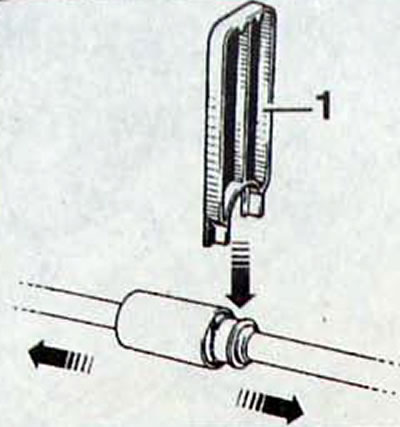
Fig. 5.11. Using the device (1) to separate the sections of the hydraulic clutch drive

Fig. 5.11. Using the device (1) to separate the sections of the hydraulic clutch drive

  • Remove the brake booster
  • Remove the clutch master cylinder.
  • Disconnect the clutch master cylinder rod from the clutch pedal.
  • The clutch master cylinder mount is a bayonet type, so to remove it, turn the master cylinder body 1/8 turn counterclockwise.

Installation


  • There is an arrow on the body of the master cylinder that must be positioned opposite the marking on the mounting plate.
  • Position the master cylinder perpendicular to the mounting plate.
  • Install and secure the master cylinder to the bracket by turning it 1/8 turn clockwise. Attach the piston pusher to the clutch pedal pin.
  • Install the slave cylinder onto the gearbox.
  • Connect the quick-release fitting.
  • Press the clutch pedal and let it rise Make sure that the pedal is in the highest position.
  • Repeat this operation.
  • The clutch drive is brought to the working position.

(Article reprinted from the website: renaultbook.ru)
This article is available on: russian, bulgarian, belarusian, ukrainian, serbian, croatian, romanian, polish, slovak, hungarian
Article has been reviewed by editor: Trofimova Anastasia
Share with friends:
Previous
Espace III: Clutch
Next

Replacing the dual mass flywheel
Clutch cable
Bearing and clutch release fork
Replacing the clutch slave disc or clutch housing with pressure plate
Clutch — General Description
New design clutch slave cylinder
New design clutch master cylinder
Other articles on other Renault models

➽ Bleeding the hydraulic clutch release drive Renault Laguna 2 (2001-2007)
➽ Bleeding the hydraulic clutch release drive Renault Megan 2 (2002-2009, petrol)
➽ Clutch hydraulic drive — air removal Renault Duster 1 (2009-2017)
➽ Bleeding the clutch hydraulic drive Renault Fluence 1 (2009-2020, petrol)
➽ Clutch release drive Renault Kangoo 1 (1997-2007)
Link to this article in different formats
Reviews and comments of visitors
No comments yet


Add two numbers 47 + 15


Renault 19 (1988-1996) 
  • General information
  • Maintenance
  • Power unit
  • Engine repair
  • Exhaust system
  • Cooling system
  • Supply system
  • Single-point injection
  • Multi-point injection
  • Diesel injection system
  • Transmission
  • Clutch
  • Car gearbox
  • Chassis, running gear
  • Car suspension
  • Steering
  • Brake system
  • Wheels and tires
  • Body and interior
  • Exterior (external elements)
  • Interior (internal elements)
  • Heating and ventilation
  • Electrical equipment
  • Equipment and devices
  • Headlights and lighting
  • Ignition system
  • Power devices
  • Electrical circuits
Espace I and II (1984-1996) 
  • General information
  • Introduction to the guide
  • Troubleshooting
  • Power unit
  • Engine repair
  • Cooling system
  • Carburetor fuel system
  • Injection fuel system
  • Diesel fuel system
  • Ignition system
  • Transmission
  • Clutch
  • Car gearbox
  • Drive shafts
  • Chassis, running gear
  • Brake system
  • Steering
  • Front suspension
  • Rear suspension
  • Body and interior
  • Exterior (external elements)
  • Interior (internal elements)
  • Doors, locks and windows
  • Electrical equipment
  • Equipment and devices
  • Electrical circuits
Espace III (1996-2002) 
  • General information
  • Introduction to the manual
  • User manual
  • Power unit
  • Petrol engines F3R
  • Petrol engines Z7X
  • Diesel engines G8T
  • Diesel engines G9T
  • Transmission
  • Clutch
  • Mechanical gearbox
  • Automatic gearbox
  • Drive shafts
  • Chassis, running gear
  • Steering
  • Front suspension
  • Rear suspension
  • Brake system
  • Body and interior
  • Exterior (external elements)
  • Interior (internal elements)
  • Doors, locks and windows
  • Heating and ventilation
  • Electrical equipment
  • Equipment and instruments
  • Power devices
  • Electrical circuits
RenaultBook.ru © 2018–2026 | Mobile version | News and articles | Sitemap: EN BG BY UA RS HR RO PL SK HU | Administration | Site search | Bookmark
Duster 1 (2009-2017) | Fluence 1 (2009-2020, petrol) | Kangoo 1 (1997-2007) | Laguna 2 (2001-2007) | Logan 1 (2004-2012, petrol) | Logan 2 (2012-2020) | Megane 1 (1995-2002) | Megan 2 (2002-2009, petrol) | Sandero 1 (2007-2012, petrol) | Scenic 1 (1996-2003) | Symbol 1 (1999-2008, petrol) | Symbol 2 (2008-2013, petrol) | Renault 19 (1988-1996) | Espace I and II (1984-1996) | Espace III (1996-2002) | Clio 1 (1990-1998) |
We want your visit to be comfortable 😌 and use cookies 🍪 to do so.